Van Gogh's "Sunflowers" and "Almond Blossoms"
Sunflowers, 95×73 cm, 1888. Held in the National Gallery, London, UK.

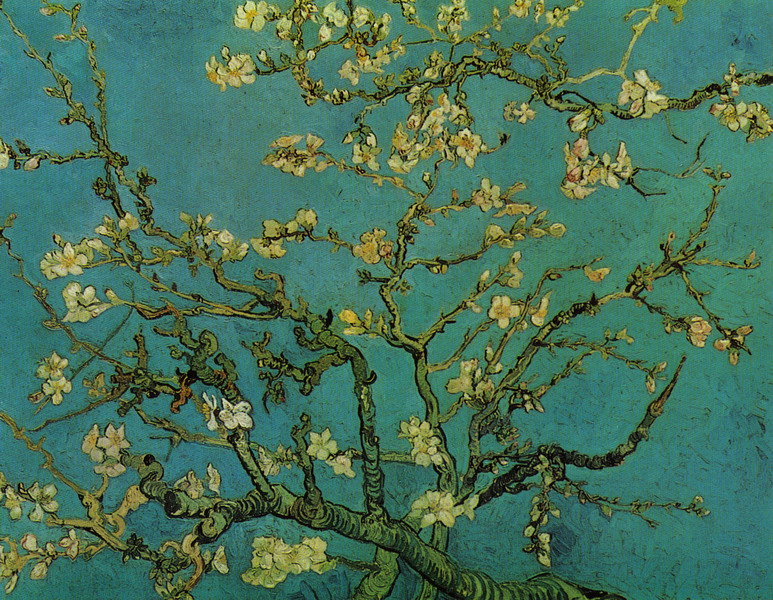
Van Gogh painted many floral still lifes, with his radiant "Sunflowers" (1888) being the most famous, and his vibrant "Almond Blossoms" (1890) the most brilliant, arguably his masterpiece. "Sunflowers" was painted to decorate his "Yellow House" in Arles, Provence, as part of a planned series. Bathed in the dazzling southern French sunlight, Van Gogh employed his most emotional warm tones of red and yellow, combined with expressive brushwork and material texture, poetically revealing extraordinary light through vivid colors.
"Almond Blossoms" is one of his final works, created while recovering in the small town of Auvers-sur-Oise near Paris. Highly patterned like exquisite printed fabric, it is quite decorative. Almond blossoms symbolize spring's arrival, renewal, and new beginnings. This is Van Gogh's most tender work; he used the blooming almond tree to signify the birth of his nephew. Both paintings share subjective consciousness replacing reality, flatness, color planes, and extraordinary decoration. Inspired by Japanese woodblock prints, their flat forms and colors became the premise for 20th-century modernist exploration.