Gauguin (Paul Gauguin) "Pastorale de Tahiti"
Pastorale de Tahiti, 86×113 cm, 1896, Hermitage Museum. Painted during Gauguin's second return to Tahiti, the primitive paradise of earthly purity.
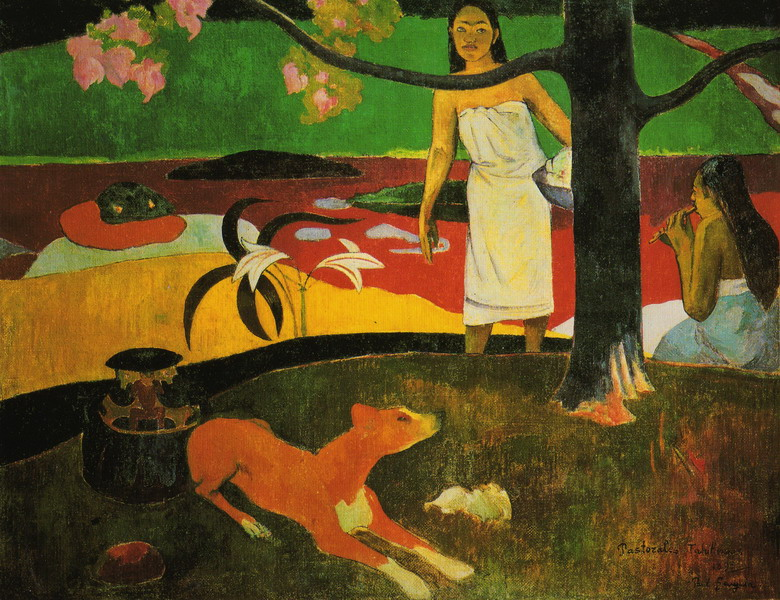
Pastorale de Tahiti, 86×113 cm, 1896, Hermitage Museum. Pastorale de Tahiti was painted when Gauguin returned for the second time to Tahiti, the primitive paradise and pure land of the human world. Moved by the primitive forests of Tahiti, Gauguin presented this poetic and picturesque utopia. Clearly, the inspiration here comes from the 1892 painting Arearea (Happy People) (compare if possible), continuing to depict the life situation in Arearea (Happy People). Especially the same people and things in the foreground: lush lawns, hieroglyphic plants and flowers, a gentle dog squatting under a tree, and a large tree trunk forming the structure of the picture. Behind the tree are two Tahitian women: one standing in a white dress holding something and facing the audience, the other sitting and facing inward playing a flute. Combined with the dreamlike, colorful landscape background, within the rigorous structure, it reveals musical color rhythms, brilliant light, and distant space. Gauguin wrote: "I do not know why, when I apply pure emerald green and vermilion, I feel as if I am facing an ancient painting or a tapestry."