Expressing the Inexpressible—Symbolism
Moreau Orphee 155x100 cm 1865 Collection of Musée d'Orsay, Paris


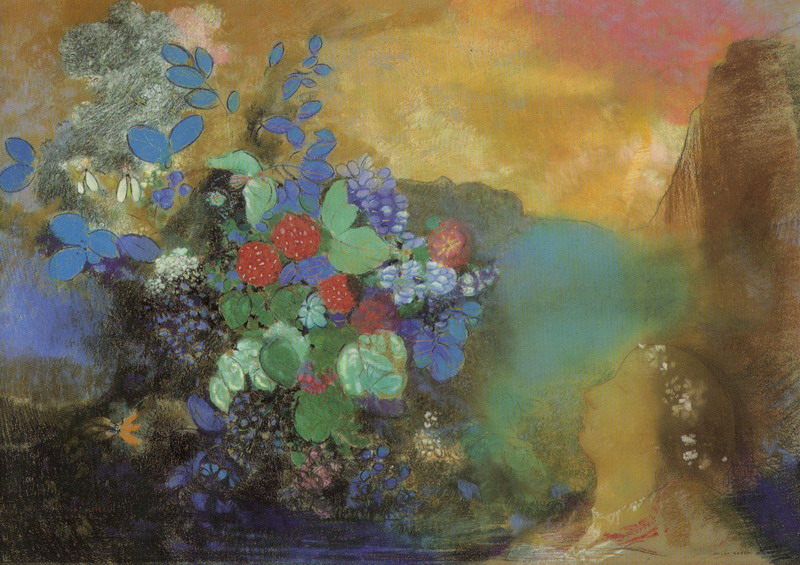
Redon Ophelie 64x91 cm 1905-08 Collection of Musée d'Orsay, Paris
If Impressionism favored the outdoors and bright light (plein air), then Symbolism preferred dim late nights and winter fog (mysterious inner light, fond of dreaming, fantasizing about the inner world). While Impressionism moved into urban civilization, Symbolism escapingly retreated into personal dreams and imaginary worlds. As the famous poet Baudelaire described: "Anywhere out of this world." Of course, Symbolism was not uniquely French; it was a pan-European trend in the mid-19th century.
What they emphasized, as Gauguin said, was "to reach the mysterious core of thought," or as the Swiss Symbolist painter Böcklin put it: "A painting must tell something, and provide the audience with food for thought; like poetry, it leaves an impression, like a piece of music." Like poetry, dreams, and imagination, and expressing the inexpressible—that is the spirit of Symbolism.
Symbolists drew inspiration mostly from the Bible, the Quran, and mythology. In their works, woman is the supreme imagination—no era or movement has portrayed woman so perfectly. Woman is sometimes pure yet elusive; she is fateful, fatally beautiful. In Chavannes's paintings, woman is like poetry, full of sensibility. In Moreau's works, woman possesses mystery. In Degas's work leaning toward Symbolism (1861), "The Building of Babylon by Semiramis," women are alluring; Redon contemplates a world as illusory as a dream.