Rousseau (D. Rousseau) "The Sleeping Gypsy"
The Sleeping Gypsy, 129.5×200 cm, 1907, MoMA New York. Rousseau's most poetic work, a dreamlike scene of a desert under stars and moon with a sleeping gypsy.
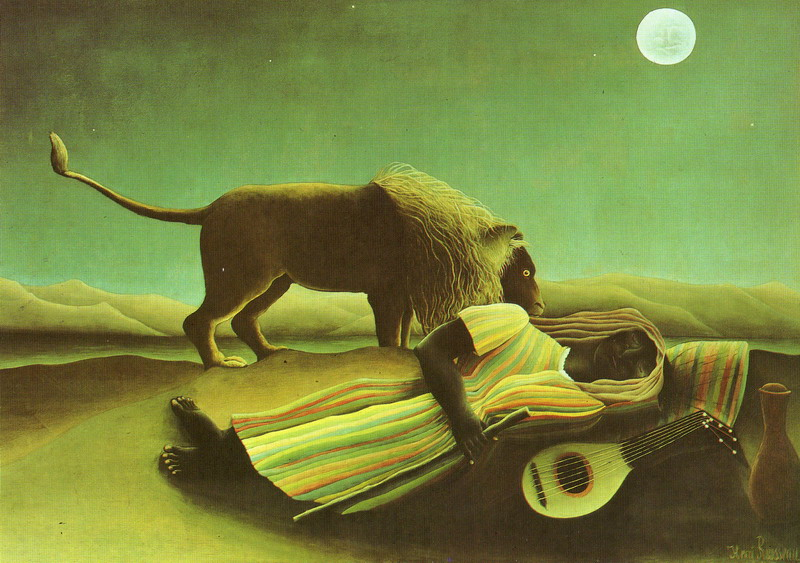
The Sleeping Gypsy, 129.5×200 cm, 1907, Collection of the Museum of Modern Art, New York. The Sleeping Gypsy is Rousseau’s most poetic work among all his creations, possessing a bewitching magical atmosphere beneath its dramatic dreamscape. It depicts a desolate desert dotted with stars, accompanied by a bright full moon; a Gypsy wanderer wearing painted striped clothing and a headscarf holds a staff, indicating his wandering life. He lies on the ground, his weary body falling into a deep sleep. A mandolin beside him symbolizes the wanderer’s singing, along with a water bottle (clay jug). Suddenly, under the starry sky and bright moon, a lion approaches the gypsy, sniffing at him. In this innocent imagery and balanced colors, an extraordinary imaginative space constructs a poetic, dreamlike scene. Rousseau explained the painting thus: “A black minstrel with a mandolin, a bottle of water beside him, his weary body sleeping in a dream; suddenly a lion appears but does not devour him, set against the desolate desert under the starry sky and bright moon.” The Sleeping Gypsy particularly attracted the attention of Surrealists, especially Breton; its dreamlike atmosphere and magic became a focus for Surrealist exploration.