The Origins and Functions of the French Painting Salon
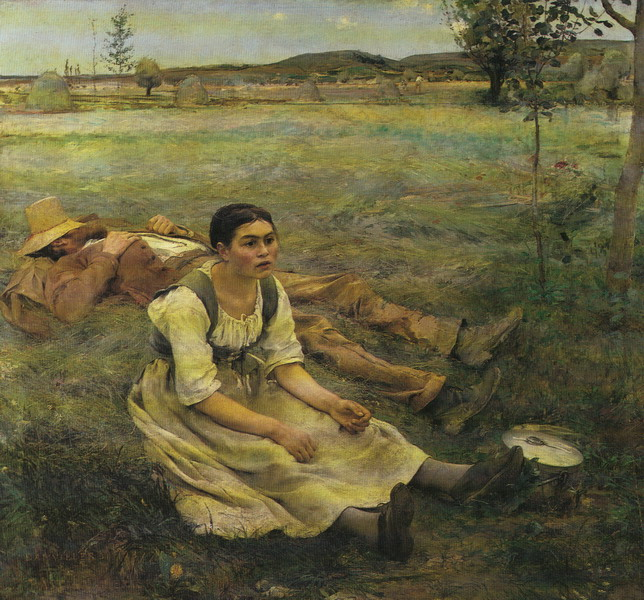
Lepage (J. B Lepage 1848-1884) Straw (180×195 cm, 1877). This work exhibited at the official Salon in 1887 presents two farmers in naturalistic rural realism, resting on cut straw after harvest; one seems asleep from exhaustion, while his wife sits on the ground with limp hands on her knees, her eye
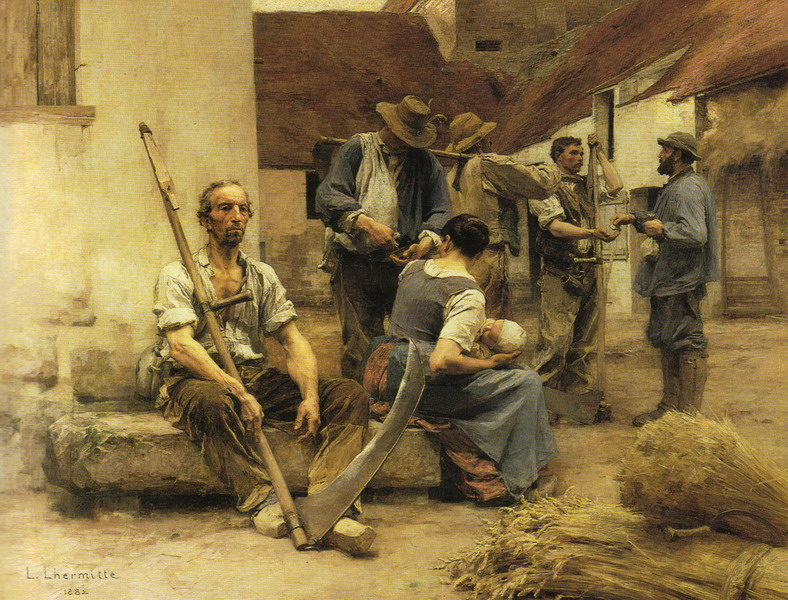
Lhermitte (Leon Lhermitte 1844-1923) Harvest Day (215×272 cm, 1882). This work exhibited at the French Painters' Salon in 1882 is a piece of naturalistic rural realism depicting a large landowner paying wages to workers in a farmyard. The vivid figures form a flowing line from the landowner's hands to the weary farmer sitting in the foreground holding a large scythe. Furthermore, its rigorous structure and skilled technique make it an excellent work.
The French Painting Salon was established on April 9, 1667, through the efforts of Colbert, a member of the Royal Academy. Art salons became increasingly important by the 18th century, especially regarding artists' creative achievements, though they remained under the strict control of the academic establishment. Fortunately, after the French Revolution, things became freer. However, during the French Empire, art was suppressed; under David's unremarkable Neoclassicism and the Restoration regime, closed and conservative art permeated the Salon, with Neoclassicism manipulated by Ingres clashing against Romanticism led by Delacroix.
Thus, the painting salon was increasingly rejected by anti-academic artists who rose up in protest, demanding the abolition of the jury system. In 1863, many rejected artists publicly published the jury's results. Consequently, Napoleon III issued the "Salon des Refusés," validating their existence and allowing them to stand alongside academic art. Led by Manet, this exhibition marked the end of academic suppression. In 1884, Seurat and Signac founded the Salon des Indépendants, which had no jury and no awards, making artistic creation even freer and more open. By 1903, the Salon d'Automne was established, bringing the total number of art salons to over ten, such as the Salon de Mai, Salon des Jeunes Peintres, Salon des Maîtres et des Novices, Salon Critique Figuratif, Salon de la Nouvelle Réalité, and Salon des Artistes Français. Salons not only allowed artists to showcase their talents but also enabled them to exchange ideas, messages, and even conduct transactions within the salon.