Chen Chi-Hsiang: Observing the Mind, Surveying the Realm
Observing the Mind, Surveying the Realm Series No. 5 Photograph 100x80 cm 2007
Observing the Mind, Surveying the Realm Series No. 15 Photograph 100x80 cm 2007 Author: Ms. Yen Hsueh-Hua, Director-General of the Chinese Culture and Physics Council, Executive Director of the Nan San San Small Group, art enthusiast, and collector. In the early autumn of 2005, Kaohsiung painter Mr. Hung Cheng-Tung introduced me to a painter and art critic, Mr. Chen Chi-Hsiang, who had returned to Taiwan from Paris for a visit. That day, at my home, he viewed the paintings in my collection; his sincere words and gaze fully conveyed his passion for art. Over the next two weeks, he also invited Professor Hung Shang-Hsiang, who resides in Spain, to my home. We sat admiring old ink album leaves, and amidst our deeply satisfying conversation, sighs and praises were frequently heard. The three of us felt as if we had known each other for sixty years; sincere hearts know no national borders, age, or gender distinctions, for what we all loved was pure art, without false sentiment or affectation. Seeing Shang-Hsiang moved to tears while reading the "emptiness" in Hsu Ku's painting touched everyone present. Chen Chi-Hsiang merely silently guarded that emotion without uttering a word; isn't this precisely the fermentation of artistic purity? That evening, each heart was filled with happiness and joy, and then late at night, Chi-Hsiang picked up the frangipani flowers scattered all over the garden, chest full of fragrance, and walked home under the moonlight.
Chi-Hsiang was born in 1956 in Pingtung, Taiwan. After graduating from the National Academy of Arts in 1979, he went to study in France in 1982, engaging in artistic creation and research. During his over twenty years in France, besides advancing his artistic practice, he also participated in numerous contemporary art exhibitions; loving Parisian culture, he not only married a French woman but also published "Paris Art Journey" in 1996 and "Picking Flowers in the Flower Capital" in 1998, followed by "European Postmodern Art" in 2002. With his close-up perspective and on-site exhibition imagery, he elucidated the overall art scene of 1980s Europe, offering thoughtful insights into the current artistic situation.
In March 2008, Chi-Hsiang visited Beijing and gave two in-depth lectures for young art creators there. Speaking of this Beijing trip, an unexpected delight was evident between his lines: "In this globalized landscape, with a macro vision and a sincere attitude, aren't all within the four seas brothers in the global village?" (from Chen Chi-Hsiang's blog). He also said, "Respecting differences has become the most outstanding gift of friendship today, as D.H. Lawrence said: 'Every continent has its own great spirit of place, every people has its own characteristic, that is home, that is homeland. On this earth, different places have different vitalities, different vibrations, different chemical scents, different stars, different qualities, call it what you will, but the spirit of place is a great reality.'" (from Chen Chi-Hsiang's blog). From these words, one can see his inclusivity from traveling widely and diligently promoting art—it is a spirit of "selflessness" and "altruism," which can only stem from "sincerity." Without "sincerity," nothing would happen.
We all know that artistic creation cannot be separated from the exploration of life and the perception and understanding of existence. Artists often experience the spiritual power of the Middle Way through repeated refinement and clarification. The Middle Way elucidates the meaning of life's essence; it is a transcendent stance. Artists also often transcend relativity in expressing the relationship between self and things, and may even perceive harmony within conflict.
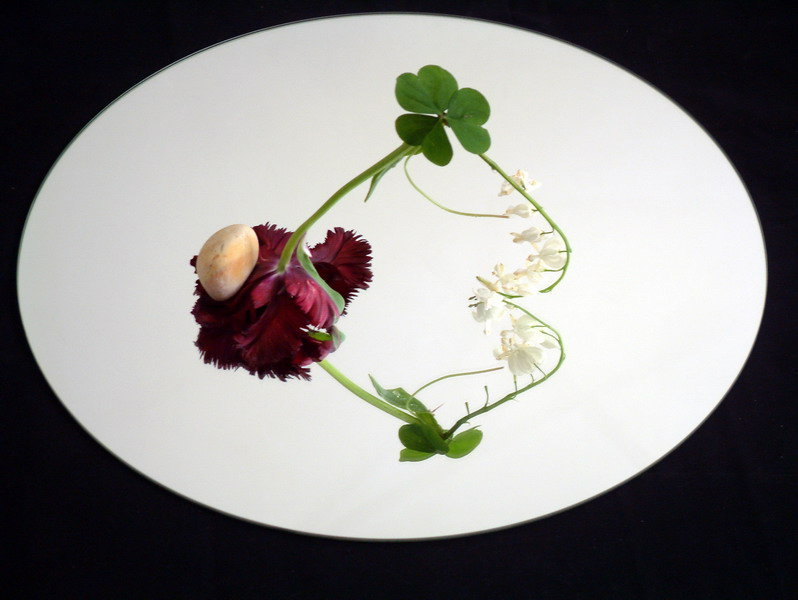
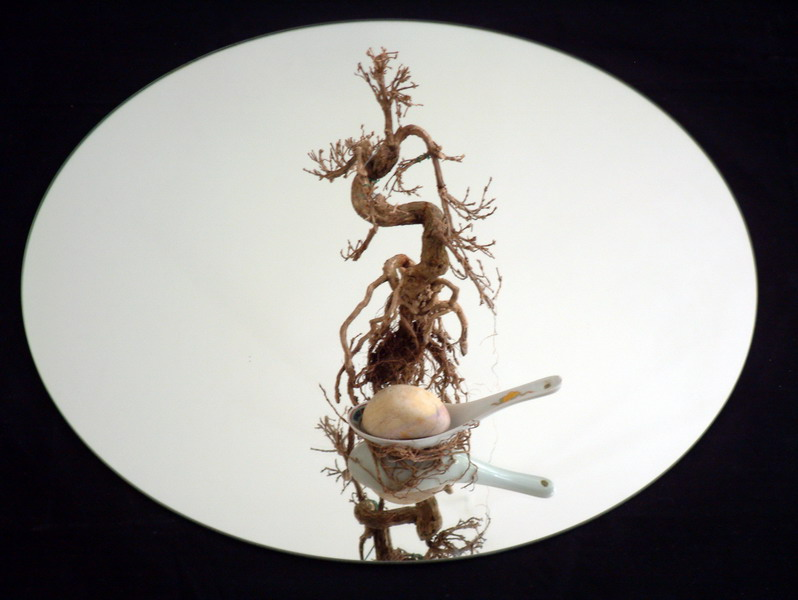
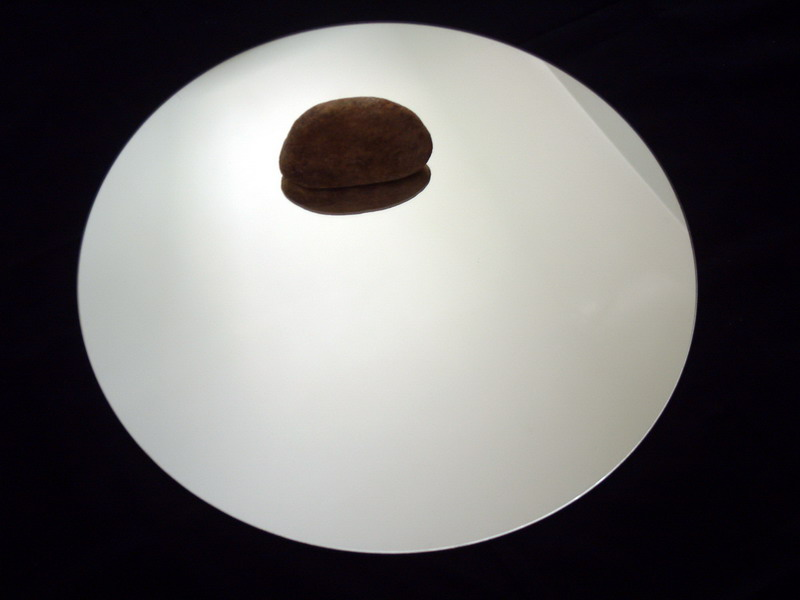
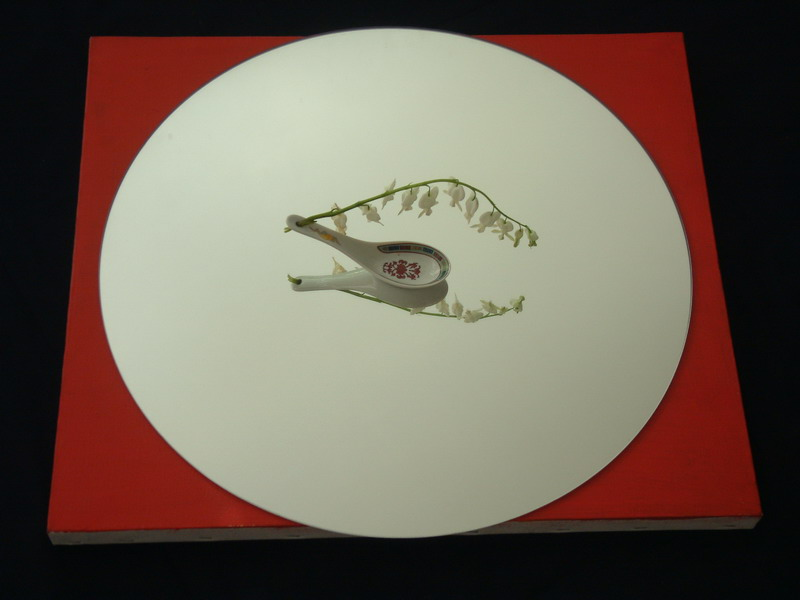
Observing Chen Chi-Hsiang's 2007 series "Observing the Mind, Surveying the Realm," he sometimes decorates the mirror surface with monochromatic real objects to reflect a beautiful background, then places flowers, stones, dried bones, spoons, etc., on the mirror to create an effect of reality and illusion, which is then photographed into works.
From Chi-Hsiang's creations, one can easily detect his humanistic aesthetic ideals. He collects objects from daily life that are visible, usable, or even meant to be discarded as materials for his work. Yet, he endows these withered or still lives with infinite vitality and power. He allows the intriguing interplay of reality and illusion reflected in the mirror to present an extremely calm, rational beauty, letting prosperity and decay reflect each other into a Zen state, and letting the water splashed freely onto the mirror surface metaphorically represent the disappearance of time and space.
The artist places withered flowers on the mirror surface, where the lines of dry branches best express a stark beauty, presenting the tranquil elegance of Chinese ink linearity. Or, he paints a dried bone with a stroke of blue or red—the latter full of triumphant color hinting at the conflict of life and the splendor of death. Or, he places a cold gray stone quietly on the mirror, letting it reflect the purity of beauty. Or, a lit candle on the mirror reveals its temperature and brightness. The "Observing the Mind, Surveying the Realm" series not only transcends relativity but also absoluteness. In these highly rational creations, one sees not only the artist's ardent desire and pursuit of life but also his presentation of three-dimensional spatial balance with an extremely warm heart. The artist's inner happiness almost leaps out, dancing romantically between modern and classical without a trace. What "Observing the Mind, Surveying the Realm" aims to express is as the Huayan patriarch Qingliang Chengguan said: "To reach the purity of the mind's source, one must know the emptiness of self-appearance; how illusory and real are forms, thoughts and considerations fundamentally have no basis." In postmodern aesthetics, the fusion of "abstract" and "figurative" is often the domain artists most wish to articulate, and within this domain, they also loudly proclaim its inviolability.
"Observing the Mind, Surveying the Realm" Series "I5-16 Work 1": The artist paints the entire canvas a vivid red, with a smaller rectangular area left white in the center, on which a mirror with a blue frame is placed. These three elements are arranged with formal beauty, and the mirror reflects colorfully romantic geometric patterns. The misaligned space is like a virtual illusion mirror, with reality and illusion coexisting inside and outside the mirror. He uses strong colors and different pictorial forms to present his obscure inner aesthetics and intuition. The calm arrangement of objects is both order and a form of self-discipline, revealing sensibility within rationality.
"I5-16 Work 2": Using the same approach, the artist places a large round mirror on a canvas fully painted red. Its diameter is the same as the square red canvas, creating strong tension. He places a Chinese porcelain spoon on the mirror surface, with a lily of the valley flower inserted into the spoon's ear hole. The spoon bears ancient Chinese totems, while reflected below in the mirror are pure white porcelain and the withered reflection of the lily of the valley. The painter's calm handling not only illustrates the contrast between Eastern and Western cultures but also, for an Easterner living abroad, these elements write of loneliness yet standing tall, silently calling out nostalgia.
"I3-14 Work 1": The artist places a large round mirror against a deep black background, with a small oval-shaped stone on the mirror surface, illuminated by natural light. This work is full of stillness and Zen opportunity, as if entering a realm without people. The artist does not look at objects with the physical eye but contemplates and meditates with the mind's eye, observing mind and things in a Zen state and forgetting both. The artistic conception of this work is extremely high; it is one of my favorites, full of pure aesthetics and humanistic thought.
"I3-14 Work 2": This work is similar to the aforementioned "1," but the stone placed by the artist has higher brightness and is softer. He playfully splashes water and adorns it with a petal, forming an extremely romantic landscape of flowers in the mirror and moon on the water. In the contrast yet fusion of cold (stone) and warm (petal), a highly pure aesthetic viewpoint is expressed. From this work, we can observe that any three-dimensional object placed on a mirror can cast a double reflection, but water does not reflect an image; its transparency is an intermediary state of being. It silently clarifies, omnipresent, yet uncertain, restless, flowing, but also beautiful.
"9-12 (1)": This work again places a large round mirror before a black background. The obscure state behind and an animal bone on the mirror surface, adorned further with dry branches and fruit—the fruit painted with a layer of decorative color. The round mirror reflects the prosperity and decay of life; the state of perfection expressed by the round mirror reveals an unpredictable helplessness of life. Even with exquisite artifice, one cannot reclaim the passage of time.
"9-12 (2)": The artist truly went wild with this series of round mirrors, playing to the point of being unable to stop, unable to extricate himself. I love the artist's "play"—it is a relaxed and natural posture and an unconstrained sentiment. He places red and blue ornaments on dried bones, the ornaments covered with colorful inserted pins. This scene reminds me of the mockery of "one general's achievement is built on ten thousand withered bones," and resembles the tear stains left on a "chastity arch." I insert Eastern thinking into a Western artistic context; presenting these two completely different phenomena inside and outside the mirror is actually not easy. This highly experimental work successfully expresses the artist's unique Eastern sentiment.
"Work 9-12 (3)": The author boldly places a white porcelain spoon filled with cinnabar on the round mirror. Above the spoon, he places an animal bone, then connects dry branches of individual charm on both sides. The elegantly undulating lines of the dry branches resemble spirits dancing with clear shadows, reflecting into an arc-shaped form full of rhythm on the round mirror. In this "observation of material nature" and "observation of insight," due to the calm projection of the mirror surface, the "self" becomes more real and clear.
"Work 5-8 (4)": Here, the author contemplates Zen with flowers, keeping the round mirror spotless. Only green oxalis, white lily of the valley, purplish-red flowers, and a small white stone enter the mirror at this moment. The pure colors of red, white, and green are like the newly risen morning sun, also like sparkling, transparent dew shimmering in sunlight, bright, clear, and full of joy. Among the series of round mirror works, this piece is the most heart-touching; the declaration of "having happiness, approaching heaven" is here clearly revealed.
Observing Chi-Hsiang's artistic creation is like treading on a bright mirror platform. He uses the qualities of material things like stones, dry branches, petals, and bones to project the state of his mind's understanding through insight with simple creation, conveying realms beyond language. Also, through this corresponding relationship between material nature and insight, he achieves the broader vision the artist seeks. This vision has no so-called good or bad, high or low; Chi-Hsiang wants to pass through another wall, chiseling a hole to let in light in that high wall, repeatedly polishing his own heart, aided by a clarified mind, striving for another round mirror of artistic life.
I am very grateful for her care and outstanding artistic views. Hsueh-Hua is the most forward-thinking collector I have encountered in Taiwan, with groundbreaking insights and raptures for art, a passionate promoter of art. Hsueh-Hua's artistic zeal and humanistic concern, cultivating local humanistic arts, devoting universal love to the world, and unique views on beauty, all make one deeply feel this extraordinary energy and wisdom. She is someone I admire and respect in my heart, and I am even more thankful for her enthusiastic writing and sharing this article with everyone. More works are available for appreciation in the blog "Chen Chi-Hsiang" collection.