Picasso's Brilliant Life of Creation
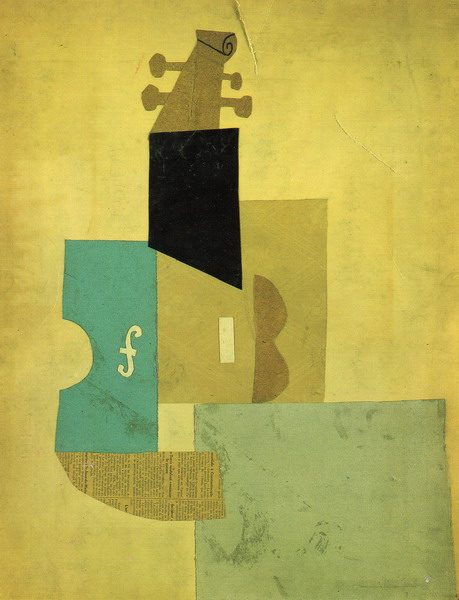
Cubist Period Violin 65x50cm 1907 Newspaper collage Collection of the Musée Picasso, Paris


Blue Period Self-Portrait 80x60cm 1901 Oil painting Collection of the Musée Picasso, Paris "I do not imitate nature; I create it." In our era, no artist is more renowned or representative than Picasso (1881–1973). In 20th-century modern art, Picasso was a reformer whose works, fueled by rich imagination, often displayed a contempt for "beauty" amidst contradiction. Tracing his evolution from Realism to the Blue Period, Pink Period, Cubism, Analytic Cubism, Neoclassicism, Surrealism + Cubism, Eclecticism, Mannerism, and finally Baroque reveals the metamorphosis of his artistic achievements throughout his life.
Picasso was a rare genius in modern art history. Any concept, filtered through his sensitive mind, transformed into a new style; any material, handled with skill, became art. His art was diverse, multifaceted, and polysemous, making him simultaneously a painter, draftsman, sculptor, printmaker, and illustrator.
Romantic and innocent by nature, Picasso was a great lover who defied traditional moral norms. Every artistic phase was linked to "love." Like a matador in the ring, each relationship (accompanied by a change of studio) yielded a new visual language, an unprecedented phenomenon in art history.
Blue Period: Picasso’s father was a painting professor, but Picasso himself became the most famous artist of the 20th century. Arriving in Paris in 1900, he was initially influenced by Montmartre painters, particularly Toulouse-Lautrec. His series depicting cafés and nightclubs around Montmartre were painted entirely in a melancholic blue tone. Picasso stated: "It was thinking of Casagemas' death that made me start painting in blue tones. Dark, sorrowful, with a touch of mystery and youthful sentimentality (though, within Spain's 500-year painting tradition, one might find his predecessor El Greco's blue tonal system)." This defines Picasso's Blue Period (1901–1904). Notable works include Self-Portrait (1901), Life (1903), Celestina (1903), and Woman with Cherry Lips (1904).
Pink Period: From 1904, Picasso settled in the "Bateau-Lavoir" studio at the foot of Montmartre, a hub for poets and writers. Here, he embraced new ideas. Nourished by love (his first wife, Olga), his paintings softened after 1905. Under pink tones, they revealed a bright, joyful style, marking Picasso's Pink Period (1905–1907). Works include The Bathers (1905), Family of Saltimbanques (1906), Bathers (1906), and Two Brothers (1906).
Cubism: Gradually called by the world of primitive art and influenced by Cézanne's rationalism, Picasso reflected simplified forms in his Self-Portrait (1906). Geometric lines and planes filled the canvas space. In 1907, his epoch-making Les Demoiselles d'Avignon was completed, revealing a new pictorial language—the birth of "Cubist painting." It broke the illusion of two-dimensional space since the Renaissance, moving toward the autonomy of painting itself. Other works from this time include Two Figures under a Tree (1907), Mother and Child (1907), and Nude Woman and Figure (1907).
Analytic Cubism: Through practiced experience, Picasso entered mature, rational Analytic Cubism. These works emphasized rigorous formal reconstruction, with color becoming secondary. Gray, black, and brown dominated this stage. These paintings were boldly abstract. The theme was still life, especially those featuring guitars and violins, allowing free artistic expression. Works include Man Playing Mandolin and Man Playing Guitar (1911), the semi-relief sculpture Guitar (1912), and Violin (1915).
Birth of Collage: Picasso quickly perceived the crisis of Analytic Cubism approaching pure concept. Starting in 1912, he cleverly incorporated concrete objects: collage. This freed his work from dryness and linear constraints, clarifying forms, enhancing color areas, and revolutionizing Cubist painting. A key work is Still Life with Chair Caning (1912). After 1913, Picasso's Cubist paintings regained rich color, shifting from linear to planar forms. Works include Violin and Music Sheet (1912), Guitar (1913), and Man with a Pipe (1914).
Neoclassical Period: During World War I, Picasso's second wife, Eva, died of tuberculosis. Invited by poet Cocteau, Picasso traveled to Rome in 1917, immersing himself in Greco-Roman antiquity. He designed sets and costumes for the ballet Parade for the Russian Ballets Russes, where he met dancer Olga Khokhlova (his third wife). Returning to Paris the next year, he married Olga. Happiness gave Picasso new drive. Reverting to solid classical rules, the "Neoclassical Period" began with Olga on a Sofa (1917). Works include Seated Woman (1920), Reading a Letter (1921), Three Women at a Spring (1921), and Boy with Flute (1923).
Living in happiness, Picasso's son Paul was born in 1921. The Neoclassical Period concluded with the portrait of young Paul dressed as a harlequin (1924).
Surrealism + Cubism Period: In 1924, just as André Breton published the Surrealist manifesto, Olga fell ill. Happiness seemed to vanish from Picasso's canvases. Facing life's setbacks, Picasso lost his creative drive. His paintings showed hidden violence, extremely distorted forms, and provocative strong colors, reflecting the cries and anxiety of the "Surrealism + Cubism Period" (1924–1926). Works include The Kiss (1925) and Painter and Model (1926).
Eclecticism: The violent expressionism was soon softened by innocent, romantic love. In 1927, Picasso met his fourth wife, the young and beautiful Marie-Thérèse Walter (she was 17, he was 46). With spiritual fulfillment, he reached a new realm of life—Eclecticism. Forms and colors seemed soulful, active in a metaphysical world. Carefree, Picasso left the ailing Olga for the Côte d'Azur with the young Marie-Thérèse. Series of lightly distorted figures like Bathers (1931) and beach scenes manifested this period. Also during this time, in his Boisgeloup studio, Picasso boldly experimented with three-dimensional Cubist sculptures: Standing or Sitting Woman (1930), Bathers (1931), and Head of a Woman (1931), all incarnations of Marie.
In the 1930s, Picasso's three most prominent themes were the Crucifixion (Crucifixion), Bullfighting (Corrida), and the Minotaur (Minotaure). In 1932, he held his first retrospective. The following year, he began series prints. In 1935, he completely cut ties with Olga, stating, "This is the most destitute period of my life." At year's end, Marie gave birth to a daughter, Maya, ending their affair.
Guernica and World War II: In 1936, through interactions with Surrealist poets, Picasso met Dora Maar, his fifth wife. Her youth evoked memories of Spanish women. Throughout his life, Picasso naively, untidily, and romantically played the role of a great lover (and great painter).
When the tragedy of the Spanish Civil War stained his homeland, it stirred a latent expressive essence in Picasso, leading to the world-famous Guernica (1937). Picasso wrote: "Painting is not done to decorate apartments. It is an instrument of war for attack and defense against the enemy." During this period, nourished by love, the ecstatic Picasso produced numerous emotional, warm, and colorful portraits of Lovers, Beloveds, Daughters, Marie-Thérèse with Hat (1937), Portrait of Dora (1937), and Maya with Doll (1937).
However, the Seated Woman series (1937–1944) began, ugly yet charming, with twisted limbs foreshadowing human tragedy. The shadow of World War II loomed over the eve of the storm. In the artist's sensitive mind, bloody violence was displayed in Cat Eating a Bird (1939) and Weeping Woman (1938), reflections of the times. In 1939, the Museum of Modern Art in New York held a grand Picasso retrospective. Shortly after, war broke out. Based on humanitarian grounds, Picasso joined the French Communist Party.
Mannerism: In 1945, introduced by poet Max Jacob, Picasso met Françoise Gilot, his sixth wife. Picasso romantically said, "You (Gilot) are the only woman I haven't touched; you are a window for me." Thus, in 1946, Picasso and Gilot left Paris for the Côte d'Azur. There, meeting ceramic factory director Suzanne and Georges Mirande, Picasso engaged in ceramic creation for this period. The next year, young Gilot gave birth to a son, Claude, and in 1949, a daughter, Paloma, enriching Picasso's artistic creation. His innocent, lively children became his subjects.
After the war, Picasso devoted himself to three-dimensional Cubist sculpture. With skillful hands and a sensitive mind, he turned the mundane into magic. Lifelike works included Sheep (1950), Pregnant Woman (1950–1959), Little Girl Jumping Rope (1950), and Monkey and Its Child (1951). For the freedom he had rediscovered, he painted a series of Peace Doves (1949).
Having experienced two world wars and the Cold War, Picasso said: "I do not paint war because I am not a painter of that subject... But undoubtedly, war exists in the works I paint. Perhaps later, a historian will argue that my painting changed under the influence of war." After Guernica, based on care for humanity and humanitarian stance, he condemned the tragedy, terror, despair, and destruction of war, expressing political views again in The Massacre in Korea (1951), interpreted in Goya's form through Cubism. The following year, he created two large murals War and Peace for the Vallauris church.
Art's End – Baroque: The vigorous old Picasso found a new love. When Gilot left through the front door, Picasso's last wife, Jacqueline Roque (a typical Mediterranean beauty with bright eyes), appeared from the back room of his studio. At this point, Picasso's lifelong art concluded in the Baroque painting style.
In his later years, Picasso successively used famous paintings as subjects. From 1955, he interpreted Delacroix's Women of Algiers series, followed by Manet's Luncheon on the Grass series. Simultaneously, he created series based on prints Bullfight and Idyll. In 1966, for Picasso's 85th birthday, the French government held a grand retrospective at the Grand and Petit Palais in Paris. In a short period, it attracted 800,000 visitors, allowing us to imagine the brilliance of Picasso's lifelong artistic creation. In 1973, Picasso passed away, leaving behind a life of colorful anecdotes and works. (This article was published in Taiwan Artist Magazine No. 403, December 2008, Picasso World Exhibition Special Issue.)