"2007 French Presidential Election" Part 3: A Gathering of Storms
The top image is from segoleneroyal2007.net. The tense French presidential election intensifies, with sharp confrontations and booming artillery everywhere. Passionate political debates, dramatic daily media coverage, and fluctuating social polls aim to rouse citizens who have lost faith in politics

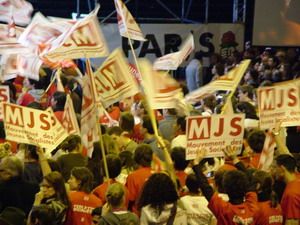
The top image is from segoleneroyal2007.net. The tense French presidential election intensifies, with sharp confrontations and booming artillery everywhere. Passionate political debates, dramatic daily media coverage, and fluctuating social polls aim to rouse citizens who have lost faith in politics and are in a slump. Major parties deploy every trick to win votes. In this election, the leader of the French right-wing UNP party, Nicolas Sarkozy, chose spectacular, dramatic American-style election staging. His grand, majestic momentum was highly attractive to the public, and he was also the first to propose a complete policy platform. Amidst the prevalent capital liberalism of globalization, his poll numbers have been catching up with Ségolène Royal, the "hot mom" candidate of the Socialist Party, since mid-January. Under the right wing's comprehensive assault on the left-wing candidate and their unclear policy positions, the right wing's offensive has benefited greatly. Current polls show them exceeding the Socialist Party candidate. Is this the result of an attack strategy and clear political discourse? In the first round, the vote was 32% to 27%; in the runoff, it is projected at 53% to 47%. Of course, the election situation can change at any time with social circumstances. Another poll shows that the center-wing UDF party's leader, François Bayrou, replaced Jean-Marie Le Pen of the National Front as the third figure in this election. The two are actually close (13% to 12%), and moreover, far-right voters are not very vocal, making it hard to discern the subtleties here, as upsets are common in politics.
Clearly, regardless of left or right, the entire French society seems to be waiting to see the Socialist Party's presidential policies. Against a backdrop of tight social situations, on Sunday, February 11, the Socialist Party held a grand event at the Villepinte Exhibition Hall near Paris. Ségolène Royal unveiled her "Presidential Pact" under the slogan "A fairer France will be stronger." On the path of social democracy, there were nearly a hundred policy proposals covering society, education, law, environment, research, employment, housing, healthcare, youth issues, social equality, national systems, Europe, and international issues. She proposed establishing a civil society alliance contract, harmonizing relationships between French people and enterprises, and criticizing endless speculative capital dominance. Addressing French people's love for work and dissatisfaction with it (especially low wages and unstable jobs), she aimed to improve everything possible, including schools, social healthcare, low wages, and meager pensions. Her humanistic and people-oriented policies led the Socialist Party's presidential candidate to hope that governing would be like handling household chores. She declared, "I want to give all French children what I give my own," fully demonstrating unprecedented maternal spirit and enhancing the possibility of social harmony and evolution.
Of course, the Socialist Party's policies are left-leaning. On Ségolène Royal's humanistic stance as a female candidate, they cut into today's fragmented family views and a society dominated by egoism and self-interest, offering a more humanistic vision for French society. Leftists generally affirmed the Socialist Party's humanistic policies, though Communists and the extreme left had criticisms, arguing that the policies were not left-wing enough. Naturally, it is impossible to satisfy all leftists. The next day, French media polarized: the left-wing Liberation praised the policies, while the right-wing Le Figaro questioned them. The biggest backlash came from the Socialist Party's rival, UNP's Nicolas Sarkozy, who argued these were unachievable promises, especially questioning minimum wage assessments, social healthcare, and pensions. The Socialist Party candidate hoped to break through her poll dilemma after releasing the policies, but unexpectedly faced continuous fierce attacks from the right wing and internal discord within her campaign. Her financial officer resigned due to differing views from the party leader. The Socialist Party seemed helpless, and everyone waited for Monday night's political program "I Have a Question for You" on France Télévision. Leftists worried about Ségolène Royal's performance, while those opposing her hoped she would face embarrassment. Two weeks prior, Nicolas Sarkozy performed exceptionally well on this program, attracting over eight million viewers, boosting his momentum and poll numbers. The French presidential election continues to entertain, leaving everyone waiting to see what happens next. 2007-2-17