Chen Chi-Hsiang "Mirrors Stage" Solo Exhibition
East Home Gallery - Mirrors Stage exhibition invitation card
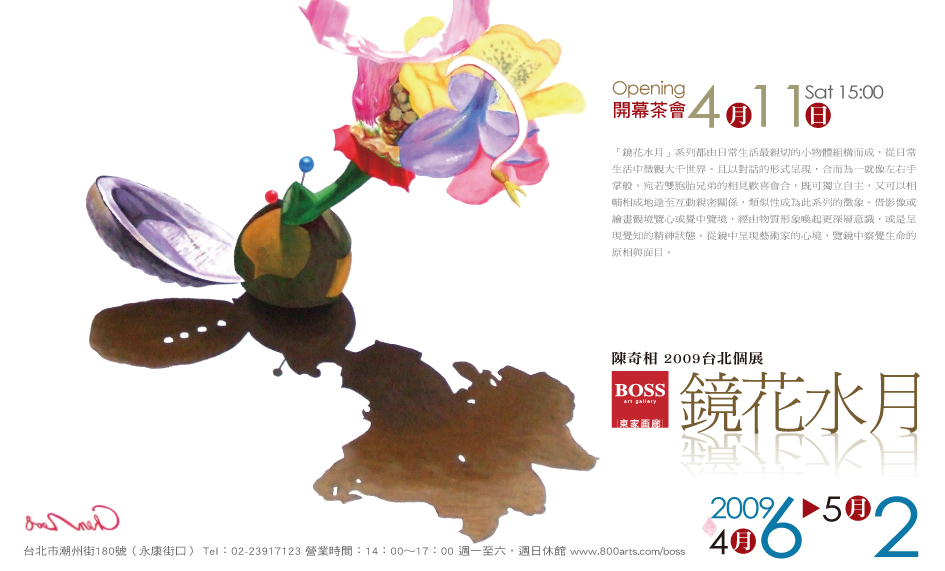
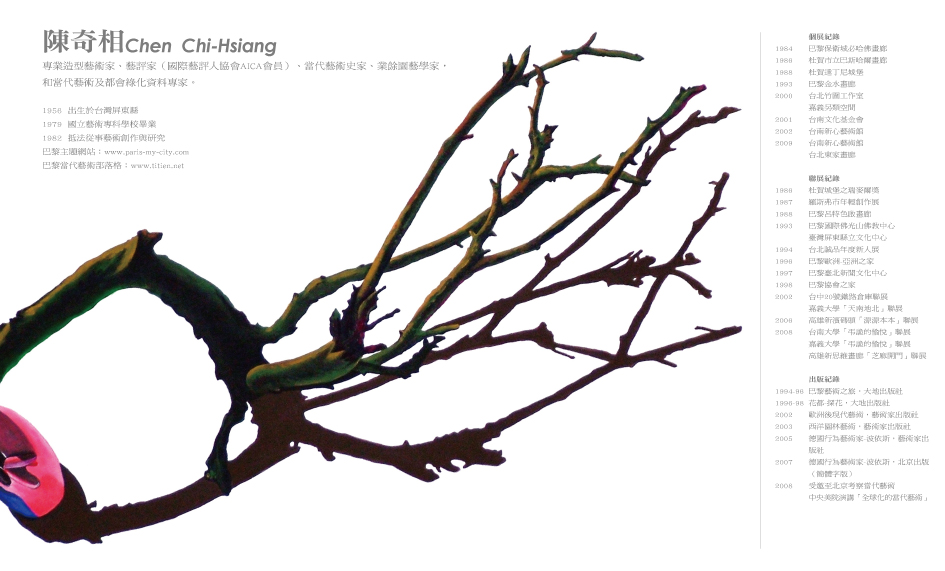
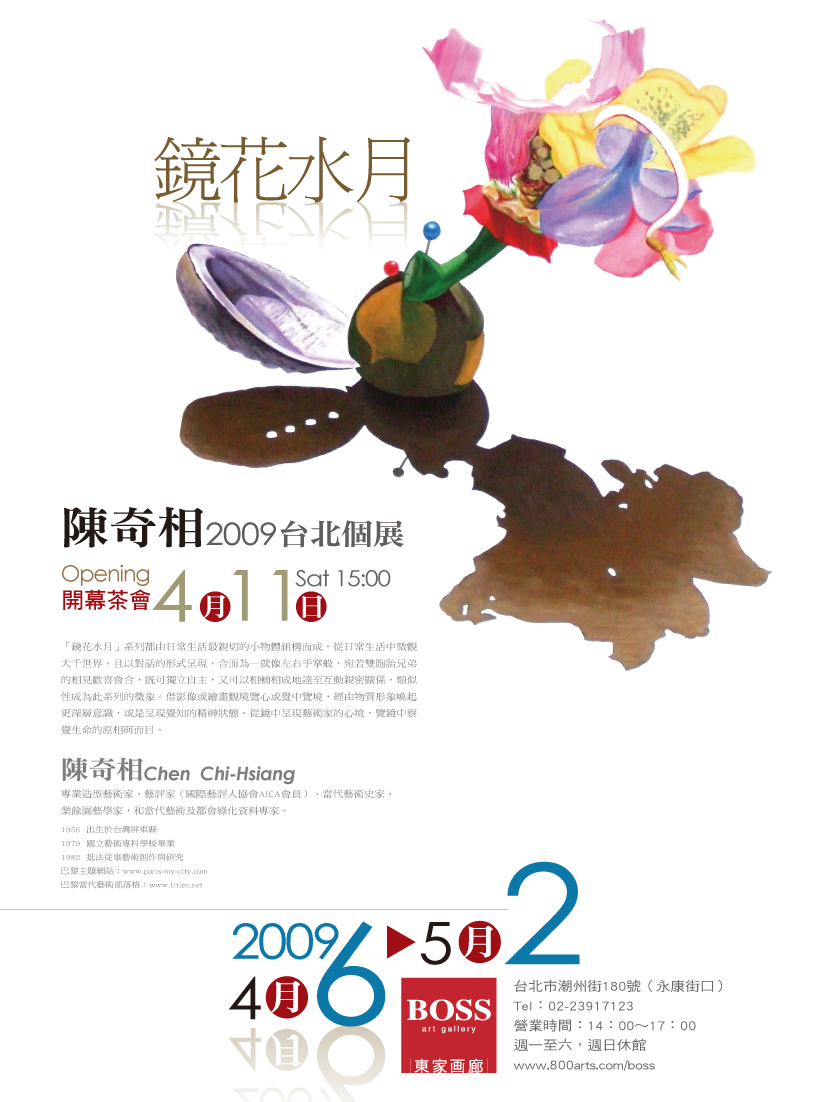
Chen Chi-Hsiang’s 2009 solo exhibition, "Mirrors Stage," was held at East Home Gallery in Taipei from April 6 to May 2. Born in 1956, Chen is a Taiwanese artist and critic living in Paris. He has quietly cultivated his creative garden, known for contemporary art criticism. "Mirrors Stage" metaphorically describes the illusory nature of things, like flowers in a mirror or the moon reflected in water. From the changes of nature and worldly affairs to the self-reflection of life itself, everything evolves and fades naturally. The idiom "flowers in a mirror, the moon in water; life is like a dream" reflects reality, reminding us how to see through phenomena to find essence amidst various situations. Art is also a clear mirror reflecting the creator's state of mind. Life itself is a pristine painting, allowing people to paint freely within its emptiness. It mirrors life states; creation is the projection of life experience, reflecting perception and understanding.
Following the "Observing the Mind, Surveying the Realm" photographic series, the "Mirrors Stage" painting series draws inspiration from the 2005 "Non-Mental Image" works. Through years of quiet observation, Chen witnesses the mirror-like surface of life, attempting to reveal deep inner consciousness through external material exploration. He highlights omnipresent entities and elusive emptiness within the material and phenomenal world, verifying the essence of existence and consciousness here and now. This trial moves from mental images to non-mental images, witnessing the supernatural through nature, moving from matter to spirit, from the visible to the invisible, and from language to perceptual imagery.
Viewing objects reveals essence; life is nature; the external is an extension of the internal, or more precisely, they are one body without boundaries. Like shadows following objects, time wraps around space, and space itself is time. Entities combine with emptiness; truth has no form yet contains all forms. In this vast, changing universe, he consciously observes silently or captures fragments of reality as eternal microcosms based on life's unchanging nature and romantic sentiment, experiencing art as the natural manifestation of ontology.
The "Mirrors Stage" series is presented in dialogue, united like left and right hands, similar to twins meeting joyfully. They can be independent yet complementary, creating intimate interactive relationships; similarity becomes the symbol of this series. Moving from photography to painting, the goal is neither image nor painting per se. Instead, it uses them to observe realms and minds, awakening deeper consciousness through material forms or presenting spiritual states of awareness. It reveals the artist's heart through scenes and perceives the original face of life.
This series is composed of familiar small objects from daily life, viewing the macrocosm through the microscopic lens of everyday existence. It is subtler than imagination, bridging reality and unreality, the seen and unseen, concrete and abstract, cognition and awareness. It attempts to grasp metaphysical realms or highlight serene mental states. These objects follow each other or reflect like mirrors, such as the moon in water or reflections of worldly items. All reality is constructed by yin-yang or opposing forces unified; objects under light must have shadows, and mirrors must show forms. In these physical phenomena, time follows space, and space constructs time. Paintings and photographs achieve the entity of art, highlighting not just light and shadow but the whole of things. Poetic imagery highlights what is seen and unseen in painting, expanding the artistic realm and imaginative space beyond objects.