Hou Chin-Lang "Duet of Life Memorial Exhibition"
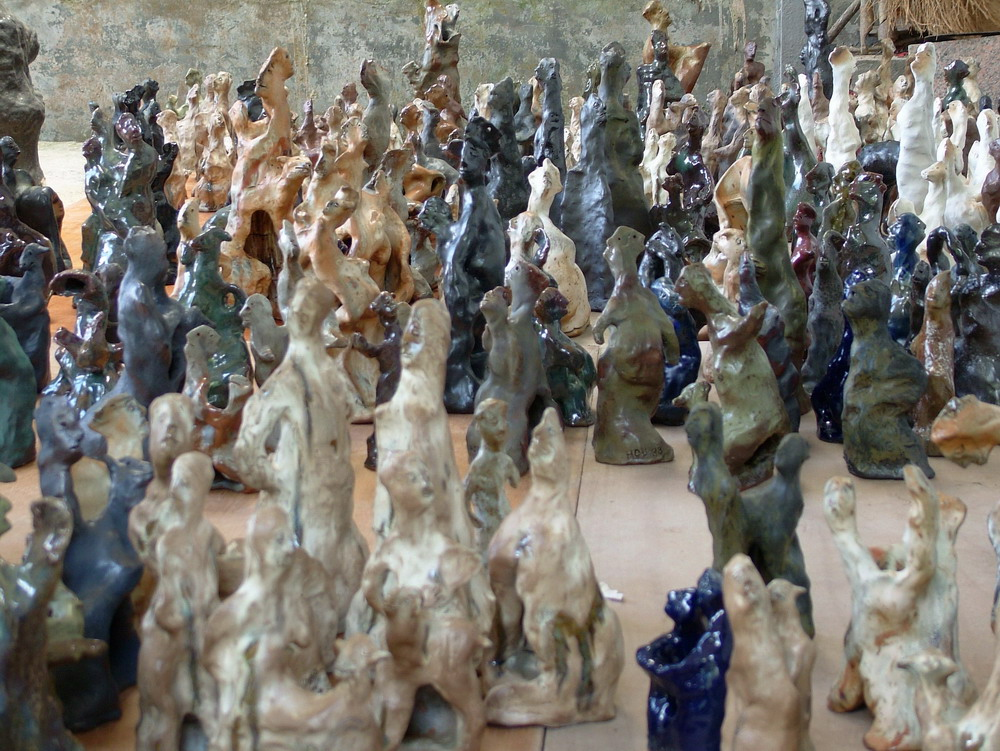
Pottery sculptures full of will and the struggle for life - Family Group Portraits Series 1995-2000
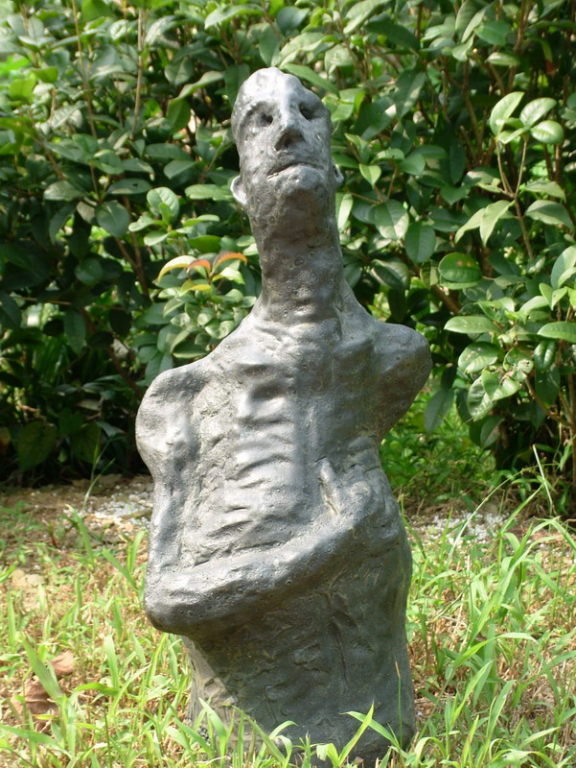
Life Journey Monument - Hyper-realistic Self-portrait, 32x30x68 cm, 1998. French-based painter Hou Chin-Lang's "Duet of Life Memorial Exhibition": On display at the National Museum of History in Taipei from April 17 to May 17. Hou Chin-Lang's life is not just a duet but like a symphony with rising climaxes; he is a scholar, a fighter for life, and an outstanding artist. He has unique achievements in academia, and his artistic creations are dazzlingly brilliant and undeniable. Clearly, art is like a bright mirror reflecting the creator's state of mind and condition. From Hou Chin-Lang's artistic creations, we can verify that artistic creativity is akin to the will to exist; life is the living source of art, and art is the spiritual pillar of life.
In Hou Chin-Lang's artistic creation, two-dimensional painting is the main body, but he also delves into sculpture. The perfect image was already presented in his early lifelike "Mei Zhi" statue (1964), fully demonstrating the characteristics of three-dimensional sculptural art, affirming his talent in this field. Ultimately, through coincidence or fate, he realized his world of clay modeling in his later years. In 1995, Hou Chin-Lang returned home to visit relatives, went on vacation to his sister's house in Shulin, and by chance, introduced by classmate Chao Kuo-tsung, went to Lin Chen-lung's ceramic kiln in Tucheng, New Taipei County, to paint ceramics. This intermittent immersion in ceramic creation lasted four years, expanding an extraordinary world of clay modeling and finding an outlet for life and extraordinary creative power in this three-dimensional clay work, opening up new territories and challenging the construction of a new world of art. He started with simple painted ceramic plates, transferring unique family figures from his paintings onto them. Painted ceramics quickly failed to satisfy his creative desire, so he moved on to hand-thrown ceramic bottles, painting them tirelessly. Life found expression, quickly forming a large group portrait of family members.
In 1996, shifting from painting to new three-dimensional clay modeling, he began folding ceramic plates, then skillfully molded well-formed ceramic bottles using the five fingers of his left hand to depict the myriad aspects of life. Interconnected groups of figures, multi-faceted faces, intertwined bodies, rhythmic concavities and convexities, holes, and winding curves constructed dynamic aesthetics and thought. These were clearly microcosms of himself or his family, maintaining the original texture of the clay or using single glaze colors. In 1997, liberated from ceramic bottles and jars, he sculpted distinctive figure statues—family and all beings group portraits, occasionally mixing in the playful animal images (such as sheep or birds) from childhood memories. The works grew larger and more complex. With the help of Lin Chen-lung, the owner of the Ci Yang Kiln, he added colorful glazes to bring the works to life, making them more vivid and expressive.
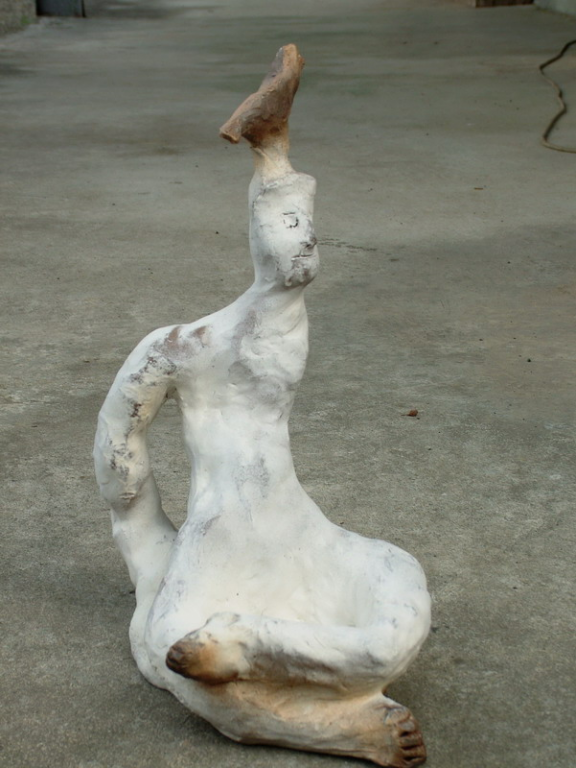
In 1998, after four consecutive years of unremitting effort in molding, numerous memorial monument-style pottery sculptures were completed at this time. Like fighting against life and his own incomplete body, he overcame physical limitations, creating clay volumes and dimensions beyond the ordinary, such as self-portraits and group portraits of all beings, which became monuments of art. He challenged the limits of life and pushed pottery sculpture to its peak, also molding the imperfections of life. Hou Chin-Lang's world of clay modeling is a reflection of the artist's own physical and mental consciousness. With group portraits as the main body, interconnected bodies, multi-faceted faces, diverse and complex forms, solid volumes, and emotional textures overflow with vitality and the mystery of existence, constructing his unique and pure style. He said, "Works created since my left-hand period truly belong to me." (Note 1). Art is like a bright mirror reflecting the creator's physical and mental state. Clearly, sculpture is formed based on one's own body and posture. Hou Chin-Lang, who challenges life and art, under a strong will to exist, with an incomplete body (hemiplegia), could only use his left hand and left eye (poor vision in the right eye) to create art. The multi-faceted face figures in his paintings and clay models come from deep subconsciousness, constructing this unique "phenomenal experience," reflecting personal imagery and perspectives on viewing the world.
Sculptural art involves the artist's body and physical strength. Hou Chin-Lang's clay statues are within the scope of limited limb operation. The statues are almost always upright, reaching from heaven to earth. The works are generally not large (around 40+ cm high, with exceptions for large works challenging physical limits like self-portraits). Under the natural flow operation of the left body, the left hand leading the way, and the skillful techniques of the five fingers, balance and steadiness present the naturalness of sculpture. Incomplete yet whole, it demonstrates the integrity of the mind and consciousness and the essence of life. This naturalness of the left body can only be discovered when people have the opportunity to hold the work with their left hand; it is so smooth and natural.
One or more eye-catching bodies are connected or intertwined, embracing each other. A face on the left, a face on the right, up to multiple faces, presenting the concept of a group. He molds the heads and arms into flat shapes and carefully adds details to enliven the statues on the faces. To enhance the volume of three-dimensional space, he uses the existing forms of ceramic bottles and jars to construct body volumes, or disassembles and deforms them, or adds clay strips to mold and combine blocky bodies, surfaces, lines, holes, concavities, convexities, and hand traces, adding substantial glazes to shape rich and diverse formal languages. Between figurative and abstract, imagination and memory, sentimentality and melancholy, reality and fantasy, he displays overflowing emotions, keen thoughts, and personal deep consciousness.
Looking at Hou Chin-Lang's unique clay sculptural works, they witness the pure reflection of life. What makes artistic creation moving is that it reflects many unique individual minds. Whether in terms of form, the unique "viewing of the world," or the different "phenomenal experience," etc., a continuous process of understanding the "new," or in the process of shaping content, coming from deeper emotional worlds and images of life rhythms, these are languages of the soul, and the two are often inseparable and interdependent. Subjective emotion relies on form to be presented, and form is endowed by each unique mind, full of subjectivity, determined by the subjective role of the heart. Hou Chin-Lang's creative process clearly presents the changes of these two contexts and their intersection and fusion. (Note 2)
Note 1: Refer to Reconstructing the Amnesiac Homeland, Hou Chin-Lang Solo Exhibition Catalogue, Taipei Fine Arts Museum, Year 1998, Huang Hai-ming, P44. Note 2: Refer to Reconstructing the Amnesiac Homeland, Hou Chin-Lang Solo Exhibition Catalogue, Taipei Fine Arts Museum, Year 1998, Huang Hai-ming, P45.