Paris Palais de Tokyo - "Spy Code" Special Exhibition
Stephane Vigny Three Electric Poles - Proposition: "Originality is Reproduction" Detail of work Leaning towards Conceptual Art 2009

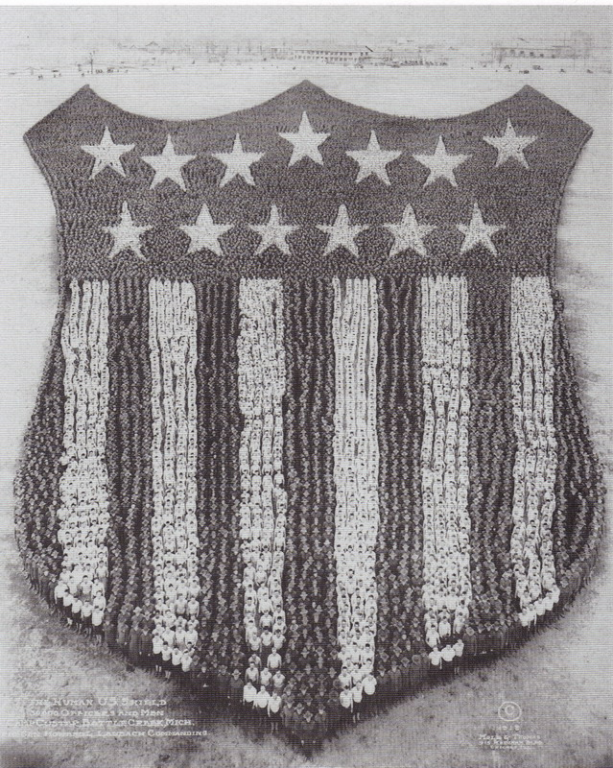
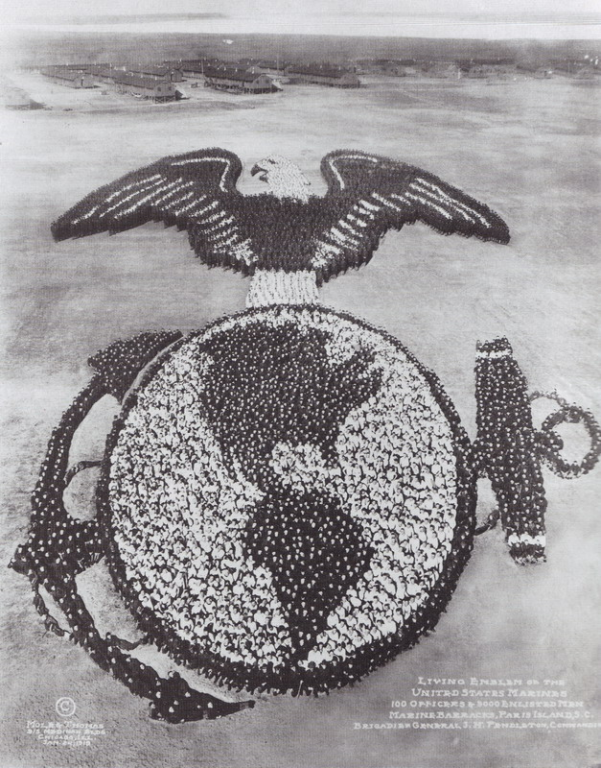
Arthur Mole and John Thomas, composed of nine thousand naval officers and soldiers to construct the Living Emblem of the United States Marines graphic photo 11x14 inches 1919. Foreword: The "Spy Numbers" special exhibition in the code space runs from May 28 to August 30 at the Palais de Tokyo in Paris. Clearly, this year's exhibitions at the Palais de Tokyo Contemporary Art Center lack the drama and visual senses of contemporary art. Under an active and optimistic non-mainstream consciousness, they avoid existing art theories and habitual aesthetics, continuing to expand the boundaries of art with a pioneering spirit that looks forward while respecting the past. "From one revolution to another," through "Gakona" to today's "Enemy Code" special exhibition are obvious examples. The enigmatic "Spy Code" exhibition is like a whimsical theater, opening up a remarkable secret coded audio-visual world with a completely new perspective. This theme draws inspiration from Nikola Tesla's explorations, continuing to develop the aspects of electromagnetic waves and their peripheral issues, often being closer to the insignificant and the spectrum beyond the visible. Especially during the World Wars of the last century and the Cold War period, military intelligence personnel gathered classified information; via radio telegrams or wireless code transmission, exchanging information through secret coded number commands like 2..11..58...35..23.. etc., these imperceptible sound wave spectrum commands were like ghosts, serving as secret reports for intelligence personnel, mutual communication among smuggling gangs, or simply modulated waves of simple telecommunications. These broadcasting code stations each had their clear functions. In today's era where it is almost unimaginable to face extreme worldly internet and vast wireless telecommunications systems, amidst the explosion of mass information, coded symbols appear even more mundane. Clearly, this enigmatic exhibition topic metaphorically represents the diverse coded instructions of current artworks, between reality and imagination, the visible and invisible, individual and collective consciousness, within the riddle-like code space of whimsy.
The enigmatic "Spy Code" exhibition gathers young artists from across Europe and American artists. Through their respective unique methods such as analyzing sound, replicating scientific instruments, collecting contact lenses, carefully examining historical images, transforming readymades, collecting specimens, constructing and deconstructing architecture, etc., the entire exhibition interprets various phenomena, information, and problems of current society through objects, sculptures, photographs, and spatial installations.
Dialogue with Space and Nature: Pascal Broccolichi (born 1967), French artist, specializes in developing ubiquitous sound, exploring undetectable phenomena through human ears, sound waves, tearing sounds, or ubiquitous vibrations in spaces. His creation establishes the way the exhibition space questions space, solely to highlight the uniqueness of the present and its imperceptible parts. Here, Broccolichi follows the space of the Palais de Tokyo, using three long straight barrel-shaped speakers and amplifiers as environmental spatial installations. By capturing active electromagnetism in the space via detectors, recording and playing back these sound wave phenomena through the process, under repeated overlapping bass oscillators, he creates extraordinary reverberation waves, immersing the audience in a space of physical and mental resonance. The artist performs direct effects on the structural space of the Palais deTokyo exhibition hall, inviting the audience to experience the exhibition space as a kind of expanded area development.
Dove Allouche (born 1972) and Evariste Richer (born 1969) are both French artists. Allouche continues his personal creation, presenting a series of dark photographic intaglio prints of Parisian tunnels, superimposing two different intaglio systems, intending to present modern tunnel systems. Richer currently wanders in India, seeking exploration of different smells of modernism. This unusual scientific instrument "La terrella" is a collaborative work by the two between 1999-2002. At the end of the 20th century, they decided to reconstruct the polar exploration machine built by scientist Kristian Birkeland at the beginning of the century (scientist Birkeland explored the North Pole in Norway at the beginning of the 20th century and collected magnetic gravity phenomena. After the discovery of X-rays, he decided to build an exploration magnetic machine La terrella to observe the influence of gravity on cathode rays, finally discovering the conversion of electron halos on the gravitational surface of the North and South Poles.). With technical help from various scientific laboratories, they replicated the La terrella machine at a 1:1 scale. For this exhibition, the two artists decided to regularly activate this machine according to the date scientist Birkeland publicly revealed his invention and the date of his startup experiments. Here, what is replicated is not just a model but the construction of natural phenomena of polar activity. Art explores the scientific field, recovering lost elements with a sense of nostalgia and placing originality within reproduction.
Luca Francesconi (born 1979), Italian artist, explores the ambiguous relationship surrounding us and nature, such as tree branches covered in chewing gum, or two trees with different appearances connected by their vascular systems. According to the artist, what we observe is what we want to see, not necessarily reality as it is. One obvious intended question is our perspective. Opposing the general concept of sharing the world, he considers transforming nature and comparing general changes as a standpoint: "Light, dark, yesterday, today are all symmetrical techniques. The corner of shadows marked by the earth and sun, thus I think the universe has no so-called day and night." Here, Francesconi conceptually presents three natural stone (limestone, granite, and slate) specimens to symbolize three high mountains. These were collected by the artist himself from three mountains in the Alps: Gressoney, Cusna, and Turchino. Titled "To lower the mountains," humble mountains, built on powerful echoes, transcending this simple extensive material sampling, the work hovers between the tangible present and spiritual imagery, between simple stones and inaccessible peaks.
Reflections on History-Society-War: Jim Shaw (born 1952), East Coast American artist, interested in the bizarre and strange, his creative inspiration comes from American folk popular culture. His ever-changing works reference modern society, advertising, consumption, comedy, and film. Through strong impact collage free combinations, he constructs a contrast between interesting reality and fanciful worlds. Jim Shaw often interprets his creations through series. Early series "My Mirage" (1985-1990) depicts the story of Billy, an American young man growing up in the suburbs. Then, in 1991-2000, he created two major series "Dream Drawings" and "Dream Objects," combining sketches, sculptures, and objects through the artist's personal dreams.
Since 2000, his overall creative development revolves around pseudo-religion. The overall creation is based on objects, works, books, films, and performance art. Here he presents a sea monster seemingly just walking out of the deep sea "Heap" (2005), unable to clearly determine its form and covered in sticky substance as if just emerging from water. The entire sculpture is constructed from colorful small plastic toys given by McDonald's, clearly originating from consumer society, thereby criticizing the current fervent consumer society.
Ken Gonzales-Day (born 1964), American photographer born in Los Angeles, is passionate about forgotten history in the American West. His works effectively capture extraordinary experiences of time, place, and identity. Especially in his "Erased Lynching" series, it is obvious that historical tyranny and power always handle political events this way, erasing brutal lenses to avoid leaving evidence. Submerging history is the history of all history. In this "Erased Lynching" series where brutal lenses are unseen, he uses postcards and historical photos showing execution hanging scenes. His participation lies in crossing out all traces of this cruel hanging on the photos (i.e., ropes and corpses). Images voluntarily ignore victims to demonstrate the mechanical value of hanging: curious crowds come to watch this extraordinary theater, thus the photos leave eternal acts of this execution. This series of absent images or hollowed-out spaces evokes memories and recollections of cruel hangings. Although corpses are not seen, victims paradoxically exist everywhere. Within these beautiful images, silently narrating one historical torture and social collective memory after another.
Experience of the Body: Tony Smith (1912-1980), American minimalist artist, originally an architect, he pioneered new sculptural thinking. His most striking work is "Die" (1962), also his most famous and purified work, a perfect four-sided geometric form of a "cube" measuring 183×183×183 cm, within the range of six human footsteps, with thick solid volume, simplified faces, profound black color, carrying a hint of apocalyptic meaning. This sculpture directly establishes a relationship with the audience; he considered it neither an object nor a monument.
The displayed "For v.t" (1969) here is dedicated to his artist friends. This work calls for a type of viewing, only skimming over its meaningless black surface into its environmental space. This hexagonal crystal form is composed in a dynamic structure, prompting the audience to walk around to comprehend this complex form. Smith said: "The forms I want to display are through space and light, not coming from the material itself." Tony Smith's works all possess a bodily experience: "That was late at night (on the way to building the New Jersey highway), with no lighting, seeing only white lines on the road, nothing else, just direction changes passing through a landscape (...) First I only knew this state, then suddenly realized, this night effect liberated many of my artistic viewpoints."
Norma Jeane (born 1962), Italian artist, was born on the day Marilyn Monroe died. He used this to choose his pseudonym (real name Norma Jeane Baker), thus witnessing the disappearance of the most iconic figure of the 20th century. Clearly, how great is the gap between private life and public image? Norma Jeane's artistic creation often updates wandering between the contrast of reality and pop culture. He considers himself a virtual artist through his existence, but very realistically through his works and numerous collaborations. Here Jeane displays 730 contact lenses "Everyday sight-Tribute to Aldous Huxley 2003-6-21a2004-6-20", for a whole year through the eyes of artist Davide Legittimo, displayed in two round glass dishes. Through objects via behavior, attitude, and concepts, it evokes massive perceptual visual images, storing such creations for a whole year. Here, special highest respect is paid to blind writer Aldous Huxley, although he was nearly blind, he still continued reading and writing tirelessly.
Matt ODell (born 1976), British artist, has been extremely interested in religious beliefs, disasters, conspiracy theories, and media phenomena in the current world for many years. His works have a worldly worldview, in the iconography after 9/11 in the US. Each work undergoes long deliberation, carefulness, and clarity. His sculptures often start from common materials, such as cardboard or wood.
Here Matt Odell presents a memorial-form eight-sided broadcast radio tower - "Numbers station Beacon / Community Broadcast towes". This speaker-shaped sculpture continuously plays recorded radio sounds via shortwave broadcasts. Among many mysterious series of distinct voice tones, it sequentially plays all four hours continuously for eight minutes. Giving people a baffling feeling, transmitting somewhat arrogant rumors or delusional interpretations, etc., clearly mass media becomes a medium for teaching and manipulating groups.
Conceptual Construction: Felix Schramn (born 1970), German artist, whose work forms he considers like those of a sculptor. Skilled in using architectural materials like plaster, wood, or paint, etc., he often presents extraordinary perspectives, such as fictional maze-like indoor buildings, puzzles hovering between demolition and construction. All creations come from rehearsals of small models in the studio. Schramn uses basic forms, diagonals, and dynamics, carefully thinking before destruction, constructing a true aesthetics of ruin.
Here Schramn establishes the location space by constructing this memorial-form "Omisson", dramatically between the boundaries of architecture and sculpture. He digs holes in the white walls of the exhibition space and erects the wall surface with triangular structures as facades, in an uneven unstable balance. The wall becomes the core of this deconstructed and reconstructed work. The audience stands bewildered facing this dramatic sculpture-environmental spatial installation, between deconstruction and construction, sculpture and architecture, part and whole.
Stephane Vigny (born 1977), French artist, is particularly interested in cement-made ground facilities, increasingly depicting ground facilities for aesthetic, environmental, or political reasons. When artist Vigny talks about electric poles which are almost sculptural quality forms, he is almost eloquent and full of emotion. Clearly, his creative inspiration mainly comes from "objects" of popular culture. His artistic exploration intends to move away from the boundaries of traditional fine arts, bearing conceptual and humorous artistic products founded in an extraordinary real world.
In this thematic exhibition, Stephane Vigny's work is the most insignificant, so small as to be invisible. Three cement electric poles lie drooping in the corner of the entrance wall, square cement blocks covered in mud at the head, without any signage, like discarded objects, titled "Originality is Reproduction" (2009), using the technique of transferring position within a concept of readymades.
Arthur Mole (1889-1983) was a photographer and John Thomas was a church choir director. The two collaborated during and after World War I to shoot the extraordinary series "Living". They were iconic featuring the American flag, eagle flag, the British flag of the empire on which the sun never sets, the Japanese national flag with the red sun, the US Navy emblem, Lady Liberty, and portraits of Woodrow Wilson, etc. They traveled throughout the US, carefully organizing memorial-form images constructed collectively by the US armed forces, photographed from high places looking down. Within a collective consciousness, the overall photos display the effects of war (numerous troops just about to go to the front line), strengthening feelings of military affiliation and the spirit of freedom and democracy at that time. These popularized images hover between ghostly illusions and collective memory, art and documentary archives, uniqueness and totality. Clearly, when facing war or history, individual power is limited, and unity of will is inevitable.