Contemporary Iranian Art in Self-Liberation (1)
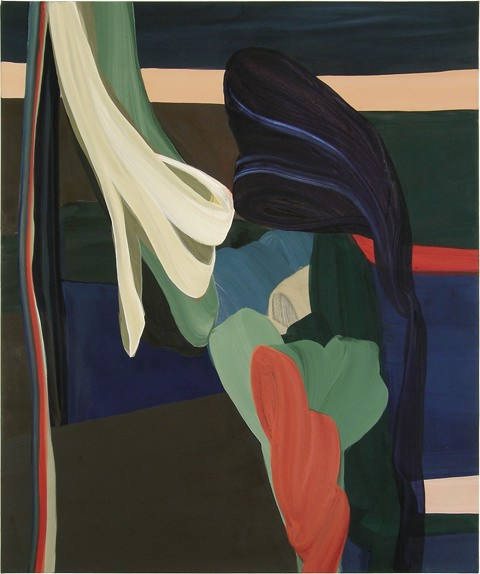
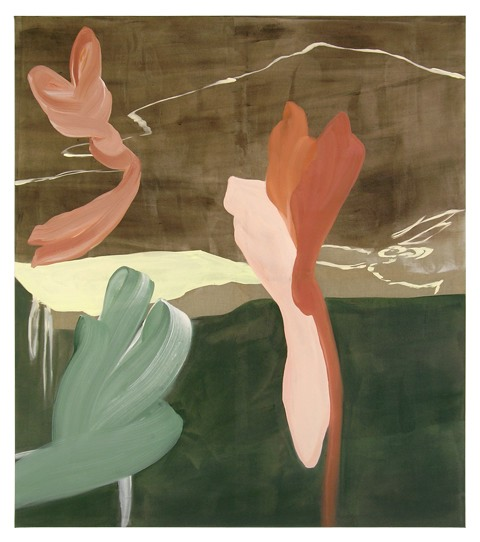
Moje Assefjah, flores nocturnos, 115x90 cm, oil on canvas, 2008. Image from www.artnet.fr
Text and photos by Chen Chi-Hsiang
Preface: In the current era of globalization, with its political and economic shifts, cultural exchanges, and the open doors of the internet, a strong wave of social and artistic liberation has swept across the globe. It penetrates various severe barriers of dictatorship and totalitarianism. With political loosening and economic development, the trend of liberated creation presents an unprecedented atmosphere of freedom. The grand artistic development in China today is clear proof; the rise of Middle Eastern art is no exception. Driven by self-aware consciousness of self-liberation and a desire for freedom, it now presents a diverse and brilliant landscape. Under global and local political and cultural concerns, it forms unique styles and paradigms. The past periphery has become today’s core, capable of standing against the Western art situation.
The Imagery of Middle Eastern Art: In recent years, with the political, economic, and cultural waves of globalization, the rise and development of contemporary Arab art in the Middle East has been evident. Examples include the Istanbul Biennial in Turkey, the International Art Fair and construction of new museums in Dubai, Saudi Arabia, and the rise of galleries. The West has begun comprehensive collecting and operation, driving the emerging Middle Eastern art system and market. At major contemporary exhibitions worldwide, Middle Eastern artists have drawn attention, such as Palestinian artist Mona Hatoum, Iranian artist Shirin Neshat, Algerian artists Adel Abdessemed and Kader Attia, Egyptian artist Ghada Amer, and others. Middle Eastern contemporary art is no longer absent from the Venice Biennale, with national pavilions for Turkey, Egypt, Iran (starting in 2005), and the newly established Palestinian National Pavilion this year.
Notably, among contemporary Middle Eastern or Iranian artists, female artists are rare and precious in their majority. Most live and create in their native countries, accepting challenges from the social environment and using their local homeland as the foundation for creation. Others have self-exiled abroad to settle in the West, often possessing cross-cultural experiences and tending toward an international character under global artistic trends. Thus, in today’s diverse art scene, contemporary Middle Eastern art, like the global creative situation, divides into two main attributes of exploration: Globalized: Concerned with the transformation of local political, economic, and cultural images into international large-scale styles; and Localized: Using local homeland images and perspectives as symbols for modern creative expression.
Like various political systems, democracy seems luxurious in some places, and freedom is the artist’s desire, amidst complex traditional and modern Islamic politics and culture. In recent years, Iran’s hardline Islamic regime has frequently been the focus of global media, especially regarding its nuclear development and recent presidential elections, which shape its internal and external political pressures and social violence. Once labeled by President George W. Bush as part of the Axis of Evil, Iran’s every move clearly involves the overall Middle Eastern situation and future development. Since the Iraq War, Iran has become the most significant political, economic, and strategic nation in the Middle East, with its regional international political influence growing daily. Under this complex political and economic situation, the rise and development of contemporary art cannot be separated from the influence of local conditions: war, political violence, social environment, traditional pressure, historical interpretation of personal freedom, and the tyranny of anti-religious regimes, etc. These issues nurture the creative imagery and ideological dimensions of art.
Clearly, both Iranian and Palestinian art represent individual liberation, defending thought, human rights, and democratic awareness, breaking through oppressive religious fanaticism and social norms. Iranian artists target the Islamic fundamentalist system, aiming to liberate society through a combative consciousness. Palestinians, displaced under Israeli oppression, emphasize self-sovereignty and identity, possessing a strong consciousness of resistance. This case is manifested in the works of two outstanding contemporary artists: Iranian artist Shirin Neshat and Palestinian Mona Hatoum. The former is based on the relationship between Islamic religion, society, and female constraints rooted in Iranian homeland emotions. She said, “I understand my work as a visual discourse on the theme of ‘contemporary Islam and feminism,’ like a discourse analyzing some mysteries and reality. The conclusion is that these are more infinitely complex than we can imagine.” The latter uses the scenes of Palestinian displacement, oppression, and exile, along with real history and memory, as the starting point for creation, attempting to interpret the extraordinary tensions and embarrassing situations of personal, Palestinian (Arab world) political, social, economic, historical, and personal aspects through artistic creation. She said, “Artworks are first feelings truly lived; content and structure only come from true living initiatives.”
Contemporary Middle Eastern art explores a wide range of faces in diversity and plurality, including painting, sculpture, video, installation, objects, etc., addressing political criticism, social and historical concern, ideological combat, consciousness of freedom, personal and collective memory, etc. It manifests through diverse forms such as figurative, abstract, imaginative, symbolic, metaphorical, poetic, pop, humorous, or satirical.
The Rise of Contemporary Iranian Art: Contemporary Iranian art was blessed by the democratic election legislative procedure of the religious regime in 1997. This political reform brought about a comprehensive wave of social liberation (which was not as liberating as imagined under the Islamic fundamentalist regime). Art suddenly woke from slumber, becoming an effect of society’s self-freeing consciousness. Museums and the art system came back to life and became active; galleries were established, and collector groups emerged (it is said that major contemporary art collectors in the Middle East are Iranians overseas). Thus, under the loosened basic fundamentalist regime and economic development environment, contemporary Iranian art was reborn from the ashes.
In 2001, the Barbican (Europe’s largest) multimedia art center in London, UK, co-hosted “Contemporary Iranian Art” with the Tehran Contemporary Art Center, attracting high attention. Energetic contemporary Iranian art thus stepped out of its cage and pushed onto the international art stage. In 2005 at the Venice Biennale, the establishment of the Iranian National Pavilion featured two noteworthy heavyweight artists: Mandana Moghadam with her innovative object installations and Bita Fayyazi with dramatic photographs. Meanwhile, the gallery opened by Iranian Leila Taghinia in New York became an international window platform for contemporary Iranian art, beginning to gain favor from Iranian and international collectors. Works by these Iranian artists quickly entered important art auction markets in Dubai, London, New York, and Paris.
Important Western galleries also seized the opportunity. Famous Iranian female artists Shirin Neshat and Y.Z. Kami exhibited at Barbara Gladstone and Gagosian galleries in New York. Shoja Azari and Shahram Karimi exhibited at Castelli Gallery in New York. Shirin Neshat also exhibited at Jérôme de Noirmont Gallery in Paris. Shirazeh Houshiary exhibited at Lisson Gallery in London. Mitra Tabrizian participated in the retrospective exhibition “This Is That Place” at Tate Modern in London this year. In 2009, a series of exhibitions took place: Saatchi Gallery in London grandly organized two major exhibitions, first “Contemporary Middle Eastern Art” and then “Contemporary Iranian Art,” attracting international media attention and causing a sensation in Europe. Then, Thaddaeus Ropac Gallery in Paris exhibited a comprehensive group exhibition of contemporary Iranian art titled “Raad o Bargh.” Ghislaine Hussenot Gallery held a group exhibition of five contemporary Iranian artists. Almine Rech Gallery held a contemporary artist group exhibition “Iran Without Borders.” The Henry Moore Institute and Royal Academy of Arts in London held a major exhibition “Contemporary Iranian Video Art,” etc. Middle Eastern and Iranian contemporary art has thus become another rising artistic force in globalization.
A Panorama of Iranian Contemporary Artists: Liberation of Female Consciousness: Shirin Neshat (born 1957, residing in the US) continues in a fresh literary narrative within highly professional film art, weaving delicate female thinking structures and dense poetry. In recent years, she has expanded from feminist issues toward concepts of the Third World’s society, identity, exile, refuge, and utopia.
Avish Khebrehzadeh (born 1969, residing in Washington, US) excels in detailed painting and projecting moving images onto paintings—painting videos—immersing dramatically into a world of folklore. Here, the artist uses Iranian legends to discuss human fragility, alienation, sorrow, and sentimentality, expressing the intimate and complex relationships surrounding humans and animals, or people and the environment.
Laleh Khorramian (born 1974, residing in New York, US) mixes multimedia and various possible techniques in dramatic abstract expressionism, sensitively presenting sensual abstract landscapes through materials and brushstrokes, uniquely displaying the artist’s childhood memories and women’s unique lyrical dreams.
Ala Dehghan (born 1982, Tehran) depicts various substantial experiences and feelings around daily life in a series using women’s daily writing methods. Self-liberation strengthens all elements, reinforcing the consciousness of existence, implying that under this repressive and binding society—I create, therefore I exist.
Maryam Amini (born 1976, Tehran) draws inspiration from sexual fantasies in a closed social environment. This erotic and feminine lyrical painting world is constructed through free combinations of image forms, floating lightly on white backgrounds with subtle illusions, possessing delicate female thinking structures and dense poetry. As a consciousness of liberation of personal free imagination, it aims to liberate the repression and constraints of women by the Islamic religious regime and society.
Mandana Moghadam (residing in Göteborg, Sweden) was one of the representative artists for the Iranian National Pavilion at the 2005 Venice Biennale. Exploring contemporary Islamic female liberation consciousness, she excels in mastering unusual materials such as telephones, stones, water, hair, cement, etc., through the great tradition of Italian Arte Povera, ingeniously constructing or forming installations. Her large series “Chelgis” is particularly striking, constructed from incredible black hair, powerfully highlighting material tension and its metaphorical nature. For example, the remarkable “Chelgis-II” in 2005 presented a huge concrete block suspended in mid-air by four long black hairs woven into ropes. It seems to imply the veil pressure endured by women in traditional Islamic society through this concrete block. Ali Reza Sami-Azar, director of the Iranian Contemporary Art Museum, explained this work: “This inspiration comes from ancient Iranian mythological traditions, excellently expressing the duality of men and women, leading to unity in facing challenges: women’s hair softens the rigid block, especially education and support in the family…”
Bita Fayyazi (born 1962, Tehran) was one of the first representative artists for the Iranian National Pavilion at the Venice Biennale. She excels in multi-media construction involving ceramics, sculpture, objects, video, and installation. She takes life as the core of her creation. As artist Louise Bourgeois said, “Art is not just art; life itself is the subject of art.” Thus, she transforms her personal marriage into works. In the recent series surrounding “Goli’s Dowry,” she elaborates on the complex marital relationships between men and women in contemporary Islamic traditional society. Objects (dresses, dowry cabinets, and traditional carpets) and the artist’s performance inverted video installations metaphorically depict sexuality between men and women, social violence, traditional pressure, and women’s struggles.
Shirin Fakhim (Tehran) is famous for her provocative, sexy, comical, grotesque, and sexy life-size cloth doll sculptures, especially in her large series “Tehran Prostitutes.” Based on the perspective of modern female artists, she discusses the plight and environmental difficulties faced by Islamic women today, criticizing the hypocrisy of current Iranian religious moralism, which pushes many good women into poverty and domestic violence, forcing them to become prostitutes in darkness to make a living. Fakhim’s humorous and satirical “Tehran Prostitutes” have become an alternative social realism in contemporary Iran.
Ghazel (born 1966, residing in Paris) specializes in performance art and video. Since 1997, she has been famous for her self-portrait video art project “I.” Depicting the daily life situations of a traditional Islamic housewife, wearing a black robe and headscarf, doing chores, sunbathing, skiing, smoking, walking on the street, running to the sea, playing guitar by the roadside, going to the toilet, etc., with a touch of irony and absurdity, it presents the contradictory and complex situation of identity, exile, and integration into other countries through a sense of being a foreigner.
Shirin Aliabadi (born 1973, Tehran) is famous for her photo series “Miss Hybrid” featuring Islamic teenage girls. These young girls wear veils, have intricate hand tattoos, golden wigs, sexy lipstick, and fashionable eccentric outfits, obsessed with nose jobs, dreaming of becoming typical Western beauties—an illusion. Another series, “Eyebrows” on paper, continues to criticize the pursuit and longing for freedom and Western aesthetics by teenage girls in the current conservative Islamic environment.
Mitra Tabrizian (residing in London) is a contemporary Iranian photographer who settled in London before the 1977 Islamic Revolution. Early works were based on subjective consciousness, ideology, psychoanalysis, feminism, sex, and race. In the 1990s, she actively updated visual imagery, tending toward postmodern social daily life criticism and display systems. Recently, she returned to reconstruct personal stories in the “Border” series: immigration, exile, identity, urban alienation, and appearance, constructing documentary-style image series between fictional performances and real scenes. The artist said, “Here (London) I am a stranger; there (Iran) I am someone who cannot prevail. I am equally speechless. Indeed, there are rules; having views inconsistent with yours is like a negative element.” “Of course, I see it almost as positive information because it gives me some cultural distance. However, simultaneously, this makes my stronger attachment to (Iran). It is often there, not just the feeling of being ‘at home,’ but something more complex.”
Personal Memory and Collective Consciousness: Behrouz Rae (born 1979, Tehran) excels in photos and sensitive paintings reflecting his inner world of personal impact, attempting to release mental states and reveal intimate relationships with a second self. For him, art is a way of self-liberation and self-healing. Through this, he expresses the trauma of childhood anxiety and insecurity, and faces his own autism and anorexia. Broadly speaking, it also metaphorizes the Islamic fundamentalist regime and social situation.
Y.Z. Kami (born 1956, Tehran-US) is famous for his lifelike large portraits, constructed between appearance and mental state. His innovative large portraits radiate a vibrant, abnormal contemplative tension. Clearly, the artist tends toward philosophical thinking, transforming portraits into deep natural and existential consciousness. For example, in the 2007 Venice Biennale, he presented a series of religious dignitaries titled “Jerusalem,” subtly transforming these figures into unreal and ghost-like beings under a delicate atmosphere. His alternative written picture series is also quite striking, using densely coded Arabic text cut into geometric shapes, between text and graphics, vision and reading, imagination and poetry.
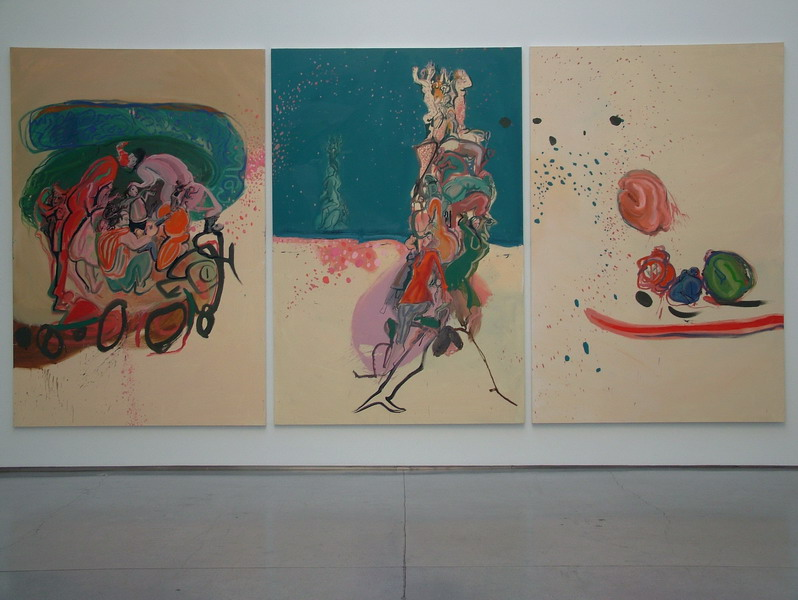
Ali Banisadr (born 1976, New York, US) creates memory paintings between figurative and abstract, revealing the painter’s personal childhood memories of Iran and the Iraq War. Between modernism and the tradition of Middle Eastern miniature painting, colorful and extraordinary scenes resemble the imaginative world of Arabian Nights, displaying personal imagination and homeland emotions.
Rokni Haerizadeh (born 1978, Tehran) creates extraordinary expressionist paintings, fully displaying the painter’s deep critical consciousness and sensitivity, integrating traditional literature and memory with modern Islamic folk culture. The painter repeatedly re-evaluates his creative environment, referencing local literature and history, expressing dissatisfaction and criticism of the society under current religious regime oppression through allegory and strong metaphor, amidst lyricism and sentimentality.
Moje Assefjah (born 1970, residing in Munich) presents profound space construction with rigorous structure, generous form, orderly light and shadow, overflowing rich colors, radiating a gentle and quiet temperament, full of poetry and sensitivity, resembling extraordinary natural imagery. Art critic Anne-Marie Bonnet believes this symbolic painting gives images an excellent quality. She said, “His paintings are like the morning world, reconstructing beauty daily with energy and peace,” or “This fluid and free painting of color and form is like reality.”
Amir Mobed (born 1974, Tehran) is an outstanding sculptor. His creation wanders between local and Western modernist sculptural traditions. The overall creative intent reaffirms the volume, space, time, and vision of sculpture. He tries various possible materials, creating new sculptural aesthetic possibilities through diverse and repetitive elements or installation construction.
Morteza Ahmadvand (Tehran) is a young generation video artist in contemporary Iran, skilled in mastering modern digital technology imagery. In his new work “Flight in the Cage,” pigeons fly back and forth in a grid series. Through poetic afterimages, it presents a lyrical and romantic situation. Clearly, the pigeons in the cage refer to the current social situation of the Iranian religious regime and the limits of personal freedom.
Additionally, there is Mostafa Dashti (born 1960, Tehran), a lyrical abstract painter, in modernist indeterminate forms or paintings. Reza Derakshani (born 1952, Tehran) belongs to the older generation of painters, in Arab traditional imagery and modernist painting.
Middle Eastern Pop with Critical Consciousness: Farhad Moshiri (born 1963, Tehran) possesses humor, sarcasm, and provocation in post-pop art exploration. He receives and transforms consumer society objects, incorporating them into panoramic paintings and object installations. His inspiration often comes from contemporary decoration and household ornaments. Through the viewpoint of a colorful market world and sales, he ingeniously constructs extraordinary (art) commodities.
Vahid Sharifian (born 1982, Tehran) excels in mastering consumer society imagery and objects within the great tradition of Dadaism and Pop Art. Through abnormal panoramic juxtaposition, he forms extraordinary scenes, or uses ironic methods to create his personally sexy “Islamic Dolls.” His bizarre and whimsical creations, full of imaginative space, question and criticize the relationship with the Islamic religious and social environment and contemporary women.
Ramin Haerizadeh (born 1975, Tehran) excels in manipulating pictures and digital image collages, ingeniously creating an extraordinary absurd and abnormal world. In his most subversive recent series “Contemporary Women,” he uses self-portrait collages played by the painter himself to form extraordinary comical and satirical visuals, clearly targeting the critical stance toward contemporary Iranian religious politics and society.
Shahab Fotouhi (born 1980, Tehran) is a young video artist. Under a documentary style, his striking work “Direct Negotiation” depicts a black cat scratching and baring its teeth in front of an outdoor transparent glass window, seemingly attempting to attract the attention of people indoors. Humorous yet calming, it metaphorizes the disconnect between the regime and the masses, or Iran’s predicament in facing current global exchange.
Mahmoud Bakhshi Moakhar (born 1977, Tehran) explores modern history surrounding Iran, especially the Islamic religious political revolution and the tragic events of the Iraq War. Through ingenious symptomatic objects and installations, such as the work “Tulips Growing on the Blood of the Nation’s Youth,” he offers metaphors for martyrdom in the Islamic political revolution and the Iraq War. Through these constantly rotating tulip neon light installations, clearly tulips are also the symbol of the Iranian flag. Viewers can autonomously turn the work on or off, invisibly giving the work a participatory game volume.
Shoja Azari and Shahram Karimi (born 1957, residing in New York) are childhood friends. The former is a filmmaker, the latter a painter. Starting in 2006, they launched a collaborative project in the “Stalker” series, initiating a dual-video-painting creation. This series’ inspiration comes from Soviet experimental filmmaker Tarkovsky’s 1979 film “Stalker.” Through reproduced variations of abstract natural landscape imagery reproduced into paintings, and projecting dynamic natural wind and water imagery onto the surface, water-light illusions bring flat paintings to life in real space-time. This poetic and unique video-painting creates an extraordinary sense of distance for the audience and guides them into poetry and imagination.