Palestinian Contemporary Art of Resistance Consciousness (1)
Sherif Waked Fashion for Israeli checkpoints Video art 2003 Image from www.universes-in-universe.org

Preface: Following contemporary art from China and India, another artistic force in Southeast Asia is intervening, and a globalizing trend is rapidly spreading to every corner of the world. With this strong wave of social and liberal liberation, Middle Eastern contemporary art has also risen in turn, as Iran’s contemporary art is a clear example. In the self-aware consciousness of liberation and the desire for freedom, Palestinian contemporary art has also emerged and advanced. Against its unique political and cultural background, it presents the historical context of displacement, exile, and banishment under the current harsh political situation, along with a spirit of resistance, striving to construct its own identity, sovereignty, displacement, memory, utopia, and hoped-for dreams.
Brief Introduction to Palestinian History and Current Situation: The uninterrupted conflict between Palestine and Israel has always been the focus of world media, concerning the peace and key issues of the entire Middle East. Since Israel’s independence and statehood in 1948, its expansionist policy led to a series of Arab-Israeli wars (1948, 1956, 1967, 1973). The Palestine Liberation Organization (PLO) was established in 1964. In 1967, Israel completely occupied the West Bank, causing Palestinians to lose their homeland; millions became refugees, displaced and exiled to this day. In 1978, Egypt signed the Camp David Accords with Israel and the United States, attempting to resolve the Israeli-Palestinian conflict, but it collapsed due to the PLO’s rejection. In 1988, the Palestinian National Council passed the Declaration of Independence, declaring the establishment of a Palestinian state with Jerusalem as its capital on Palestinian land. The PLO declared acceptance of UN Security Council Resolutions 242 and 338, thereby recognizing the existence of Israel. In 1993, secret peace agreements were signed in Norway between Israel and the PLO, proposing a plan for Palestinian autonomy. In 1994, the PLO and Israel signed a historic agreement in Cairo implementing limited autonomy. In July, Arafat ended 27 years of exile and returned to Gaza. On October 15, 2001, Arafat, leader of the PLO, was invited to London for a meeting urging both sides to resume negotiations for the Middle East peace process, reiterating Britain’s commitment to establishing a Palestinian state. In 2003, Farouq Qaddoumi served as General Secretary of the PLO and Chairman of its Central Committee. In November 2004, Arafat, the father of the Palestinian nation, died of illness, and Abbas succeeded him as PLO Chairman. To this day, the dream of building a Palestinian state remains the ultimate goal of the entire people’s struggle.
After the founding of Israel, continuous violations of Palestinian land occurred under expansionism. The constant expansion of settlement areas in the West Bank made it even more ironic that after the fall of the East and West Berlin Wall symbolizing freedom in 2000, Israel built a tall separation wall along the West Bank border for national security and set up military checkpoints on major roads, strictly controlling Palestinian movement and blocking terrorist explosions. The PLO autonomous zone launched a series of primitive resistance actions and stone battles. Radical factions of the Palestinian Islamic Jihad Movement actively resisted violence through force and suicide attacks, fighting tooth and nail. The public constantly faced the shadow of threat from this endless conflict and war. The difficult life in refugee camps, combined with continuous internal power struggles within the autonomous zone, expanded the suffering, tension, and widespread violence within the society. Under an extraordinary suffocating atmosphere, violence, war, political and economic oppression, social tension, and experiences such as being a refugee, displaced, or exiled abroad all became the core will for the survival of the nation.
Obviously, the realistic history and personal encounters of Palestinians have become indelible memories for individuals and collective consciousness for the group. These accompany every Palestinian and have become the driving force for this generation of artists’ creation, their consciousness of life’s battle, and the collective dream of statehood.
Symbols of Palestinian Contemporary Art: In recent years, with the political, economic, and cultural waves of globalization, the rise and development of contemporary art in the Middle East Arab world has been obvious. Especially around the Cairo Biennale (started in 1984), the Sharjah Biennial Contemporary Art in Saudi Arabia (1993), and the Istanbul Biennial in Turkey, contemporary art centers and museums in major Middle Eastern cities have been established. The recent Dubai International Art Fair has also driven the emerging Middle Eastern art system and market. In major contemporary exhibitions worldwide, Middle Eastern artists are indispensable, such as Palestinian artist Mona Hatoum, Iranian artist Shirin Neshat, Algerian artists Adel Abdessemed and Kader Attia, and Egyptian artist Ghada Amer. Middle Eastern contemporary art is no longer absent from the Venice Biennale; national pavilions for Turkey, Egypt, and Iran, as well as the newly established Palestinian national pavilion this year, are clear examples.
Among Middle Eastern or Palestinian contemporary artists, those who attract attention are mostly female artists (this is an artistic tradition of the Arab world). Some Palestinian artists live and create in their native territories (Jerusalem, Gaza, West Bank), enduring hard and difficult environments in refugee zones; others have self-exiled overseas, settling in other countries (Jordan and Lebanon) and the West (USA, UK, and France). They explore diversity in globalization, focusing on photo-images, video, objects, and installations. Regardless of whether they are inside or outside the territory, artists act like warriors, participating in politics in the art world and presenting historical situations and shared memories through personal experience. Artists inside the territory have a deeper understanding of these issues, while those outside are more poetic and nostalgic. Although their exploratory aspects differ, their creations consistently demonstrate a strong spirit of resistance and combat, internalizing the violence of war, displacement, and exile, narrating this endless conflict, bearing witness with sorrow to the nation’s suffering, broken families, displaced lives, and historical contexts. The resonance of their works is like a mirror of history.
Empathetic Object Installations: Obviously, Palestinian artists use local origins and perspectives as symbols of modern creation, emphasizing self-sovereignty, identity, memory, and history, possessing a strong spirit of combat. For example, the work of today’s most famous Palestinian artist Mona Hatoum (born 1952) uses personal experience to depict the scene of Palestinian displacement, oppression, and exile identity, using real history and memory as the starting point of creation. She attempts to interpret personal or Palestinian reality politics, society, economy, history, etc., through artistic creation, showing extraordinary tension and embarrassing situations. She said, "Artworks are first feelings truly lived; content and structure only come from true living initiatives."
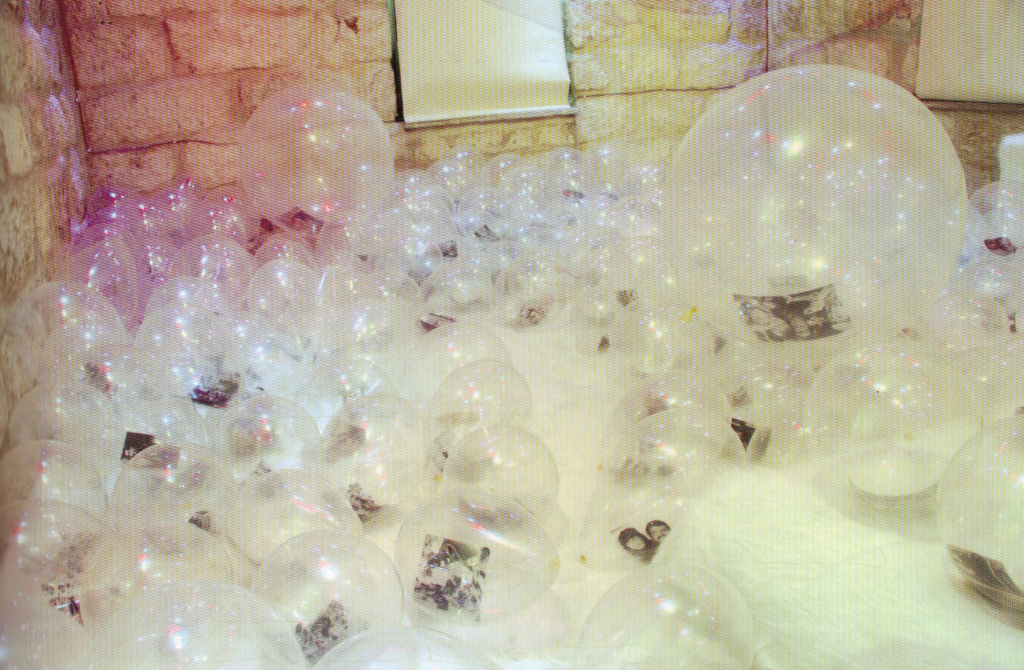
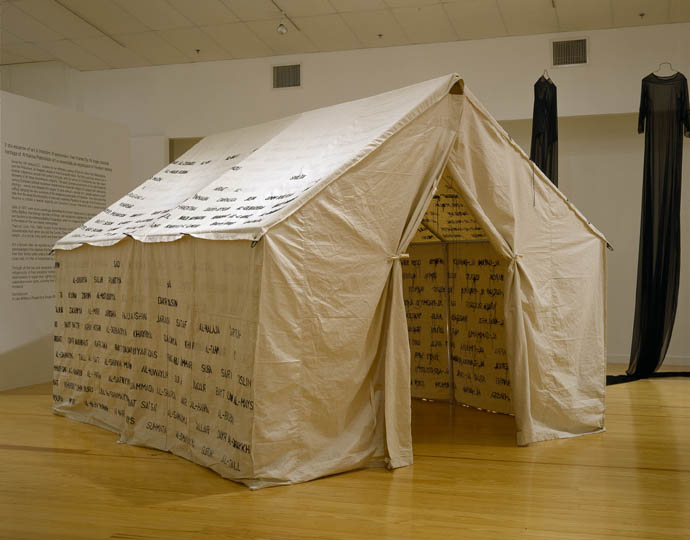
Emily Jacir (born 1970), a rising star in the international art world, creates around the shared historical memory of Palestine—the "Monument to 418 Palestinian Villages"—presenting a simple canvas tent in a refugee camp, embroidered with the names of 418 villages destroyed by Israeli expansionism since 1967. Rana Bishara (born 1971) presents moral-aesthetic object installations in a semi-realistic and semi-dreamlike manner titled "Homage to Children." In a closed space, crude children’s beds are covered with large and small transparent balloons, each containing black-and-white photos of children and mothers in refugee camps, echoing light lullaby music, referring to the desolate plight of women and children in this endless conflict. Khalil Rabah (born 1961) excels at manipulating photos, videos, and objects, with recurring themes revolving around displacement and repositioning, identity, and historical background. For example, the work "Palestine Air," longing for freedom, is constructed between personal history and collective consciousness.
Metaphors of Reality – Photo-Images: Taysir Batniji (born 1966) moves between photos and video, approaching conceptual exploration, such as the series "Military Observation Posts." It presents Israeli tall concrete cylindrical observation posts surrounding the Gaza border, referring to the realistic life situations and violence of Palestinians. Fawzy Emrany (born 1968) creates photo-environmental spatial installations, pointing to bodily construction and referential combat. Steve Sabella (born 1975) excels in digital images; through repeated construction of several images, he sensibly expresses the displaced and wandering state of mind in poetry and imagination. Rula Halawani (born 1964) uses photo-images to describe various occupations under Israeli expansionism, focusing on the teasing and humiliation suffered by Palestinians in daily life, depicting the national situation under continuous colonization. Noel Jabbour (born 1970) uses documentary photos to narrate the daily life situations of refugees and unusual Palestinian rural scenery, expressing a sense of existence. Raeda Jumana Abboud (born 1971) attempts to convey an artistic behavior and attitude through simple object-photo combinations. Raeda Saadeh (born 1977) uses personal performance-photos to present the consciousness of occupation under this archetypal social form, metaphorically displaying cruel historical realities, occupation, and violation under Israeli expansionism. Sandi Jabbour (born 1973) is not only an artist but also a Palestinian revolutionary warrior, using his photographic works as spaces for combative resistance. He depicts the daily life situations of women in refugee camps through documentary video, showing that existence itself is combat, and women become the most solid essence of the nation-state’s survival. Rula Halawani (born 1964) uses photo-images to describe various occupations under Israeli expansionism, focusing on the teasing and humiliation suffered by Palestinians in daily life, depicting the national situation under continuous colonization.
Metaphorical Reality – Video Art: Sherif Waked (born 1964) uses the metaphorical theme "Pretty Points" in video to present a series of handsome Palestinian men wearing fashionable, cut-out clothes walking in a show, satirizing how Palestinians crossing border military checkpoints must expose their chests and backs to be forcibly checked for weapons or bombs, resembling an unusual insult and humiliation. Suha Shoman (born 1944) created the remarkable video monument "Bayyaratina - My Grandfather Loved Our Land - My Mother Loved Our Land - We Love Our Land," exploring issues of land invasion and occupation throughout history, because land is like a common place and memory for displaced people. Larissa Sansour (born 1975) excels in digital photos and video. In the video series "Space Exile," she lands on the moon, plants the Palestinian flag, and then lets it drift away in the universe until it disappears, poetically and imaginatively presenting the disillusionment of the Palestinian state-building dream. Mohammed Al-Hawajri (born 1976) is the most representative video artist of the younger generation. His dramatic work "Children Playing with Fire" metaphorically depicts the context of continuous warfare, where children become future warriors under the consciousness of combat.
Palestinian contemporary art is like a comprehensive state of empathizing with or witnessing these indelible personal experiences and collective disaster memories. It transforms this cruel historical reality and politics into aesthetics that soothe the soul. Palestinian painter Samia Halaby said: "Palestine is an epic material trace of objective exploration, seemingly where you look, no one asks you, push open the door, there exists a material as great art."
Note: "Overview of Palestinian Contemporary Art" was exhibited at the Arab Cultural Center (IMA) in Paris from June 23 to November 22.