Picasso (Pablo Picasso) - Neoclassical Period
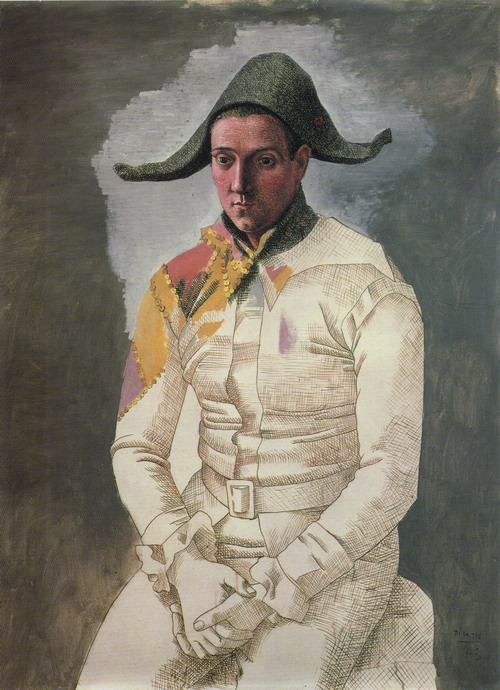
Seated Clown 130x97 cm, Musée national Picasso-Paris collection
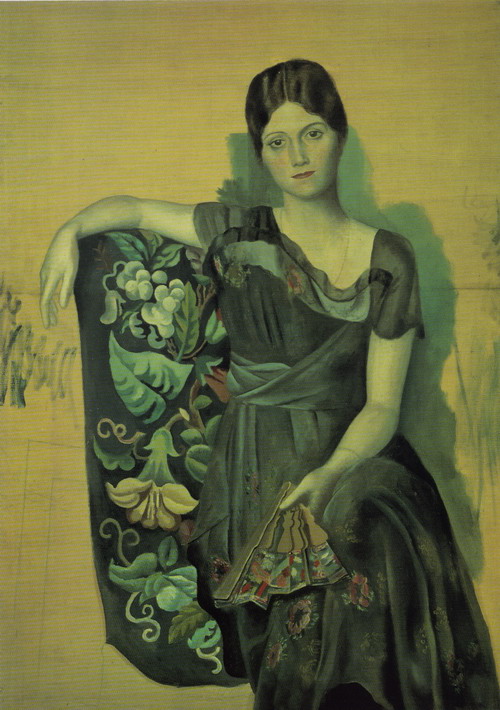
Kiki de Montparnasse, 130x88.8cm, 1917, Musée national Picasso-Paris collection. During World War I, Picasso's second wife, Eva, died of tuberculosis. Invited by the poet Apollinaire, Picasso traveled to Rome in 1917, immersing himself in ancient Greek and Roman civilizations. He designed sets and costumes for the Russian Ballet's Parade, where he met the troupe's ballerina Kiki de Montparnasse (his third wife). The following year, he returned to Paris and married her. Her happiness gave Picasso new momentum. Returning to the solid rules of classical art, his "Neoclassical Period" began with works like Kiki on a Sofa (1917). Other notable works include Woman Seated (1920), Reading a Letter (1921), Three Women at the Spring (1921), and Boy with Pan Flutes (1923).
Living in a world of happiness, Picasso's son Paul was born to Kiki in 1921. The Neoclassical period concluded with the 1924 portrait of young Paul dressed as a clown.
Kiki de Montparnasse on a Sofa: In 1917, Picasso traveled to Rome to design sets and costumes for the Russian Ballet (photographs of these materials can be seen in a small exhibition room). Fully immersed in ancient Greek and Roman civilizations, he also met the dancer Kiki. This work clearly returns to painting order, under Ingres's neoclassical method and classical idealist aesthetics. She wears an elegant dress, holds a fan, and sits on a floral-patterned sofa. The portrait lacks three-dimensionality; it is quite flat, seemingly pasted on, with no spatial depth (Doesn't the floral fabric of the sofa look pasted on?). There are only slight shadows, creating a slight illusion of volume on Kiki's face and neck. The background is sketched hastily. Clearly, this work is unfinished—it marks the beginning of Neoclassicism. Notably, if you compare this with photographs of Kiki on a sofa, you will find the answer (Picasso borrowed the image from photos).
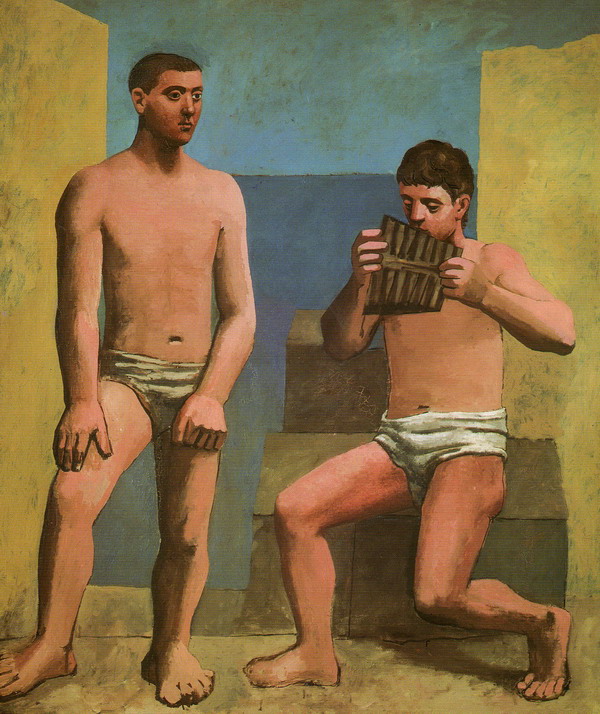
Boy with Pan Flutes: Another masterpiece of Neoclassicism. Two shirtless young men are depicted: one sits on steps playing pan flutes intently, while the other stands beside him, looking away indifferently. The background seems to be a calm blue coast under bright sunlight, with little shadow (only some near the left foot). Picasso places the two youths within a geometric setting and vertical, parallel architectural structures, using the rhythm of their curves to soften the composition, presenting a sturdy and powerful neoclassical geometric construction.