Picasso (Pablo Picasso) - "Guernica" and the Second World War Period
Picasso's masterpiece, Guernica, 349.3x776.6cm, 1937, collection of the Reina Sofía Museum, Madrid. In 1936, through interactions with surrealist poets, Picasso met his fifth wife, Dora. The young Dora evoked memories of Spanish women in Picasso. Throughout his life, he naively, casually, and romant
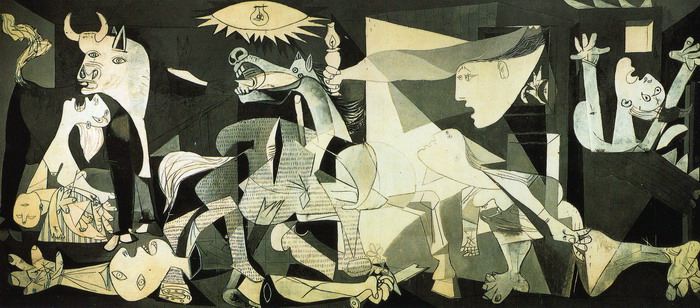
Picasso's masterpiece, Guernica, 349.3x776.6cm, 1937, collection of the Reina Sofía Museum, Madrid. In 1936, through interactions with surrealist poets, Picasso met his fifth wife, Dora. The young Dora evoked memories of Spanish women in Picasso. Throughout his life, he naively, casually, and romantically played the role of a great lover (and great painter). When the tragedy of the Spanish Civil War stained Picasso's homeland with blood, it stirred a latent expressive nature within him, leading to the creation of the world-renowned Guernica (1937). Picasso wrote: "Painting is not made to decorate apartments; it is an instrument of war for attack and defense against the enemy." During this period, nourished by love, a delighted Picasso produced numerous sensitive, warm, and richly colored portraits such as Lovers, The Beloved, Daughter, Marie-Thérèse with Hat (1937), Portrait of Dora (1937), and Maya Holding a Doll (1937). However, beginning the Seated Woman series (1937–1944), ugly yet charming, especially with its distorted limbs, seemed to foreshadow the coming human tragedy. The shadow of the Second World War loomed over the eve of the storm; in the artist's sensitive mind, bloody violence was displayed, as reflected in works like Cat Eating a Bird (1939) or Weeping Peasant Woman (1938). In 1939, the Museum of Modern Art in New York held a major retrospective of Picasso. Shortly after, when the war broke out, Picasso joined the French Communist Party from a humanitarian standpoint.