Picasso - Mannerism
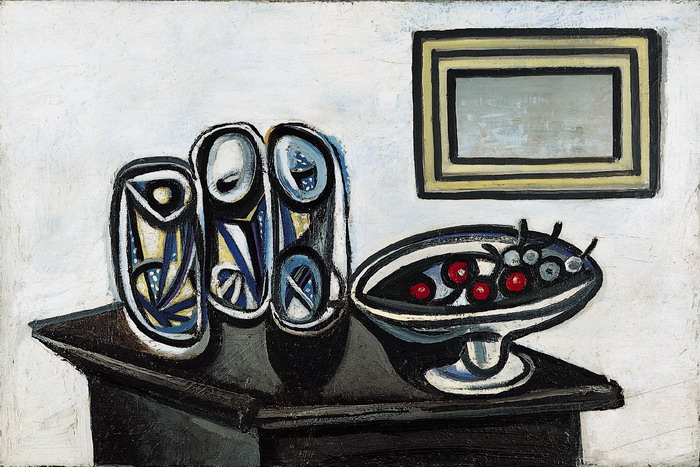
Still Life with Cherries, 53x80cm, 1940-41, Saint-Etienne Museum Collection
In 1945, introduced by the poet Max Jacob, Picasso met his sixth wife, Francoise Gilot. Picasso romantically said, "You (Gilot) are the only woman I have never touched; you are a window for me." Thus, in 1946, Picasso and Gilot left Paris and settled on the Côte d'Azur. There, they coincidentally met Suzanne and Georges Mirande, heads of a ceramics workshop, which led Picasso to create ceramics during this period. The following year, the young Gilot gave birth to their son Claude. In 1949, she gave birth to their daughter Paloma, enriching Picasso's artistic creation further. His innocent and lively children became the subjects of his work.
After the war, Picasso devoted himself to developing three-dimensional Cubist sculpture. With his skillful hands and keen mind, he turned the mundane into the miraculous. Lifelike works such as The Sheep (1950), Pregnant Woman (1950–1959), Little Girl with a Jump Rope (1950), and Monkey and Its Child (1951) were created. For the freedom he had regained, Picasso painted a series of Peace Doves (1949).
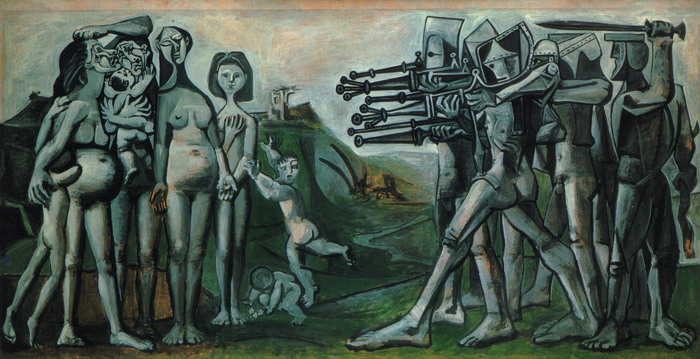
Having experienced two World Wars and the Cold War era, Picasso stated, "I do not paint war because I am not a painter of that subject... But undeniably, war exists in my paintings. Perhaps later, a historian will argue that my painting changed under the influence of war." After Guernica, based on his care for humanity and from a humanitarian standpoint, Picasso condemned the tragedy, terror, despair, and destruction of war, expressing his political views again in The Korean Massacre (1951). Interpreted through a Cubist lens within Goya's pictorial form, the following year he created two large murals, War and Peace, for the Vallauris church.
The Korean Massacre: From a humanitarian standpoint, Picasso painted several Korean Massacre works; this is one of them. Following Guernica, Picasso once again engaged politically. Through his provocative, tradition-defying depiction style, he presented this tragic and desperate war. Here, Picasso borrowed the theme of Goya's The Third of May 1808. Like Goya, he depicted the unpredictable machinery of war, armored troops massacring a group of innocent women and babies. Especially in these distorted faces, fear and unease are revealed. A helpless mother tightly embraces her child (their hope), standing amidst desolate ruins plundered and destroyed. Between the two opposing large groups on the left and right, a slaughter unfolds, deeply hiding an extreme tension (violence).