Lu Ren-Yang Solo Exhibition "Mirage Universe - A Vast Modern Journey of the Spirit"
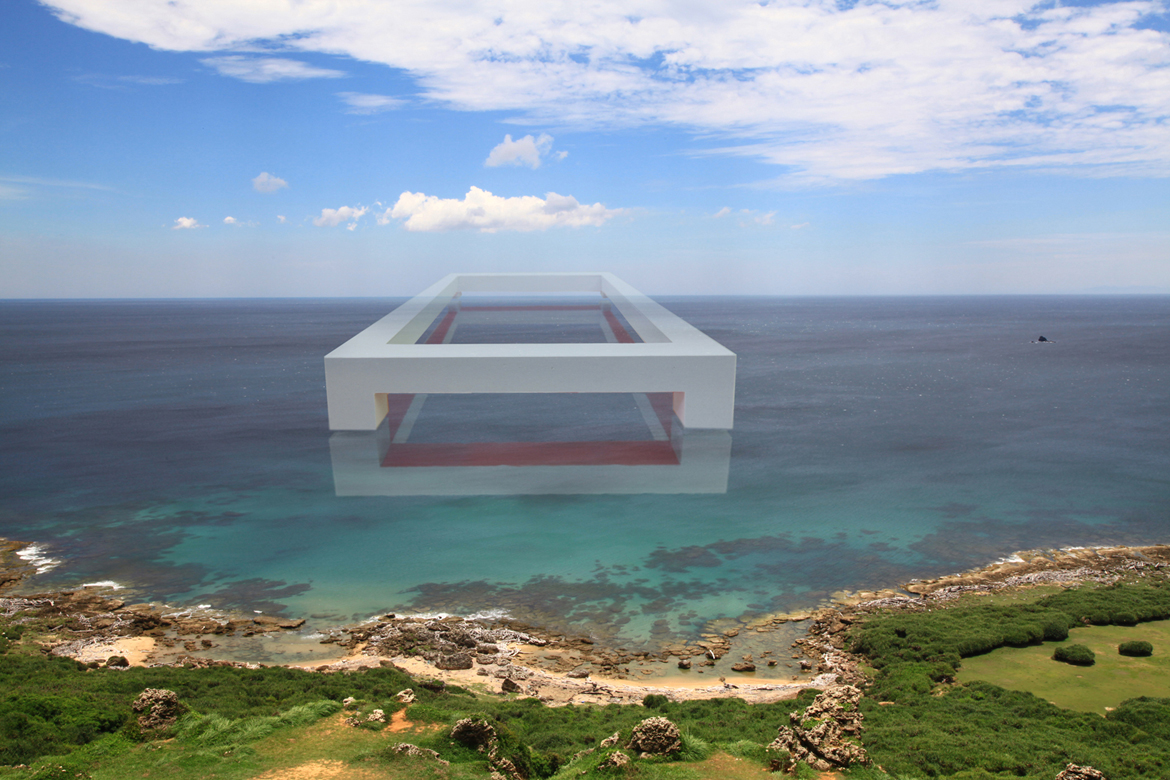
Mirage Universe Work No. F-1113 Digital Image 2010

Venue: Department of Fine Arts, Huafan University Exhibition Dates: December 27, 2010 to January 2, 2011 Text by Lu Ren-Yang
During my time studying in France, one year I traveled with the student association to the south of France. On the calm, windless, deep blue sea surface, the sea appeared bottomless, as if continuously deepening its saturation; that was the Côte d'Azur. I remember after returning to Paris, I always wanted to create a work about a spiritual journey to the Côte d'Azur. I tried many techniques but none succeeded, so the matter was set aside, though I kept it in mind. After returning to my home country, I experienced the impact of the rapid spread of the information revolution, and the progressive advancement and popularization of audiovisual technology. I felt the unfinished work from that year had a chance of being realized. Coincidentally, a colleague who was also teaching part-time at a university with me was skilled in these techniques. So I took out the slides I had taken that year and photos of models I had made, and asked him to operate according to my ideas to complete it. That was my first work related to "Mirage Universe".
In the past year, I felt the relevant conditions were gradually maturing, and I was determined to improve some issues and overcome some difficulties (transitioning from early 35mm camera use to full-frame digital cameras, obtaining a motorcycle license for long journeys, self-studying related techniques to master digital compositing), intending to take full control in producing a series of works. The above pertains only to overcoming technical aspects. My ambition in creating this series is to, from a modern perspective, imbue the ancient concept of "spiritual journey" with new meaning, and through the lens and simple digital technology, not only achieve the "lens" surpassing the brush, but even pursue the "lens" simultaneously capturing both scene and state of mind.
It was natural for ancients to think about "the brush being able to capture the scene". However, in contemporary times, what can capture the scene is not limited to the brush; it is merely a tool. The one who captures the scene is the person, it lies with the artist's taste, propositions, and choices. With the advent of the digital age, the "lens" can surpass the brush, and can even pursue capturing both scene and state. Although the impact of digital technology is unstoppable, much like the revolutionary influence of Meng Tian's invention of the brush in its time, these are, after all, natural products of their era. While insisting that painting is the so-called correct path may seem pedantic and narrow, debating whether computers or photography can replace painting, or whether painting is dead, is actually not very meaningful. That is merely a kind of benign obsession to highlight the propositions of artists or critics. Ultimately, we must return to the person themselves; that is, what does the artist discover through these media? What do they want to say? What do they want to explore? Is it new vocabulary? Is it pioneering? Does it truly have substance?
Apart from being a natural fit for my disposition, the creative tools I choose also aim, in this exhibition, to pursue connections and dialogues with some traditional values through the development of new vocabulary and techniques, attempting to revitalize and regenerate visual experience and meaning.
Science and Allusion: The "Mirage Universe" series transforms from the so-called mirage. Although modern science explains it as a virtual image illusion formed by the refraction of light reflected from objects on Earth through uneven atmospheric density, and mirages are closely related to geographic location, geophysical conditions, and the specific weather at certain places and times, the content of this special phenomenon is not only thought-provoking but also rich in poetic and dreamlike qualities. Thus, since ancient times, mirages have been endowed with much mystery. Although interpretations differ between East and West, in Western mythology, the mirage is the embodiment of evil spirits or an ominous sign. In China, legends say that Qin Shi Huang and Emperor Wu of Han sent people to Penglai to seek the fairyland and elixirs precisely because mysterious scenes often appeared there. These legends or stories seem to be passed on from here to there like mirages themselves, gaining narrative tension through the winding refraction of time and space.
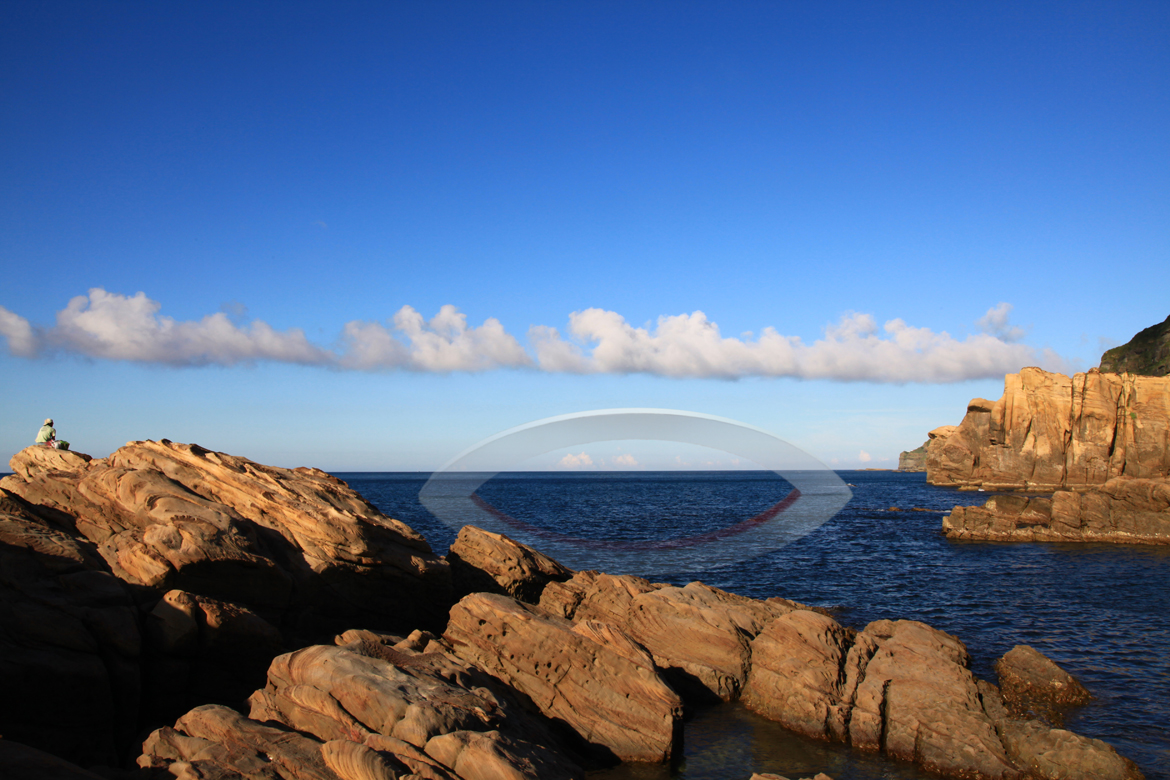
From Visible Prototype to Invisible Prototype: In this series of works, regarding the model part, the production method is as follows: In my studio, I created a series of three-dimensional geometric forms, some with perspective illusion shapes (appearing large and deep in photos). Their lower edges were carefully pasted with red Cutting Sheet (the Chinese transliteration for "Cutting Sheet", this material's scientific name is Vinyl), then placed on a mirror surface, thus merging into a new form. This fusion is a "heterogeneous fusion". Here I might add: the visual and semantic effect of photographing the reflection of a handmade model on a mirror surface is completely different from using computer flipping techniques. Then, I selected an appropriate angle to photograph it, followed by computer editing, compositing, and some technical processing. Thus, during the process of manipulation and contemplation, my state of mind also traveled from my studio, crossing time and space, embarking on a mirage-like spiritual journey.
Whenever I look back at a photo of the Côte d'Azur scenery I took back then, I feel a yearning for a spiritual journey. As time passes, I don't know if I can revisit the Côte d'Azur, but in fact, from before and after completing the first "Mirage Universe" work with the Côte d'Azur as background, each viewing is a kind of reading, also a spiritual journey, and each time the state of mind is different. They can be connected to form a subtle spiritual field. This spiritual journey is actually a common experience shared among us. It has a kind of "prototype" psychology. For example, around us, we often hear people promise to revisit a place someday. Perhaps it is realized, but is it truly without regret? Is it so perfectly wonderful? When people decide to revisit, they actually still carry the mental imprint from before to verify again. Maybe the result is additive and satisfying, but times change, and sometimes revisiting the old dream creates a great disparity. Therefore, sometimes maintaining anticipation or a wish can instead be a motivation, even a kind of aesthetic beauty. This spatiotemporal distance has the evidence of memory; it makes people fascinated and yearn for it. Just as Jung believed in the incredible power exhibited by the collective unconscious, which can traverse the tunnel of historical time, break geographical and cultural barriers, soar in the sky like a bird with wings, and swim leisurely in the sea like a fish. We know that the so-called archetype theory is the key cornerstone of Jung's doctrine, and this "archetype" is a universal mental pattern. "The deepest layer of the human psyche he [Jung] called the 'collective unconscious', and believed its content synthesizes universally existing patterns and forces, called 'archetypes' and 'instincts' respectively... Everyone possesses the same archetypes and instincts; one can only find individual characteristics in other parts of the personality." [Note 1] Therefore, the "archetype" issue involved in the "Mirage Universe" series has its universal "universal" aspect and individual "particular" aspect, possessing both visible and invisible duality.
Spatiotemporal Transformation of the Spiritual Journey: Through the modern spiritual journey conducted via my proposed "Mirage Universe", it aims to penetrate not only spatiotemporal limitations but also attempt to form an expansive spiritual journey field through continuous connections between past and present points. Whenever I create a work, the three-dimensional forms I made earlier are like my avatars. Through compositing with the landscape photos I recorded, their encounter involves, in terms of the model, sometimes custom-fitting, for example, how to make the 3D model correspond and connect with certain scenes within the landscape. Sometimes it is a two-way permutation and combination, for instance, combining images of the same prototype shot from different angles with the same location; or combining images of different prototypes with the same location; or combining images of the same prototype with different locations. Thus, from the space of my studio to the scenic location, a line is drawn. From here to there, from small to large, from near to far, from narrow to vast, from finite to infinite, from reality to imagination, from experience to meditation, a spiritually complex journey of revisiting old places unfolds.
Having a Well-Thought-Out Plan and Vastness: Actually, when we appreciate ancient Chinese landscape paintings, like Guo Xi's "Early Spring" from the Northern Song dynasty, or Fan Kuan's "Travelers among Mountains and Streams", the so-called "scattered perspective" is actually a kind of "having a well-thought-out plan" by the artists, a projection of their spiritual journey onto the mountains and rivers. This is like what Chen Yao Zui said: "Establish ten thousand images in the chest, transmit a thousand years through the brush" [Note 2], and what Tang Zhiji of the Ming dynasty also said in "Subtleties of Painting" in the section on the nature of landscapes: "The nature of the natural mountain is my nature, the sentiment of the mountain is my sentiment, ... the nature of natural water is my nature, the sentiment of water is my sentiment". [Note 3] This process comes from long-term familiarity through observing mountains and rivers, possessing the broad-mindedness and state of mind to "internalize" the landscape. However, regarding this point, its background has the conditions of an agricultural society's pace. As modern people of the 21st century, the time and space are completely different. When discussing the attitude towards landscapes, it is impossible and unnecessary to repeat that "internalization through long-term observation and familiarity". It should be admired but not replicated. Under the disappearance of those past conditions, facing natural scenes, if one wants to address the issue of "internalizing" landscapes, its meaning should be vastly different. What my "Mirage Universe" series seeks to trace is the immense sense of the "realm" that the ancients led us into through spiritual journey and meditation. "This 'realm' comes and goes from the author's broad-mindedness, and also moves back and forth through the viewer's spiritual wandering, resonating with the author's 'realm'..." [Note 4] This is also a kind of connection from here to there, and a continuously extending link. Regarding this, the French philosopher Gaston Bachelard said: "Its core is a world. The miniaturized deformation radiates towards the various dimensions of a universe. Once again, immensity is contained within the minute." [Note 5] This "minute" can be an individual's broad-mindedness, or the "mirage" that appears in my works, namely the three-dimensional forms.
Bachelard also said: "One might say that immensity is a philosophical category of daydream. Daydream undoubtedly feeds on all kinds of sights, but through a natural tendency, it contemplates grandeur. This meditation on grandeur forms a very special attitude, a state of soul different from others; daydream transports the dreamer outside the immediate world to a world marked by the infinite." [Note 6] Here, the "daydream" Bachelard refers to can meditate precisely through its spreading power, constantly growing, accumulating, fermenting, and thus achieving vastness. On the coordinates of time, it performs a multi-dimensional connection to achieve a sense of immensity, even a limitless field. In this series of works, I attempt through digital image processing not only to achieve a realistic yet illusory fusion in the image, but also to guide me in spiritually revisiting old dreams through mental methods, even roaming in the imagination of phantom seascapes, proposing a new interpretation of the so-called spatial spiritual journey. That is, like "Mirage Universe", the connection produced under special locations and conditions leads to a kind of infinite expansion in the state of mind. This is the level at which the meaning of "Mirage Universe" is greatly different from a mere mirage.
Human affairs hold infinite beautiful scenes. Many accidents and coincidences may spark surprises and unexpected outcomes. Many seemingly ordinary scenes actually contain much imagination and possibility. "To see a world in a grain of sand, And a heaven in a wild flower" also contains another kind of spiritual journey within the microcosm. Bachelard also said: "Like countless other poets, this poet sits behind a windowpane dreaming his dream. But he discovers a tiny deformation in the glass, and he spreads this deformation throughout the world." [Note 7] And the Ming dynasty's Tang Zhiji also said, "The difficulty with landscapes lies within the space of a foot." [Note 8] So, this should not only be the difficulty of spatial composition, but also includes the back-and-forth of spiritual transformation. Therefore, the concept "Mirage Universe" wants to convey can be seen as within a small space, or taken as a vast world; it always lies in this back-and-forth spiritual exchange!
Notes: [Note 1] Murray Stein, translated by Zhu Kanru, Jung's Map of the Soul, Taipei County, Lixu Culture, 1999, p.113. [Note 2] Classified Anthology of Chinese Painting Theory, Heluo Book Publishing, 1975, Taipei, p.737. [Note 3] Ibid., p.738. [Note 4] Lu Ren-Yang, Shadow "Picture" Follows My Body, Taipei County Government Cultural Affairs Bureau, 2006, p.4. [Note 5] Gaston Bachelard, translated by Gong Zhuojun, Wang Jinghui, The Poetics of Space, Taipei, Teacher Chang Publishing, 2003, p.249. [Note 6] Ibid., p.279. [Note 7] Gaston Bachelard, translated by Gong Zhuojun, Wang Jinghui, The Poetics of Space, Taipei, Teacher Chang Publishing, 2003, p.248. [Note 8] Classified Anthology of Chinese Painting Theory, Heluo Book Publishing, 1975, Taipei, p.733.