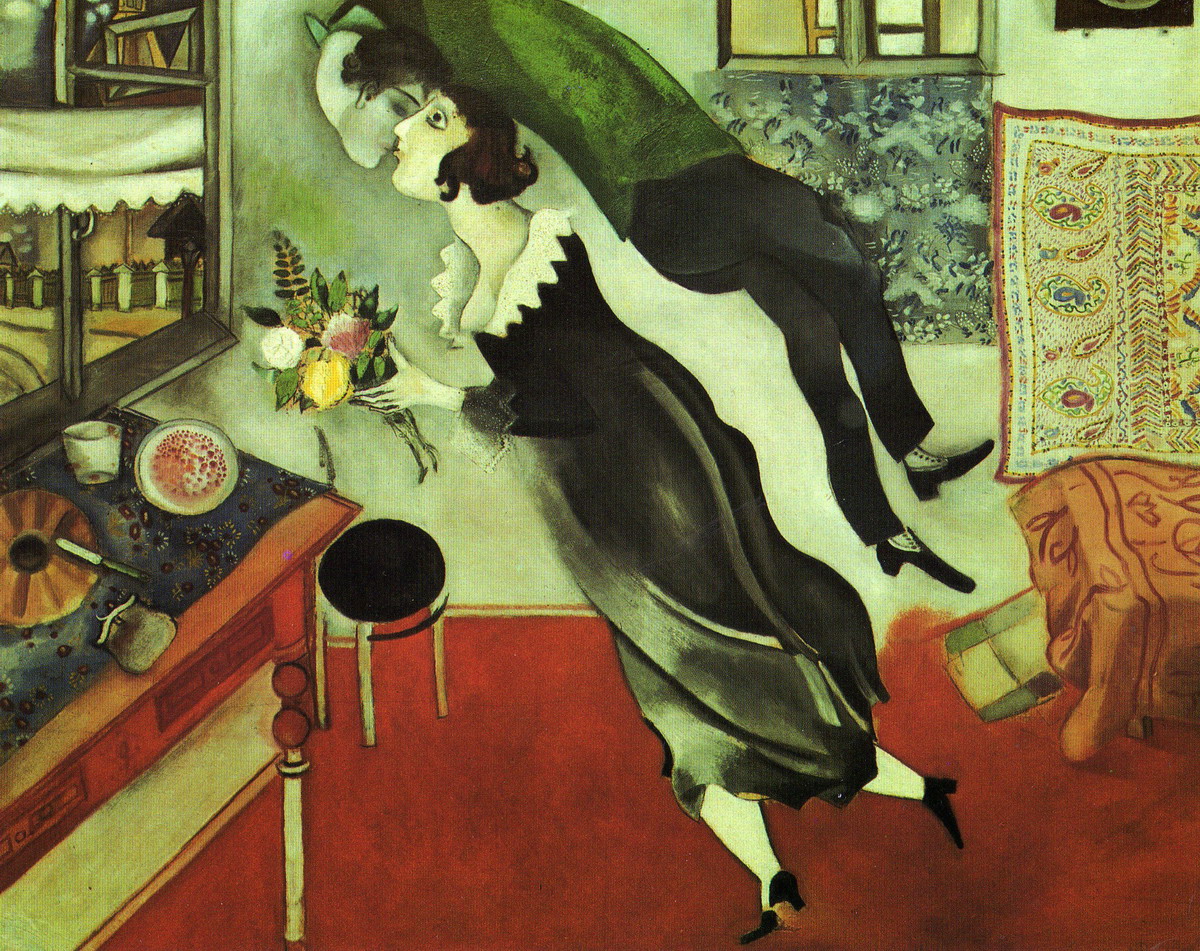
The Artist and His Fiancée with the Village
The Artist and His Fiancée with the Village 191x150cm 1911 MoMA, New York
There is a unique way to approach painting and color. What it reveals is extremely important: his palette. — Marc Chagall (M. Chagall, 1887–1985)
Marc Chagall was a Russian-born painter and one of the most representative figures of the Paris School. His work is highly lyrical, filled with dreamlike and poetic imagery. All his creative inspiration stems from distant memories of Russian folk art, Jewish traditions, and childhood. He once said: "If my art does not depict any role in my parents' lives, conversely, their lives and their creations profoundly influenced my art."
Chagall’s entire body of work is rooted in life. He wrote: "My work is my life itself, a practice of living, moving onto the canvas." Life events are expressed through painting; it is the confession of his existence. Arriving in Paris in 1910, he was quickly influenced by Cubism, as seen clearly in works from 1911–1913. Yet Chagall remained faithful to himself, particularly in his mastery of color style. He stated: "Overthrowing naturalism, Impressionism, and the realism of Cubists... our madness comes at the right time! A baptism of atonement. A complete revolution, but not merely superficial."
Chagall explored another reality, one that was lyrically irrational. He presented an extraordinary concept of individual space, using non-realist colors and arbitrary logic freed from constraints, praising fluid rules. He was neither a symbolist nor "fantastic"; Chagall rejected such labels: "Do not call me fantastic. On the contrary, I am a realist, because I love the earth."
Memories of the Russian landscape, biographical elements, and events of his era are mixed into Chagall’s works, varying by each phase. These childhood memories often appear when recalling the small village of Vitebsk, visible in numerous paintings between 1910 and 1914, or upon his return in 1914. One finds narrow streets lined with houses and fences, pointed churches, and villagers: rabbis, news vendors, etc.
In The Artist and His Fiancée with the Village, the painter and his fiancée are depicted floating like a dream in an interior space, sharing a kiss. The fiancée holds a vibrant bouquet, while the artist floats above, kissing her. The room is filled with decorative arrangements. Through the window on the right, a strange peasant scene appears, hovering between dream and reality—a nostalgic sentiment. The entire painting exudes a joyful atmosphere, revealing a meaning of full happiness within the artist’s state of mind.