Liang Meiping’s Solo Exhibition “Hong Kong Made” of Social Iconography
[Beima Gallery] Liang Meiping solo exhibition advertisement draft
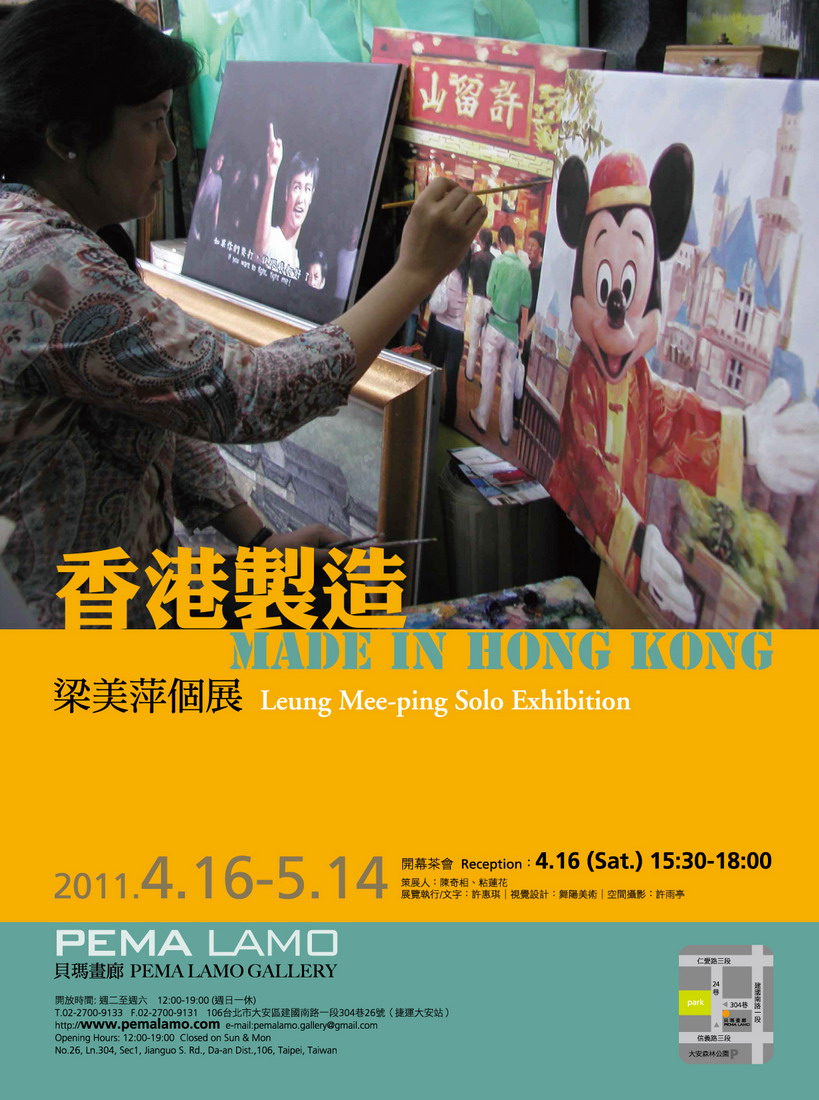
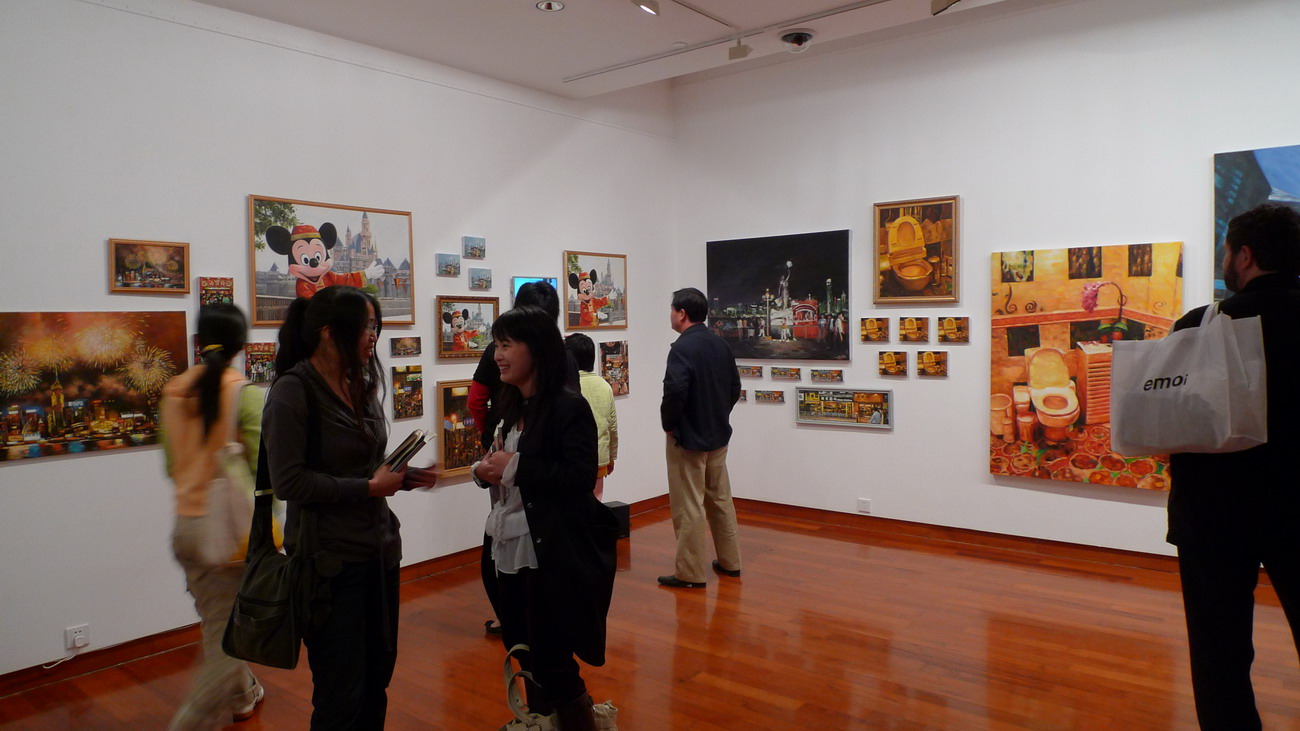
Text and images by Chen Chi-Hsiang. Venue: Taipei Beima Gallery. Dates: April 16 to May 14. Curators: Chen Chi-Hsiang and Nian Lianhua. Text: Chen Chi-Hsiang. In this globalized world, local differences have become a unique cultural value and taste. In an era where the creative industry thrives, locally made products serve as certification of quality production and sales, and as a brand. Liang Meiping’s “Hong Kong Made” intentionally highlights the characteristics and cultural style of Hong Kong’s urban life itself. The Oriental Pearl, “Hong Kong,” due to its past British colonial history, formed a unique international cultural metropolis. Before 1997, it played a pivotal role for the two sides of the strait and the three regions. It was also the most international or globalized financial and commercial metropolis among them. Although direct links between the two sides now exist, it remains an indispensable block in the world’s global finance and production-sales transit.
The Oriental Pearl has its special commercial and cultural landscape. After Hong Kong’s return to the motherland in 1997, it became part of China’s territory, transforming from an overseas region into the mainland. Relations between the Special Administrative Region and the mainland became closer. Regardless of politics, economy, and finance, under decolonization, Chinese became the dominant official local language, forming a new cultural landscape. Naturally, the Hong Kong SAR attracted the mainland middle class, tycoons, and business groups to visit. The Oriental Pearl became a space for mainlanders to enjoy Western capitalism and breathe free air. It is the mainlanders’ top choice for sightseeing, shopping paradise, and luxurious consumption venues, as well as their global hub for investment and trade transit. Although Hong Kong does not have particularly eye-catching historical sites or sacred places, it is a paradise for eating, drinking, playing, and reveling, and a city for leisure and pleasure. In recent years, the number of mainland tourists, both organized groups and independent travelers, has grown year by year, surpassing tourists from all over the world. Hong Kong’s unique international commercial metropolis has become a preferred pilgrimage site for mainlanders.
Exploration of Cultural Phenomena: Many contemporary artists no longer paint, or cannot paint anymore; more accurately, they no longer need to paint (in fact, there are more ways to convey messages). Of course, everyone’s purpose for learning to paint is different. Meiping learned to paint out of personal strong curiosity and need. As a commodity painting to deeply understand the current Hong Kong tourism culture phenomenon, she further uses the imitation of commodity painting forms or images as a basis for two-dimensional painting creation, intending to recreate the alternative value and meaning of commodity paintings. Meiping is an artist with strong personal insights and unique viewpoints. One day, whimsically and impulsively, she picked up her brush again to fulfill a wish, began painting, satisfied her motivation to paint, quenched her desire to paint, and gained alternative creative inspiration and the concept of imitating commodity paintings from studying Hong Kong’s export paintings.
To get to the root of the phenomenon of local cultural image consumption in Hong Kong and delve into the core of commodity paintings, she personally used weekends or holidays to go to the hometown of the world’s most famous export paintings, Dafen Village, to study art. This renowned painting village is located in Shenzhen, adjacent to Hong Kong, serving as a foothold for Hong Kong and international foreign merchants, and as a leading area of China’s economic industry. More than 80 percent of the world’s export paintings come from Dafen Village, making it an internationally known painting village, possessing highly skilled technicians and painters from all over China.
Meiping went to Dafen Village with curiosity and a spirit of exploration, secretly taking a master at a certain studio, formally started painting, began to explore, from canvas, brushes, colors, mixing, form, color, composition, and images, etc., under the guidance of her concepts, she copied pictures she carefully selected in the form of commodity paintings. She painted seriously without any ambiguity, entering the realm of copying paintings, personally painting imitation paintings with a sense of the times, while also recording a unique creative (or manufacturing) method of an era through video. This alternative mimism is also a reflection of the current knock-off culture. Knock-offs have become the reality of global political economy and culture, permeating the consumer society of the Third World. Knock-offs seem to have more value and significance than originals.
As an artist, Meiping clearly understood the subtleties and quickly sorted out the core and concepts of imitation painting creation. The content of this series of imitated commodity paintings depends entirely on the artist’s concepts, carefully selected pictures and images, which are not only typical but also possess social significance and signs. Unlike the export paintings currently available in the Hong Kong market, which remain stuck in nostalgic old scenes of Hong Kong sailing boats from the 1970s and 1980s of the British colonial period, and street scene impressions with Eastern flavors, these works are all commissioned and manufactured by the painting village. However, the size and quantity are entirely determined by the artist. Ironically, the artist also participated in the collective production anonymously in this batch of works. Thus, without deliberately distinguishing, under the same manufacturing form, none were signed. Finally, at the request of collectors, to ensure collectors’ certification of the work’s value, she had to sign her name on the back of the paintings. This seems to contradict the intent of the works. Is imitating commodity paintings creation? Or another type of knock-off? Between individual and collective, concept and manufacturing, art and non-art, export paintings and art paintings, artworks and non-artworks.
Meiping’s clear intention is to peel back the layers and extract the global-local cultural connotations of Hong Kong from these iconic images of mass-produced imitation commodity paintings, and to propose new viewpoints. The artist said: “In today’s 21st century, I went to Shenzhen to learn to paint commodity paintings, researching and ‘producing.’ I use the impressionistic scenic spot consumption of mainlanders visiting Hong Kong as the creative text, managed by Hong Kong, produced in Shenzhen, reinterpreting the new Hong Kong commodity picture.”
Painting and Not Painting = Manufacturing = Concept: Hong Kong signifies Meiping’s cultural identity and local product value certification. Manufacturing reveals quantified production, standardization, industrialization, and commercialization. Manufacturing implies self-production or outsourcing, handmade or factory mechanical manufacturing. Today, factories in developing countries have almost all moved abroad, and many products adopt overseas-world factory production and manufacturing to reduce costs. Meiping’s “Hong Kong Made” series of paintings purely carries typical Hong Kong tourism cultural images, entrusted to the Shenzhen world export painting factory-Dafen Village for production, under handicraft and creative manufacturing. Here, the works involve the relationship between the artist painting and not painting. The artist’s participation can be conceptual or procedural. Painting or not painting no longer constitutes a problem because manufacturing is a process, production is a fact, and thought is the core driver.
“Hong Kong Made” is conceptual, indicating that these works prefer to form unique expressive power, stating, depicting, anecdotal, or visual elements. They show that their ideological core lies in those rules, symbols, and languages. “Hong Kong Made” here involves a procedure table for expression, defined in advance. Production is a subsequent matter because manufacturing can be done by oneself or entrusted to others. Conceptual artist Lawrence Weiner clearly pointed out three methods of presenting (conceptual art) in the American magazine New Art in 1968: First, the artist directly realizes his work. Second, the work can be realized by others. Third, the work does not necessarily have to be realized. Minimalist artist Sol LeWitt defined conceptual art as follows: “When an artist uses a conceptual form, obviously what is involved is a procedure table, because decisions are made in advance, production will not be an important matter, that is, before considering visual realization, these linguistic factors definitely occupy their dominant position and logic.” He believed: “A concept is a machine that makes art.” Or “Once the concept of an artwork is established and final decisions are formed, things must follow their progress. Of course, some results may be unforeseen by art. The concept is regarded as the artistic work, opening other possible directions.”
Two Major Series of “Hong Kong Made”: The typical Hong Kong metropolitan tourism “commodity painting” series (works from 2007) and the simulated Western classical “still life” series (works from 2011) are both produced in a quantified manner using export painting methods. The intention is to explore the transformation of another emerging tourism culture phenomenon after Hong Kong’s return to China in 1997, elaborating on the material beliefs of the mainland middle class, conveying a succession of narrative and iconic visual consumption images. The works have strong irony, humor, and critique of the current mainland visual consumption and superficial tourism appearance culture. Under the same manufacturing (creation) form, the biggest sign of these two major series is the popular, consumer-oriented, vulgar, and superficial pop imagery suitable for the masses, presenting the current mass cultural signs of Hong Kong.
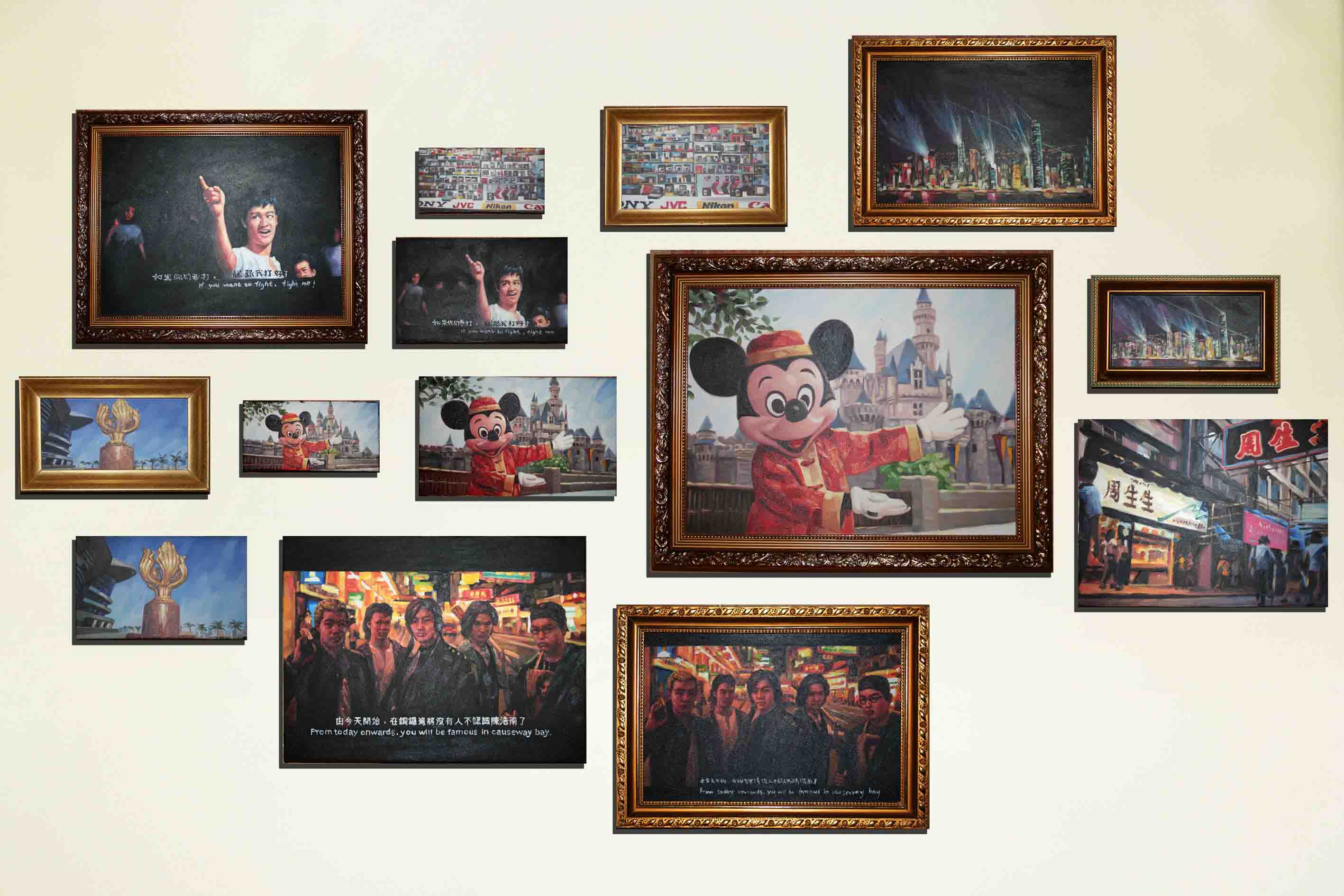
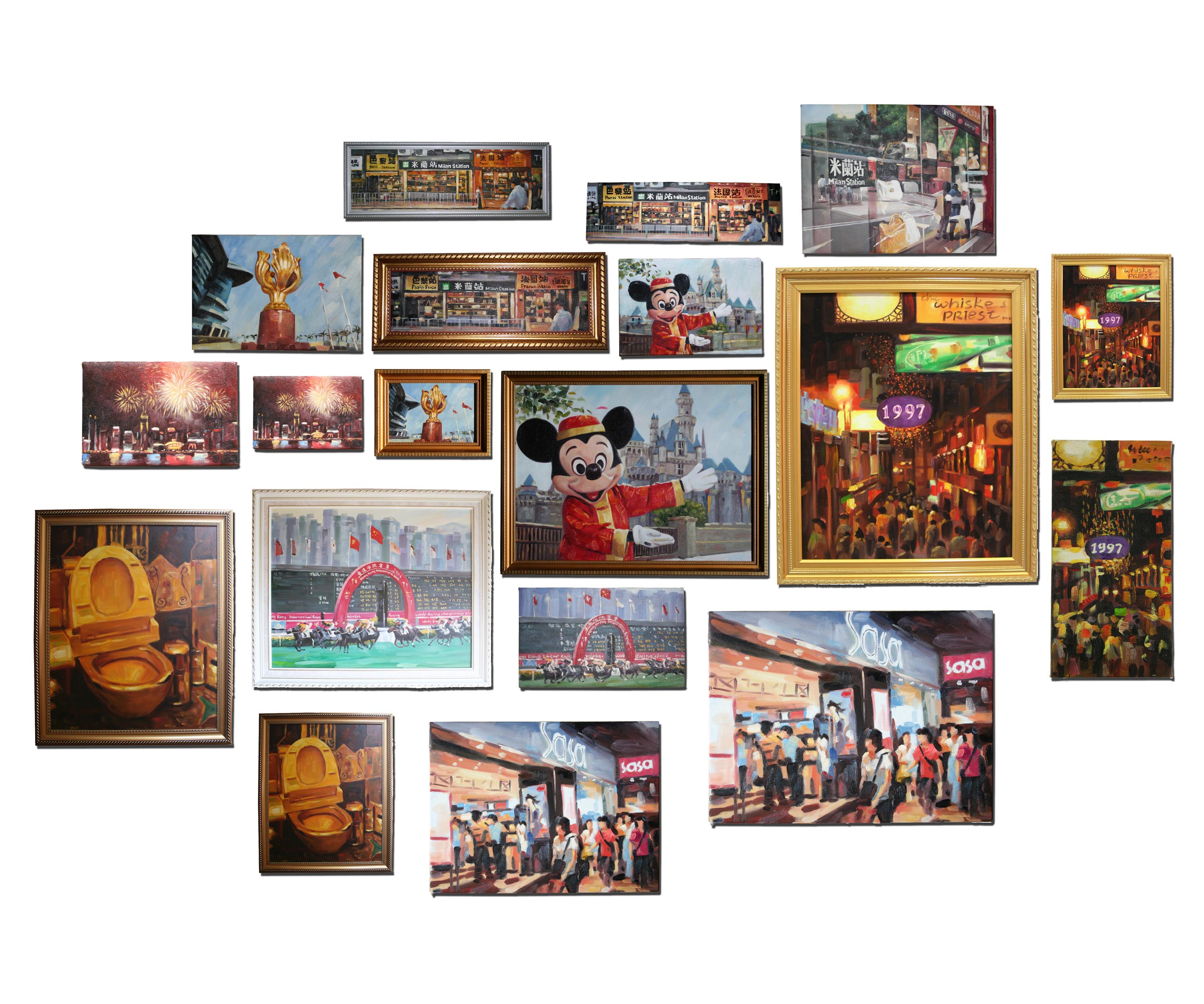
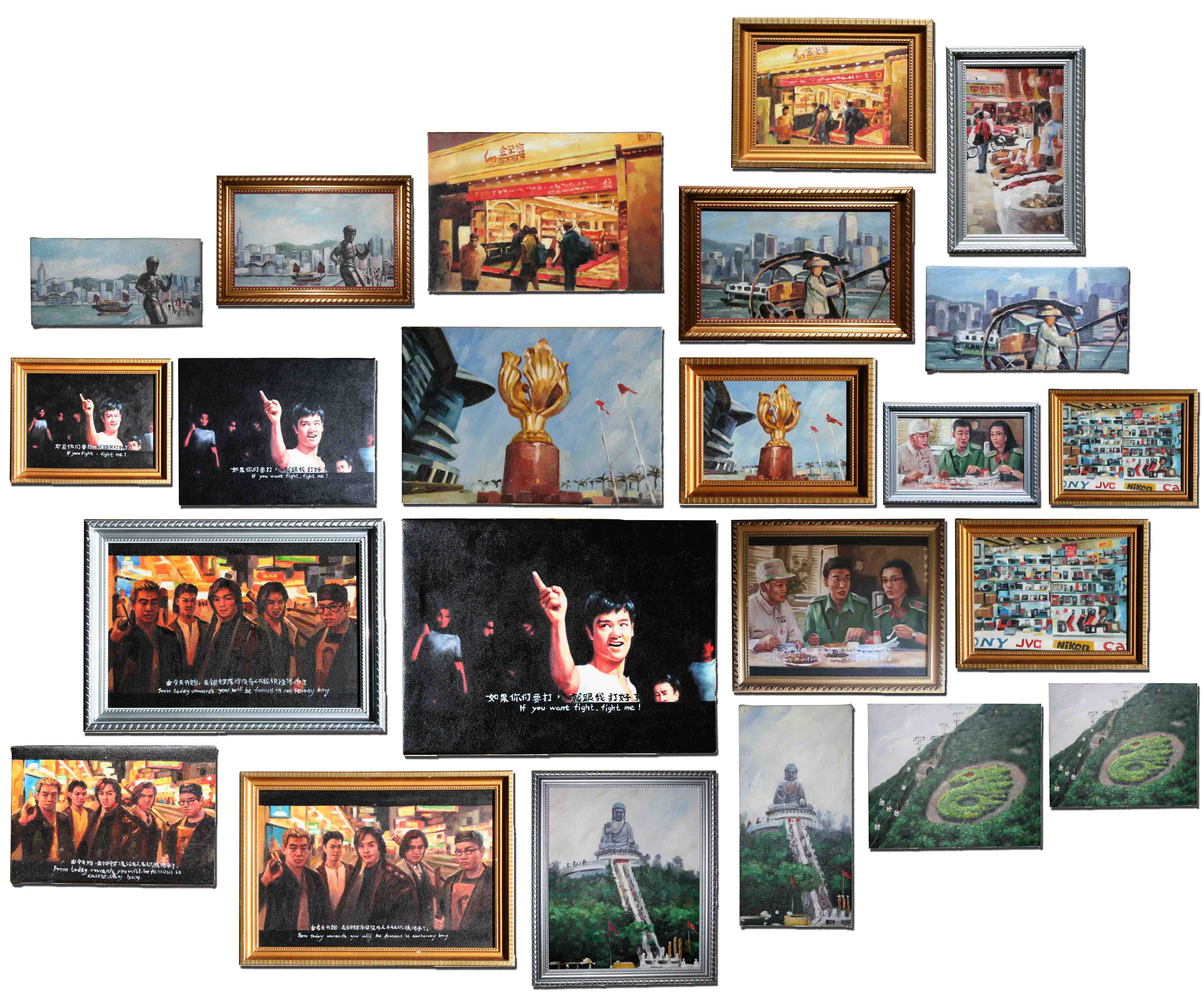
First, the “commodity painting” series uses Hong Kong scenic spots, most popular with mainlanders after the 1997 return, as content, depicting the tourist image chronicle of the typical Hong Kong metropolitan impression: such as street scenes marking the 1997 return, colorful and brilliant fireworks shows on the harbor shore, the charming starlight night view of Victoria Harbour, the scenery of the promenade along the harbor shore, the branded commercial streets of the international metropolis of Hong Kong, typical houseboats, Mickey Mouse and Disneyland, typical Chinese kung fu films-Wu Xing “Bruce Lee” portraits, Hong Kong’s famous horse racing, Hong Kong gangster movie images-black society legends, Hong Kong’s Golden Bauhinia Square with red flags and golden monuments, giant Buddha statues, knock-off branded stores, Hong Kong’s dazzling duty-free shops for cameras and camcorders, and golden toilets, etc.
The all-encompassing “commodity painting” series, under figurative painting, emphasizes form, emotional color, and structure, using several unique Hong Kong image vocabularies, quantified replication, and through flexible changes in various sizes, framed and unframed configurations. Framed ones are specially paired with vulgar gold or silver frames, highlighting their vulgarity. Some images also come from dialogues in typical Hong Kong movies, such as “If you want to fight, fight me” in the Bruce Lee portrait or “From today on, no one in Causeway Bay will not know Chan Ho Nam” in the gangster movie script. Quoting Hong Kong martial arts and gangster movies strengthens their anecdotal nature, pointing out typical Hong Kong impressions and cultural memories, local emotions and scents, and showing the prosperity of the metropolis. So, beneath these typical beautiful visual consumption appearances, what social truths are hidden? Only Hong Kong people know best.
Second, the Western classical “still life” series full of metaphors is Meiping’s new work, continuing to borrow the mimism method of “commodity paintings” to pile up Western art history’s “still life” with Chinese-style luxurious food: that is, by replacing the Western still lifes in the painting with elements such as abalone, sea mushrooms, shark fin, cordyceps, ginseng, and famous wines from various parts of China, using the dazzling classical still life mode of the West. If not paying attention, it is impossible to distinguish whether it is Eastern or Western still life. The calm classical realist description, contrasting colors, rigorous composition, faithful realistic scenes, emphasizing the texture, volume, and mass of materials, confusing form and content, creates an alternative knock-off still life, proposing a postmodern unique hybrid cultural iconography picture book, and a global-local cultural consumption viewpoint, akin to the taste of Chinese food eaten Western-style or Western food eaten Chinese-style.
“Still life” in Western art history was born in the 16th century and developed in the 17th century. Meiping’s Western classical “still life” series simulates 17th-century Northern European still lifes. Still life is a product of prosperous society, symbolizing the luxury and noble lifestyle arrangements of ancient royal relatives or wealthy families in society. Today, the extravagant and luxurious lives of mainland officials and tycoons are often heard of. The arrogant banquets and arrangements of wealthy families openly proclaim their material wealth, revealing worldly trends and human nature. Hong Kong’s Manchu-Han Imperial Feast is a perfect example. The artist uses still life to depict material metaphors of glory and wealth, and points to how people treat wealth and understand ethical attitudes. Whether export paintings or imitated commodity paintings, regardless of their artistic value or cultural significance, in the eyes of tourists, besides having commemorative value for tourism, they also have decorative value. Paul Zumthor wrote: “A painting is like a piece of furniture; it cannot be replaced arbitrarily. One function of furniture is to cover the unpleasant bare parts in the room.”