The Magic Mirror’s Reflection Ascends to Heaven: Chen Chi-Hsiang’s Solo Exhibition "Original Image as Appearance"
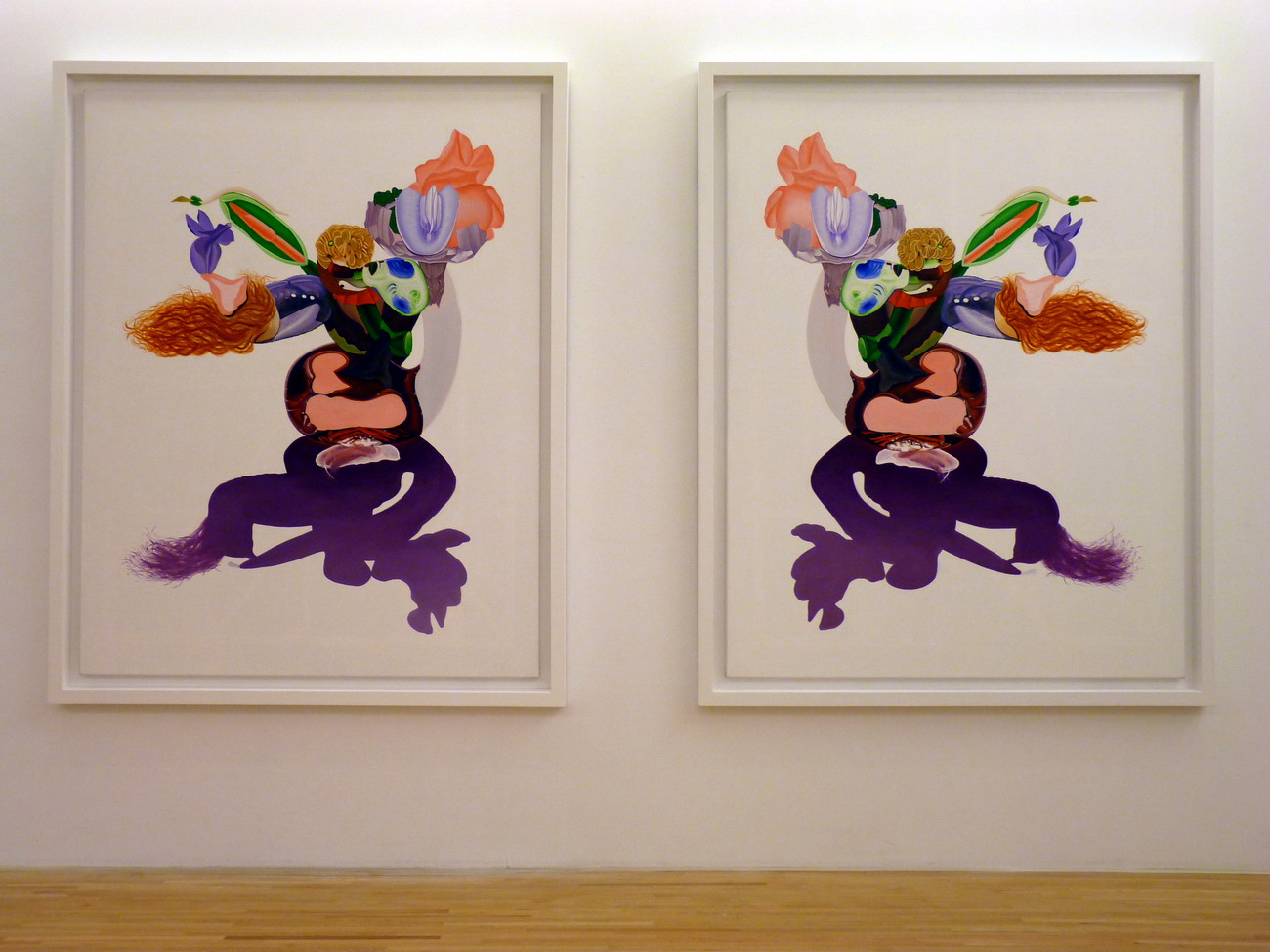
Series "Like Mirror-Like Realm" Nos. 11-12, each 44.8x57.4 inches Acrylic on canvas 2010


Text / Fang Hsiu-Yun (Natalia S. Y. Fang)
Artist Chen Chi-Hsiang (1956–), born in Fangliao Township, Pingtung County, graduated from the Fine Arts Department of the National College of Arts and Crafts (now Taiwan University of the Arts), then went to France for artistic creation and research, receiving training at the Louvre Art Institute in Paris. In his thirty-plus-year career, he has become an expert in horticulture, European postmodern art, and contemporary art, authored more than ten books, and conducted in-depth observations of current globalized art trends and cultural creativity movements, continuously writing articles, curating exhibitions, and giving lectures; moreover, he himself paints and creates installation art, thinking while creating, producing several series such as Observing the Mind, Surveying the Realm (1988–91), Surveying the Mirror, Observing the Mind (2005–6), Mirror Flowers, Water Moon (2008), Spring Dream—Non-Dream (2009), Realm—Original Homeland (2008–9), Original Image as Appearance (2008–11), Like Mirror—Like Realm (2009–10), and Dream within a Dream (2010–11). These belong to aesthetics and philosophy, and are also the results of his observation of the "original images" of the vast world.
Unexpected Encounters Chen Chi-Hsiang’s works frequently feature objects such as branches, candles, stones, flower petals, dry bones, spoons, rice, fruit shells, hair strands… Things so unrelated are intertwined and placed illogically, with bizarre shapes and unnatural tones, pieced together, wandering between figurative and abstract. At first glance, some resemble biological mutations, others seem like abnormal cell proliferation. The artist leads us into a world that is both ethereal and grotesque, elusive and hard to digest.
These everyday items, theoretically familiar, produce the opposite effect after his manipulation. Looking at his works, we seem to experience a succession of dreamlike and illusory scene shifts, lingering there yet confused, so "familiarity" and "strangeness" occur simultaneously, rising inexplicably—not calm, but disturbing factors wriggling.
He guides us into Sigmund Freud’s (1856–1939) psychology to explore and understand the proposition of "familiar" (heimlich) and "unfamiliar" (unheimlich), stating:
We know the word "familiar" is ambiguous, belonging to two sets of ideas: one is knowing and pleasant; the other is hidden and invisible. They are very different but not contradictory.
A seemingly paradoxical concept emerges. In the Oxford English Dictionary, Freud also found the word "canny," which not only means "cosy" but also "endowed with occult or magical powers." Finally, he concluded this unclear vocabulary:
Therefore, "familiar" refers to the coexistence of positive and negative emotions, until it eventually aligns with the opposing "unfamiliar."
Indeed, Chen Chi-Hsiang’s art embodies this intellectual concept. No wonder his works subtly emit a peculiar magic that makes people linger. Naturally, this reminds me of a quote by the 19th-century Uruguayan-French poet Comte de Lautréamont: "As beautiful as the chance meeting of a sewing machine and an umbrella on a dissecting table!"
Creation Begins with Romance Yes, we are drawn in by the magic. But what catalyst lies behind the works? What constitutes his visual imagination, aesthetic attitude, and thematic exploration? So I asked him about his earliest childhood memory. He said:
My earliest childhood memory is flying kites. Not only making kites myself and painting on them, such as Nezha or dragons, running freely in rural villages and nature, having a joyful childhood. Additionally, at night, I often counted stars under the moonlit sky, listening to my father tell folk tales, such as those of Liao Tianding.
Flying kites, painting on them, watching stars and the moon at night, listening to dad’s stories—this sequence of memories marks his first life experience, which is full of romance. A child growing up in a village, roaming heaven and earth, where nature became his aesthetic immersion. His kites were not bought ready-made but made with effort; he painted patterns of Nezha or dragons on them. Without any coercion, he engaged in handicrafts. If asked when his creative impulse arose, it can actually be traced back to when he was six years old!
Dragon on the Kite At a young age, his range was limited, but fortunately, he had kites. Pulling that long, far-reaching string, he could "roam the sky and look down upon the human world." To him, its significance was great, symbolizing the pursuit of freedom. Later, he studied in Taipei, furthered his education in Paris, loved traveling everywhere, and loved unconstrained imagination. If not for the initial pull of the kite, how could he fly so far and so high today!
The inspiration for drawing kites came from picture books and temple fairs. The subjects he intuitively thought of were none other than Nezha and dragons. Speaking of dragons, they are fabricated animals, covered in fish scales, with four clawed feet, whiskers by the mouth, and horns on the head. Viewing Chen Chi-Hsiang’s paintings, especially in lines and pattern outlines, the imagery of dragons clearly emerges, such as crouching, bending, stretching, or dancing. There, no limp tendencies or traces appear; all are displays of strength, power, and character. This narrates his courage and personality in creation.
Incarnation of Nezha And Nezha? This character from Journey to the West and Investiture of the Gods, reincarnated from the Spirit Pearl, is the third child of Li Jing (Li Tianwang, the Pagoda-Bearing Heavenly King). Named Nezha the Third Prince, he was born looking like a ball of flesh, resembling a monster. As he grew up, once playing in the East Sea, he killed the Dragon King’s child. To avoid implicating his family, he cut his flesh to return to his mother and removed his bones to return to his father, finally committing suicide. However, his master Taiyi Zhenren used lotus leaves and lotus roots to create a new body for him, thus reborn. Afterwards, he was taken in by the Jade Emperor as a loyal guard, wielding greater energy and stronger power, subduing demons from ninety-six caves, and was ordered to go to Huaguo Mountain to tame the arrogant Sun Wukong. During battle, Nezha transformed into three heads and six arms, fighting over thirty times, but Sun Wukong, using petty tactics, ambushed Nezha, injuring his left arm. Although Sun Wukong won, Nezha’s martial arts were superior, his conduct upright, and his loyalty and righteousness praiseworthy! Once again, he fought the One-Horned Rhinoceros King, using his Wind Fire Wheels to trap the bull demon’s horn, while Li Jing used a Demon-Revealing Mirror, finally subduing this monstrous demon.
Looking at Chen Chi-Hsiang’s paintings, I found myself immersed in Nezha’s battles, with various poses of skill usage, such as playful, flattering, waving, bold strokes, three heads and six arms… appearances (Figure 1). The artist uses various aesthetic elements desperately to find spiritual and mental outlets for chaotic art, just as Nezha uses Wind Fire Wheels, Universe Rings, Chaos Ribbons, Fire-tipped Spears, Golden Bricks for Immortals, Nine-Dragon Divine Fire Shields, and leopard skin bags… weapons, to strike against arrogant and evil forces. Inevitably, scenes of violence, madness, blood, and anger appear in the paintings.
However, after the storm, tranquility and pure beauty emerge. Rationality and sensibility meet here. All decay finds redemption and sublimation. He does this to pave the way for his aesthetic view, as he says: "Within rationality lies sensibility and intuition, approaching the spiritual world of spirituality."
The Eternal Magic Mirror Counting stars under the moonlit sky at night, listening to his father tell folk tales—this warm image remains forever in Chen Chi-Hsiang’s heart. Just as Li Jing took out a Demon-Revealing Mirror to help his son subdue the bull demon, the artist’s father also handed him a "magic mirror" during his childhood. Since then, he has guarded and cherished it. This is why he uses this mirror in every work, putting it to good use, because through it, he has found the original appearance (image) of all things.
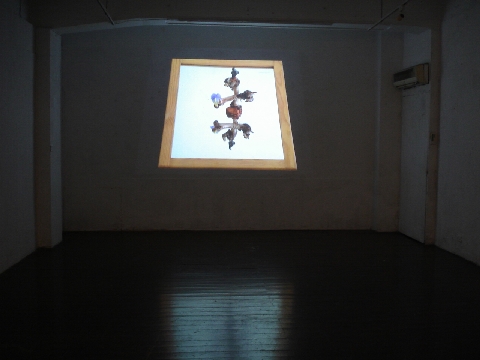
Observing the Mind, Surveying the Realm (Figure 2) is a spatial installation of a diptych. Black and red cloths are placed right and left, with white and black rice on each. Food is the priority of the people; "rice" is a staple food. For Chinese people, nothing is more real than this. Using it as a medium to express material appearance is most appropriate. Here, the two sides form a contrast, as if the magic mirror is set in the center. Which is real? Which is illusory? We can no longer distinguish, as he says:
In the phenomenal world of reality, the virtual and real heavens and earth, the recognizable or unrecognizable, the understandable or incomprehensible, the tangible and intangible (gases and liquids), the visible and invisible, the imaginable or unimaginable, the perceptible and imperceptible.
In the Surveying the Mirror, Observing the Mind series (Figure 3), he places mirrors directly, putting real objects on top. Mirror images are thus formed. Symmetrical from top to bottom, but the upper part is touchable, while the lower part can only be seen. Such unequal feelings are immediately compared.
In Mirror Flowers, Water Moon (Figure 4), if a horizontal line is drawn in the center, one will also discover that the top and bottom appear symmetrical but slightly different. After flipping left or right, they become double pairs. And in Spring Dream—Non-Dream (Figure 5), it expresses the relationship between objects and shadows. At this time, light elements are added, with shadow variations showing gradient effects. In Realm—Original Homeland (Figure 6), the top and bottom present different patterns, colors, and saturations. After flipping and major changes, the result is another different work. And in Original Image as Appearance (Figure 7), the images above and below are very different, seeming unrelated; in Like Mirror—Like Realm (Figure 8), inside and outside the frame, due to the mischief of spoons, break through human visual perception; in Dream within a Dream (Figure 9), the relative relationship of top and bottom is located at the front center of a giant object, with short black shadows on the ground. Although we cannot see mirrors in these series, whether top/bottom and left/right are relative becomes another glimpse into aesthetics.
The magic mirror seems extracted, yet hides invisible power, whether weak or stubborn, it continues to manifest there. Do his achievements not fully explain the so-called "Original image has no form, original appearance is empty form, nothingness is strange, without emptiness there is no form, the myriad phenomena of the great universe are all original images (appearances)"?
Rebirth of Aesthetics Taiyi Zhenren bestowed lotus leaves and roots, reviving Nezha. Do the petals and branches here symbolize the artist’s aesthetic rebirth? Do the bones he paints carry the meaning of Nezha returning bones to his father? Is it an expression of gratitude to his father? (Figure 10)
In short, I witnessed that side of the artist’s magic mirror, but absolutely did not see Narcissus from Greek mythology fascinated by his own reflection in water and falling in love with himself. On the contrary, since the age of six, the artist has carried a magic mirror wherever he goes. Relying on it, he sincerely looks at himself, faces himself, and through it, observes the myriad phenomena of the great universe, reflecting the true or original appearance (image) of things.
Is this not like the Demon-Revealing Mirror held by Nezha the Third Prince? As the master of the magic mirror, Chen Chi-Hsiang retains that innocent heart in the future, continuing to bring order to humanity and life in an era of change and turmoil, drawing out countless fantastic images, and then, through projection, enlightenment, and purification, finally ascending.
Gradual Ascension Speaking of this, I still remember a passage from an email he wrote in November 2010:
Life shines because of love. I often say Doing what you like Brings you closer to God. Love allows people to go deep. Love allows people to shine.
These words touch upon his faith in art. Whatever he does, he always harbors love. Thus, when we immerse ourselves in his works, we seem to hear Vaughan Williams’ (1872–1958) The Lark Ascending. Spirituality and soul gradually ascend, slowly approaching heaven.