Ye Zhu Sheng - The Inner Sanctum of Painting: "Awakening the Mind, Creating Realms" Solo Exhibition
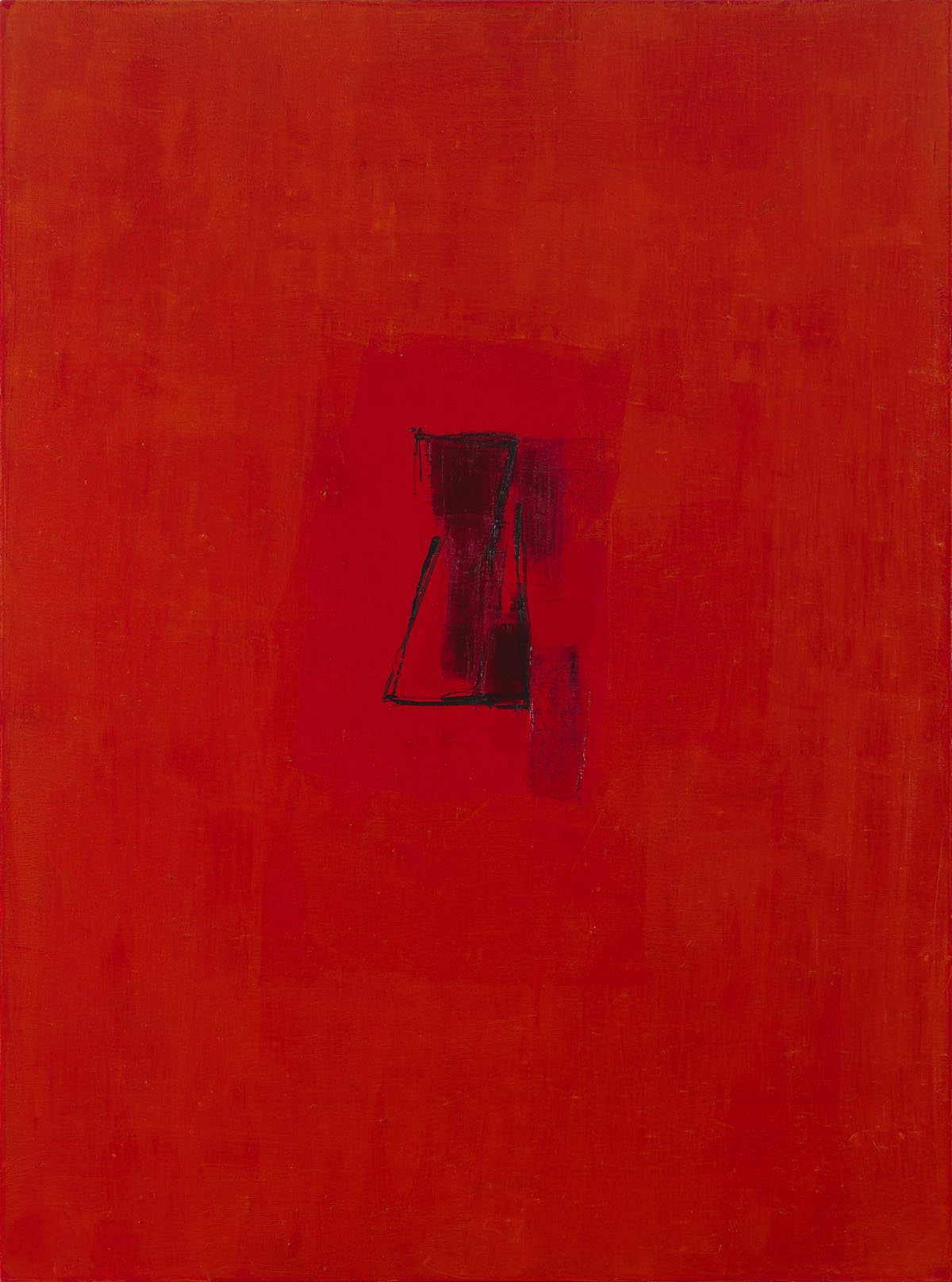
"Spiritual Environmental Protection 61," 97x130cm, oil on canvas, 2011. Bewitching pink, full of energy, evoking a spirituality within the tranquility.
"We really have no creation. We only borrow and recreate." Henry Miller (Note 1)
Text by Chen Chi-Hsiang
Foreword: Taiwan's artistic development has largely taken shape under the resonance and reaction to the grand currents of Western art. Abstract painting was transplanted from the evolution of Western abstract art, grounded in local experimental development, and internalized into new fruits and flowers of the local context. Taiwanese abstraction is divided into two major systems. The first is built upon Chinese cultural traditions, such as the Oriental and May Painters groups of the 1960s, who followed Li Zhongsheng’s artistic philosophy to enlighten themselves with Western modern art. Through an Eastern aesthetic perspective, they created cultural differences, aiming to distinguish themselves from Western modernist abstract schemas and spirit. Another tendency follows the international abstract style, exemplified by Lin Shouyu, Chen Zhengxiong, or Ye Zhu Sheng. All possess rich cross-cultural experiences, fully integrating into Western artistic trends while creating unique personal artistic vocabularies and styles against the backdrop of their Eastern cultural context. Taiwanese abstraction has never become mainstream or a trend, nor does it have obvious north-south perspectives; it consists only of individual particularities and differences.
Abstract painting generally falls into two major systems: subjective lyricism—sensibility, where Ye Zhu Sheng is one of the representative figures of sensibility-based abstract expression; and mathematical structure—rationality, with Lin Shouyu’s limit art being the most distinctive. Additionally, post-modern and post-post-modern generations explore hybrid abstractions through cross-disciplinary fusion, such as Xue Baoxia. This generation mostly includes painters living overseas, particularly in New York like Yang Shiming or Paris like You Kewen, as well as those with rich cross-cultural experiences like Qu Deyi, Chen Shengsong, and Zhang Zhengren. They operate between sensibility and rationality, order and disorder, matter and spirit, awareness and consciousness, lyricism and expression. Clearly, Taiwanese abstract art tends toward Eastern sensibility and lyrical expression, while pure rational geometric abstraction becomes rare.
The true development of Taiwanese abstract painting originated from artists returning to Taiwan in the early 1980s, such as Lin Shouyu from the UK or Zhuang Pu and Ye Zhu Sheng from Spain. This occurred under social conditions like the arrival of the museum era (e.g., Taipei Fine Arts Museum in 1983) and the eve of political martial law lifting. Guided by Lin Shouyu’s (returning in 1982) exploration of localized abstract and spatial experiments, contemporary Taiwanese artistic concepts were enlightened and horizons expanded. This laid out an unprecedented trend and influence for abstract art development in Taiwan, deriving diverse abstract orientations known as "abstract aesthetic narratives" (Note 2) from the internalization and localization of Western abstract painting experiments, transforming the diverse appearance and possibilities of local abstract art.
Ye Zhu Sheng – Leader of Sensibility-Based Abstract Art: Taiwanese contemporary art has a unique connection with Spain. Around the 1980s, three artists who studied in Spain returned home: Chen Shih-Ming, Zhuang Pu, and Ye Zhu Sheng. They brought back three different creative routes and perspectives: Chen Shih-Ming’s fine drawing, broad Western artistic viewpoints, and life attitude towards art; Zhuang Pu’s limit art, conceptual art, and explorations of diverse spatial experiments; and Ye Zhu Sheng’s post-Dadaist material and medium exploration, along with localized experimental development. These had a connecting past and future influence on artistic discussions after Taiwan’s liberalization, opening up more diverse and varied local appearances and topics.
Ye Zhu Sheng (returned to Taiwan in 1982) settled in southern Taiwan, Kaohsiung. Returning to his roots, he began to deeply investigate his environment and cultural origins, intending to create forms and content belonging to this land. Through his experimentation, internalization, and transformation of multiple materials and mediums, as well as his inclusive attitude towards art, he exerted a decisive influence on young painters in southern Taiwan, acting as an enlightenment catalyst that opened a new era for material and abstract painting development in the region.
Born in 1946, Ye Zhu Sheng is Taiwan’s most active abstract painter and a leader in sensibility-based expressive abstract art. For over thirty years, he has tirelessly expanded new fields of abstract expressionist painting with a pioneering spirit. From early post-Dadaism to current lyrical abstract expression, through experiments with material mediums, he explores inner mental images, imagery, and abstraction, expanding their possibilities. In this vast expressive space, the artist continuously opens up the inner sanctum of painting through subjective consciousness. Awakening from the autonomous consciousness of southern Taiwan, Ye reflected on the politics and environment corresponding to his existence, grounding himself in local thinking. Through the liberation of inner consciousness, he freely galloped with his imagination, discovering mental images or subconscious imagery deep within the soul. His expressive creations produced a unique painting vocabulary full of tension and energy, becoming a groundbreaking style and paradigm in the Taiwanese art world. French critic Marcelin Pleynet wrote: "Painting, transformed by its materialists, will produce an object of perception, fully expressing the intelligence of at least these material forces. Thus! The artist works objectively within historical facts." (Note 3)
The Inner Sanctum of Painting "Awakening the Mind, Creating Realms": Realms are born from the mind; meaning shifts with the realm. Everything is created by the mind. Among all phenomena, inside and outside images—material objects, figurative, non-figurative, mental images, strange visions, imagery, abstraction—all are but images representing the inner sanctum of painting. "Awakening the mind" serves as the painter’s free will and autonomous consciousness in creation, constructing various situations and fields to strike the essence of the soul. Awakening the mind implies pointing directly to the inner spirit or echoes from the depths of the soul. Through subjective consciousness and instinct, the painter awakens all possible forms between the subconscious and conscious, intuitively expressing colors. Realms transform into the universe and heaven and earth, revealing the mysteries of life. Painter Mondrian wrote: "Inner life and its powerful, active forces determine artistic form. When art expresses the immaterial, art has only one meaning, because only thus can art give humanity the possibility of transcending itself." (Note 4)
Ye Zhu Sheng’s solo exhibition "Awakening the Mind, Creating Realms" presents new works, continuing the "Spiritual Environmental Protection" series. Within this series, freehand writing, the internalization of mental images, and imagery echoing from the depths of the soul, or metaphysical abstract vocabularies, resemble sounds of inner tranquility. Viewers experience spiritual calls, permeated by an extraordinary rhythm and melody of poetic language, revealing that life contains many perceptions that can be felt but not spoken. This is the inner sanctum of painting, especially when facing abstract art. As Braque said, "Art makes us embarrassed, yet the only thing we can plan is: people will not be able to explain it." (Note 5)
The recent "Spiritual Environmental Protection" series shows the painter continuing forward with clear inner vision and instinct, liberating himself more completely than before. For Ye Zhu Sheng, abstraction is an infinite freedom and an unceasing call, capable of reaching the natural essence and content hidden beneath external appearances. With refined and mature techniques, his greatest characteristics include autonomous forms, colorful and abundant colors, energetic brushstrokes, smooth, rough, or delicate lines, emotional graffiti, natural stains, rhythmic shapes and colors, tactile textures, clever material compositions, and passion-filled inner emotions overflowing with extraordinary sensibility, natural elegance, lyricism, and poetry. This provides viewers with a space for free imagination and meditation.
Interpretation of New Works in "Spiritual Environmental Protection": The recent works in the "Spiritual Environmental Protection" series are more miniature, elegant, pure, lyrical, harmonious, and abstract. Past symbolic signs of objects fade away, simplifying complexity. Consciousness disciplines the subconscious; reason tames instinct; order constructs logic; restraint regulates passion; elegance conquers spontaneity; calm rationality replaces excessive sensibility; geometric color planes dominate rough canvases; flatness conquers depth; calm color blocks form mental states; spiritual fields replace material spaces, entering a world of meditation. From these lively and free new works, we spy/observe Ye Zhu Sheng continuing to deepen and expand his diverse styles. Besides lyrical abstract expression and material painting, monochrome and geometric color plane paintings have emerged prominently in his recent creations.
Mysterious Monochrome Paintings: Color not only forms the body of painting but also becomes a space for meditation. As in "Spiritual Environmental Protection 61," the bewitching pink is full of energy, evoking a spirituality within the tranquility. "Spiritual Environmental Protection 70" features rich layers of black, containing life experiences and pointing to profound consciousness. "Spiritual Environmental Protection 72" uses mysterious azure blue, referencing the wonders of the universe and heaven and earth. Gauguin said: "The sensory stimulation colors bring us is itself like a mystery; therefore, logically, it can only be used like a mystery. Each time, using color is not for depiction, but to take the musical feeling flowing from the color itself. Color’s nature is internally mysterious, possessing mysterious power. Relying on exquisite harmony, symbols can be created. Color vibrates like music, capable of touching the most universal, omnipresent, and extensive inner forces of nature."
Geometric Color Plane Paintings: Rationality not only disciplines disorder but also awakens spiritual consciousness. As in "Spiritual Environmental Protection 59," generous and rigorous division into three equal geometric parts, contrasted in red and dark brown, illustrates the balance between matter and spirit. "Spiritual Environmental Protection 60" divides light blue and azure blue with a central white line, outlining time and space under geometric contrasting lines. "Spiritual Environmental Protection 62" constructs a chessboard-like nine-grid pattern, symbolizing various states of existence, with a central cross referring to the field of spirit. Kandinsky wrote: "The art of painting is constituted by concrete factors of form and color, which become more expressive in combination and construction." (Note 6) Malevich believed: "In the creation of painting, what is more precious are color and organization, which constitute the essence of painting." (Note 7)
Lyrical Abstract Expression: Under the dominance of instinct and the subconscious, abundant inner thoughts and emotions gallop forth. Through intuitive expression based on personal experience, as in "Spiritual Environmental Protection 40," brown-red heavens and earth, scored with white curved lines and blue base-point notes, play out a beautiful and poetic movement. "Spiritual Environmental Protection 52" demonstrates vibrant inner feelings through the composition of thick impasto textures of black, dark brown, and brown-red materials contrasted with solvent washes. "Spiritual Environmental Protection 58" captures inner passionate sensations under bright yellow light and improvised graffiti lines. Dubuffet wrote: "Painting is an instinctive language, more direct than words, closer to shouting and dancing. Painting is a way of expressing our inner language, more effective than words." (Note 8) Klee also said: "Art does not reproduce the visible; rather, it makes visible." (Note 9)
Material Painting: Derived from post-Dadaist exploration, this is Ye Zhu Sheng’s specialty, using materials like fine sand, plaster, branches, cloth, and pastel powder. Matter is both material, form, color, and texture, but also a kind of energy. The painter stated: "Materials and textures themselves possess charming artistic vocabularies that can be used alone to express the essence of matter." Matter, internalized into imagery and symbols, appears in works like "Spiritual Environmental Protection 53-54," where symbolic black pipes and stylized white figures are constructed with mixed fine sand and thick impasto, full of tactile energy, striving for suggestion over depiction. "Spiritual Environmental Protection 75-76" adds thickly applied colors and pasted various colored skins, even using empty paint tubes and caps as material processing, ensuring the inner world has its own internal harmony and constructive procedures, metaphorically referring to intentions beyond the image or hidden mechanisms.
Not All That Is New Is Different: Is the new always new? Francis Picabia humorously said: "Crocodiles are all my friends, however, crocodiles have no distinction between modern and ancient." (Note 10) Alphonse Karr more sarcastically remarked: "The new is often new, but it is as old as this world." (Note 11) Especially post-modern or post-post-modern, new bottles hold old wine, with strong flavors and mixed tastes. Clearly, in this globalized context where the earth is flat, contemporary culture from past and present, east and west, is a common resource for Earth villagers. Everyone stands on the shoulders of civilization to carry forward the legacy. Artists’ creations are no exception, displaying uniqueness amidst commonality and difference. Ye Zhu Sheng’s lyrical abstract expression exists within this context. Henry Miller wrote, "We really have no creation. We only borrow and recreate."
Since ancient times, different regions, races (or ethnic groups) have had different outlooks on life and the universe, even values. Differences in cultural perspectives and viewpoints are inevitable. Most clearly, just as linguistics categorizes languages globally, contemporary French artist Ben (Ben Vautier) believed in the 1980s: "The next artistic innovation: is to assume its own language, culture, and race." (Note 12) Ben considered racial "difference" to be an indispensable element in current globalized art. In his concept of the relationship between life and total art, the new and the different are primary values and unique distinctions.
Localized experimental development has become another prominent study in globalized art exploration. Borrowing, appropriating, recreating, transforming, and crossing boundaries have become a source of original vitality, opening new horizons for glocalization. American anthropologists Sapir and Whorf also pointed out: "Behind every language lies its unique thinking logic and cultural values, and its users are deeply influenced and dominated by these values." Clearly, Ye Zhu Sheng’s internationally styled lyrical abstract expression has value and uniqueness in its localized significance. He uses abstract painting art as a commentary and interpretation of the local-global. In his distinctively styled abstract expressions, if people carefully examine the works, transcend imagery, enter meditation, close their eyes to feel, and listen to inner voices, they will experience that which exceeds the ordinary. As Ad Reinhardt said: "Those absent are more important than those present." (Note 13)
Human ethnic groups and regions each have their cultural perspectives. The same moon has different stories; the same sun has different insights; the same sunset has different contexts. The same existence has different energies. Not all that is similar is identical; there are categorical implications. Everything exists within the atmosphere of respective cultures, customs, and environments, where difference becomes real value. Twentieth-century great writer D.H. Lawrence wrote: "Each continent has its own great local spirit, and each nation has its local character, that is home, that is hometown. On this earth, different places have different vitality, different vibrations, different chemical smells, different stars, different characteristics. You may call it whatever you wish, but the local spirit is a great reality." Indeed, Ye Zhu Sheng’s works share cross-boundary commonalities with Western lyrical abstract expression, but also possess the reality of local spirit and the difference of unique Eastern cultural thinking. Under his life attitude and existential philosophy, Jonathan Swift said: "Art is the transmission of seeing the invisible." (Note 14) That invisible local reality and thinking are deeply hidden in his works. How to experience and decode them? It depends on individual sensitivity and depth. As I say: "Not all that is similar is identical."
Note 1: Quote - Question Forum Ben Vautier p18, Centre Pompidou Modern Art Center, published November 1991, Paris. Note 2: Taiwan 1980s "Abstract-Space" Experiment, Curatorial text by Wang Pinhua. Note 3: Reference Centre Pompidou Modern Art Museum Guide Card - French Surface Support Card. Note 4: Spiritual Expression and Essence Revelation of Nature - Brief Review of Ye Zhu Sheng’s Painting Art p12, Gong Yunbiao, 2009 Shanghai Art Museum, Leisure Art Center Publication. Note 5: Quote - Question Forum Ben Vautier p72, Centre Pompidou Modern Art Center, published November 1991, Paris. Note 6: Reference Centre Pompidou Modern Art Museum Guide Card - Kandinsky Card. Note 7: Reference Centre Pompidou Modern Art Museum Guide Card Absolutism - Malevich Card. Note 8: Reference Centre Pompidou Modern Art Museum Guide Card - Dubuffet Card. Note 9: Quote - Question Forum Ben Vautier p30, Centre Pompidou Modern Art Center, published November 1991, Paris. Note 10: Quote - Question Forum Ben Vautier p30, Centre Pompidou Modern Art Center, published November 1991, Paris. Note 11: Quote - Question Forum Ben Vautier p56, Centre Pompidou Modern Art Center, published November 1991, Paris. Note 12: Quote - Question Forum Ben Vautier, Centre Pompidou Modern Art Center, published November 1991, Paris. Note 13: Quote - Question Forum Ben Vautier p70, Centre Pompidou Modern Art Center, published November 1991, Paris. Note 14: Quote - Question Forum Ben Vautier p17, Centre Pompidou Modern Art Center, published November 1991, Paris.