Lin Hung-Wen: The Poet of Art
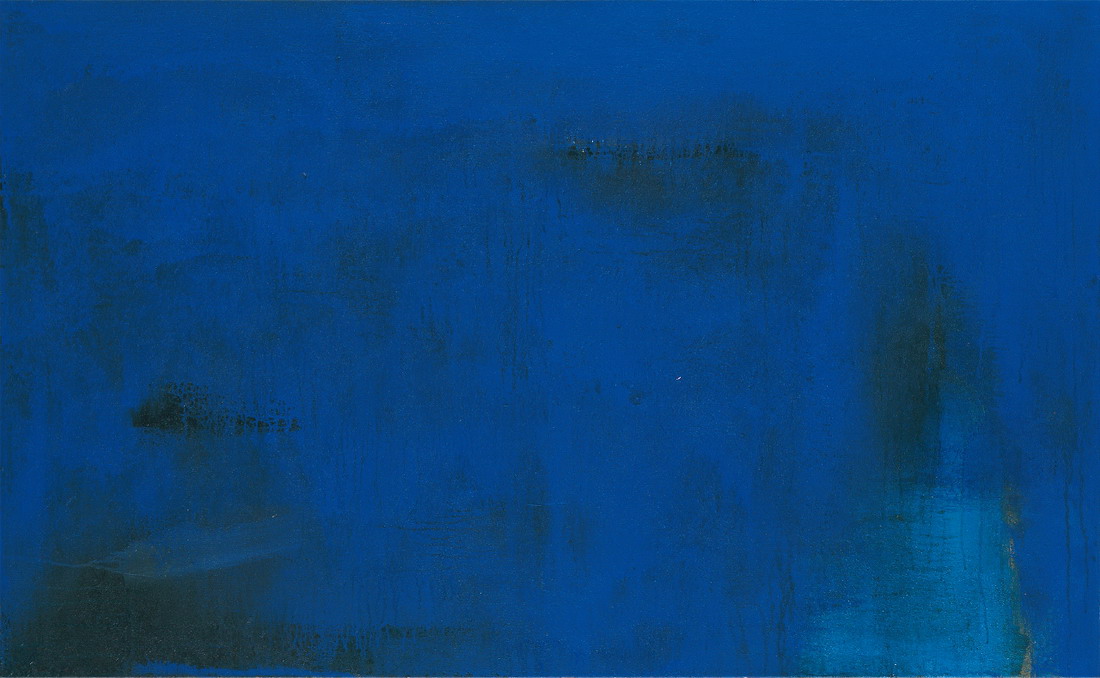
At Ease in the Sky, Oil on Canvas, 162x100cm, 1993
"Who knows what those abstract forms are? Perhaps they are these natural forms." Wassily Kandinsky (Note 1)
Text by Chen Chi-Hsiang | Foreword: Factors of Fu Cheng
Lin Hung-Wen (born 1961 in Rende) is one of the most active artists in Southern Taiwan and Fu Cheng. He is a thoughtful person full of passion for art and life. Early on, he belonged to the "New Style of Southern Taiwan" (Note 2). Together with Huang Hong-De and Yan Ding-Sheng, he formed a trio of independent spirits in Fu Cheng, igniting sparks of modern art in Southern Taiwan after the lifting of martial law, particularly through intuitive imagery and abstract painting. All three were natives of Tainan, Fu Cheng, a city rich in humanities. They were classmates before and after their time at the Arts College, and key members of the New Style of Southern Taiwan Painting Association (with Huang Hong-De as its soul figure). Their work centered on the historical capital, Fu Cheng, whose humanistic atmosphere became the field where their creative energies converged and their spiritual source flowed. None of them studied abroad or left their hometown—Fu Cheng. With a spirit of adventure, they diligently implemented experiments and explorations in local modern art. Driven by sensibility and instinct, they oriented themselves toward Modernist inquiry, transforming and internalizing the natural world. Through the fermentation of meaning and emotion, they created natural and spiritual forms and connotations belonging to this land. Examining internal factors, developing subjective consciousness and latent instincts, and maintaining a romantic sentiment, they peered into the imagery and mental images of inner spiritual writing, intending to capture inner authenticity. Particularly, Huang Hong-De and Lin Hung-Wen pioneered a unique lyrical abstract painting style rooted in the South Pacific, creating distinct personal artistic vocabularies and styles that became the most unique new fruits of the local international abstract context.
Pioneer of Consciousness – Lin Hung-Wen: Among the Trio of Fu Cheng, Lin Hung-Wen was the most vibrant and full of life force. His creation was the most diverse and pluralistic; he dared to take risks, shaping his form according to the local environment and lifestyle. He explored local natural materials like drift bamboo and crossed boundaries in his attempts to explore. Under free will, he bravely expanded new fields of art. Most remarkably, each stage saw the birth of transcendent works. He said: "I am not someone who likes to look back, because creation should be a train speeding toward the boundless" (Note 3). He ventured into the mysterious depths of unknowable consciousness. Because "moving forward is only because we do not know," he unhesitatingly probed the ultimate realm of art. His works are particularly lyrical, possessing a strong literary quality and poetic ambiance. They concretely present insights into life's fields and the natural environment, resembling a poet of art, sometimes singing loudly, sometimes murmuring softly, expressing his feelings at ease within. On one hand, he stubbornly adhered to goodness in his native land—the rich cultural garden of Fu Cheng—continuing to deepen the local spirit and reality through daily life and experiences with the natural environment. On the other hand, he freely nomadized in foreign lands for creative experiences, from overseas residencies and international sculpture camps to exhibitions in Hong Kong, Macau, Bali, Indonesia, to Vermont, USA (the "Back Garden"), and even Quebec, Canada in the north. Throughout his journey, he continued to adventure and challenge himself, opening up and transforming, stepping onto the international stage, inviting the world in, intending to expand his vision and rare cultural experiences, bringing infinite creative vitality reborn from fire.
Lin Hung-Wen’s art is all abstract, whether painting, sculpture, or natural environmental installations. Like the vocabulary of his sensual written poetry, it floats with perceptions of time-space contexts and fields, narrating the rich emotions within life and the subtle realms of deep consciousness. In tranquility, there hides an elegant spiritual energy. His artistic territory began with two-dimensional painting. Using spiritual writing, he employed intuitive, delicate imagery and mental image vocabularies to narrate perceptions in daily life and sensations latent in nature. Crossing into three-dimensional public art—iron sculpture—he gathered natural environments and humanistic consciousness within simplified, high-density volumes and shapes. Finally, expanding into natural installations and environmental art, he realized the intimate relationship between spatial existence, the natural environment, ecology, and human dependence, engaging in dialogue with surrounding environmental spaces. Monumental architectural installations elucidated the utopia of life and self-dialogue reflections. Even crossing boundaries to integrate video art exploration, entering unknown internal and external contexts and spiritual fields through audio-visual worlds, he verified the essence of existence and consciousness. He intended to move from two-dimensional to three-dimensional, and from nature and environment, from three-dimensional physical space to four-dimensional spiritual perception.
Sensual Lyrical Abstract Painting: The "New Style of Southern Taiwan" did not only implement local experiments but also widely explored all possible materials and expressions (influenced here by Ye Zhu-Sheng’s enlightenment). Lin Hung-Wen’s early creations in the 1980s used extremely diverse materials: carbon paper, ink, plaster, resin, acrylic boards, burlap, cotton paper, hardware, and acrylic. Works from this period leaned toward material-form abstraction. He believed: "Materials are merely a means to reach some resting state of the heart/mind" (Note 4). Clearly, materials became the medium for traces left when exchanging between the material and spiritual worlds.
In the 1990s, Lin Hung-Wen quickly moved into pure painterliness. Color became not only the body and energy of painting, but brushstrokes and traces carried the artist’s intense emotions. The painter often liked bold, delicate, thinly applied, fluid, and penetrating colors, especially large areas of blue, large blocks of black, large patches of gray, large chunks of green or red. Kandinsky wrote: "Point and line, freed from all explanatory or utilitarian purposes, possess their own autonomous essential identity; their expressive quality is rather color" (Note 5). On tranquil color surfaces, spiritual writing brushstrokes, vivid halos, ethereal penetrating colored clouds, unrecognizable natural forms, and indeterminate symbols often lay dormant. For example, in 1993’s At Ease in the Sky, the bewitching blue sky has light, thin black cloud gauze drifting across, with a dark halo revealing itself in the right corner. In 1996’s Let Me Shape Myself, a deep gray-blue universe appears with a few strokes of blue sky and a touch of lyrical white light. In 1997’s Morning of the Sanctuary, a sapphire-blue sky features a thick black line, lyrically presenting the sanctuary field and morning imagery. The work is delicate, riddling, and poetic, lingering in thought.
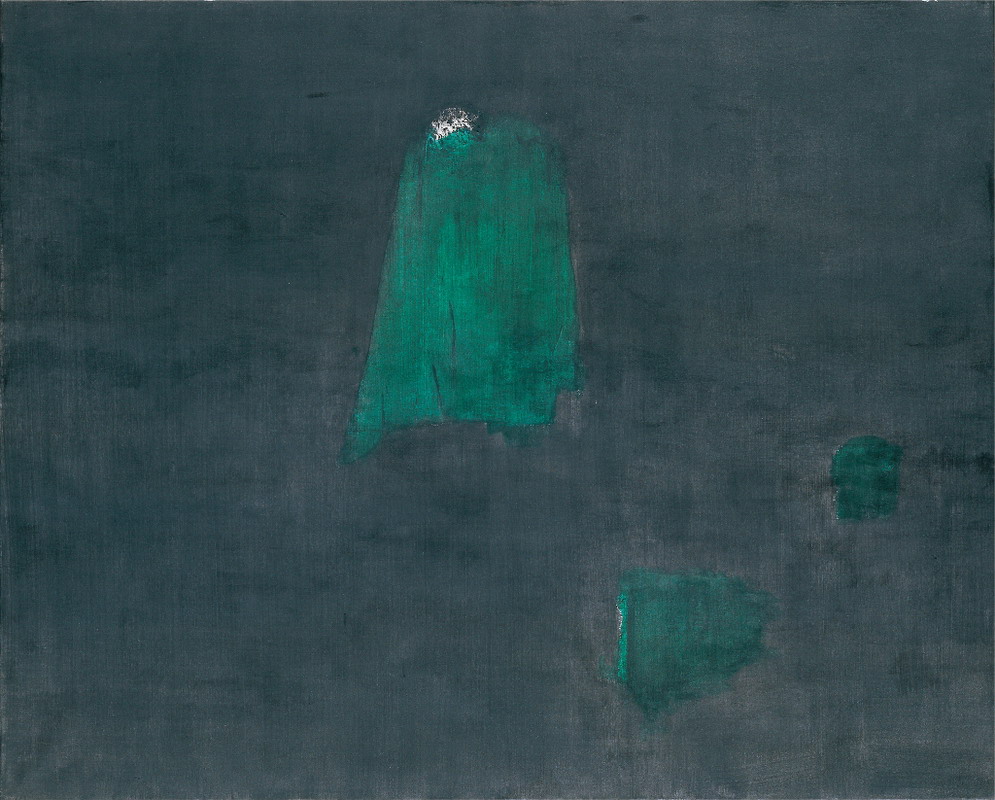
In 2001, Two Small Angles of Plane Triangle and Horizontal Ink Dots on Plane Top and Bottom, along with the 2002 paper series New Landscape, under minimalist black-and-white forms, liberated freedom, using form to expound "emptiness contains reality, reality contains emptiness; extreme emptiness becomes reality, extreme reality becomes emptiness," conveying a metaphysical horizon. Quickly entering spiritual Eastern Zen painting thinking and contextual exploration, through accidental, free-spirited brushstrokes and casual spiritual writing, such as the 2004 and 2005 Untitled series paintings, whether on color fields or bi-panel compositions, they were thinly applied, penetrating, and fluid. Poetic hidden and boundless extreme penetration, with relaxed intuitive forms, absolutely unpretentious. Accidentalness, contingency, or that inadvertent nature became his most un-demanding naturalness, serene imagery becoming the painting’s body. Because unadorned, it is pure; because uncalculated, it is precise; because unpretentious, it is at ease. This free creative attitude, the vocabulary shaped by following nature, is Lin Hung-Wen’s unique abstract appearance.
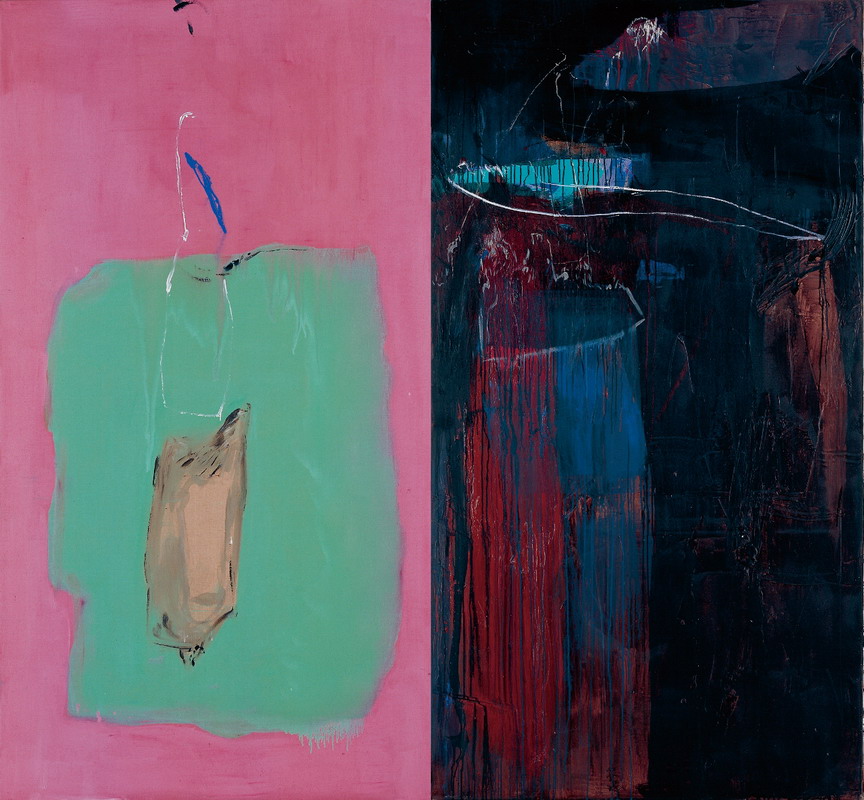
In 2007–08’s Illusion Without Flowers, monumental paintings stimulated infinite sensual waves on large gray-green surfaces. Indeterminate large brushstrokes of brown-black dense clouds became the horizon, among which a mysterious ring of light radiated. The left and right corners mixed permeable blue-gray tones, plus a few free-spirited brushstrokes. Rigorous structure, performing a magnificent symphony of the soul through color and form. In 2008’s Speaking of You, full of nostalgia, on a large romantic pink background, a symbolic, blurred scribble depicts "Her" portrait, illusory and dreamlike, unintentionally evoking memories and retrospectives of "her." Wind Waiting for the Heart, a state of mind writing piece, features chaotic black graffiti brushstrokes mixed with dripping, fluid, penetrating ink traces, presenting the painter’s black-and-white emotions without cause. Heartfelt Intentions at Winter’s End uses thinly applied, thorough large green areas with a few fluid, irregular red forms, quite lyrical, locking inner passion and love deep within the cold winter. Tacit Consent features large blocks of gray-black; amidst a mass of black, a horizontal small white line, a slanted small white dot, and a point of white reveal the distant, unreachable light of the universe, elucidating endless time and space, narrating infinite emotion.
In 2009, Lost Flowers, Waiting for That One, Waiting for You, and Traces of Heart Patterns, all under Chinese ink wash brushstrokes and minimalist compositional creation/nature, intended to approach existential consciousness and the essence of life. From Speaking of You, Wind Waiting for the Heart, Heartfelt Intentions at Winter’s End, Waiting for That One, Waiting for You, or Lost Flowers, regardless of theme or painting, they record pages of the painter’s love poems, expressing the painter’s cosmic sentiment and existential state of mind. Clearly, Lin Hung-Wen’s works require the audience to enter that invisible yet perceptible context to discern the inner emotional world. As pointed out in The Little Prince: "It is only with the heart that one can see rightly; what is essential is invisible to the eye."
Lin Hung-Wen’s paintings are born from direct contact with nature and gazing at the present moment of life. Starting from sensation and impression, under intuition, instinct, and sensibility, through subconscious and spontaneous expression, indeterminate forms, improvised lines, intuitive colors, and cleverly crafted spaces, they metamorphose into metaphysical contexts of sound, light, shadow, and image. They splash/spread the painter’s immediate sensations, express their energy, and elucidate their emotions. The canvas becomes a space for inner spiritual dwelling and a spiritual field. Internalizing nature, turning abstract thinking into concrete imagery, intending to reveal the consciousness beneath life. This precise painting within chaos is both lyrical and sensual, delicate and poetic, situated between imagery, mental image, and abstraction. His paintings are often personal sensations and realizations, elucidating the artist’s conditions regarding heaven, earth, people, and things in daily life, or the dimensions of life’s existence, pursuing inner truth. The artist believes: "My paintings are not abstract at all, nor difficult to understand" (Note 6).
Modernist Iron Sculpture: Lin Hung-Wen is one of the few Taiwanese artists engaged in iron sculpture, starting from the mid-1990s. The artist said: "When I was in third grade of elementary school, my father gave me a welding gun as a gift. From then on, the welding gun became my toy and tool." It can be imagined that engaging in iron sculpture was not so unexpected; iron sculpture naturally became another dimension of possibility for his creation. His iron sculptures are almost all upright, floor-to-ceiling vertical forms. Within simplified linear Modernist structures and symbols, they exist between natural imagery and abstraction. The artist described his sculpture thus: "Three-dimensional sculpture substantially is information found from the meta-thinking already established in painting, introduced into human spatial dimensions" (Note 7).
Lin Hung-Wen’s earliest iron sculpture, Ying Xiang (Responding Direction), appeared in 1996. In a Modernist style, formed by welding numerous irregular iron sheets, its simple, thick and thin fluid linear body is full of natural imagery, resembling birds leaping, resting on a rectangular wooden pedestal. Soon, the vertical form became the benchmark and appearance of his iron sculpture creation. In 1988, Flat Vertical Form with a bifurcated facade opened up an iron sculpture connotation between geometry and non-geometry, nature and non-nature, primal and modern, imagery and abstraction. The following year, Ji Xing (Base Form), He Li Xing (Harmonious Beautiful Form), and the Bing He Shang (Parallel Geometry Above) series were all linear variations. Between light and shadow, volume and mass, they interpreted the texture of iron and the artist’s emotion. Iron sculpture relies on the natural oxidation color of iron materials evolving over time; thus, color becomes a variation of time. Iron sculpture is heavy and time-consuming work. He realized from it: "Slowly, do what cannot be done quickly; quickly, do what cannot be done slowly" (Note 8)—a creative philosophy.
In 2000, Untitled in a minimalist monumental form resembled an organic object full of energy, slender and upright. Then came the rhythmic San Xi (Three Finenesses) series, each composed of three square-line bodies widening at the bottom and narrowing at the top, connected and assembled at the upper end. Poetic and picturesque, they constructed a novel rhythmic movement of points, lines, and planes. In 2002, at the Kaohsiung International Sculpture Festival, Lin Hung-Wen boldly created an extraordinary and spectacular monumental large iron sculpture Untitled. Approximately 8 meters high, formed by orderly welding numerous iron sheets with seams and folds, its rough linear form, narrowing at the bottom and widening at the top, resembles an atypical giant baseball bat. Between volume and mass, matter and spirit, the rough welded lines revealed the artist’s intense emotion and labor memory. In 2004, the upright linear Xi Bei Ji Dao Jian De Bian Zou Qu (Variation of Fine Stele and Swords) series was strong and upright/powerful. Encountering the tenderness of flexible welded lines, through bifurcation, double lines, and hollows, it emphasized the rhythm of void and solid, light and shadow. Poetic and picturesque, refined and mature.
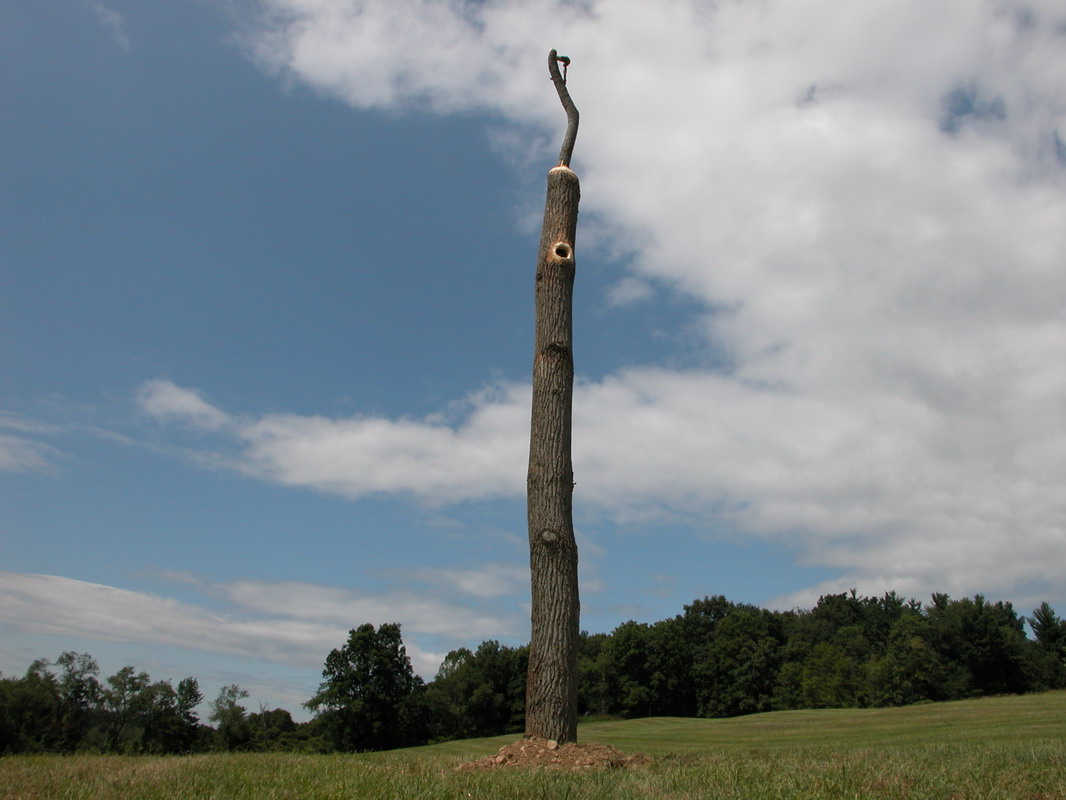
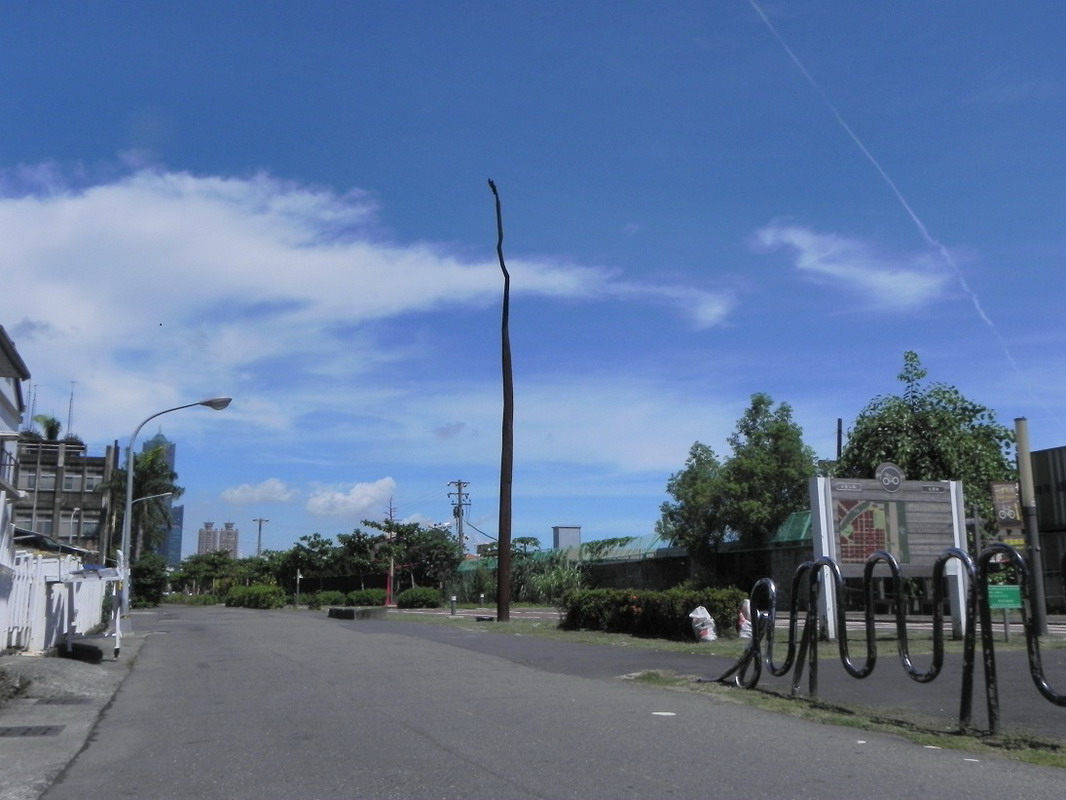
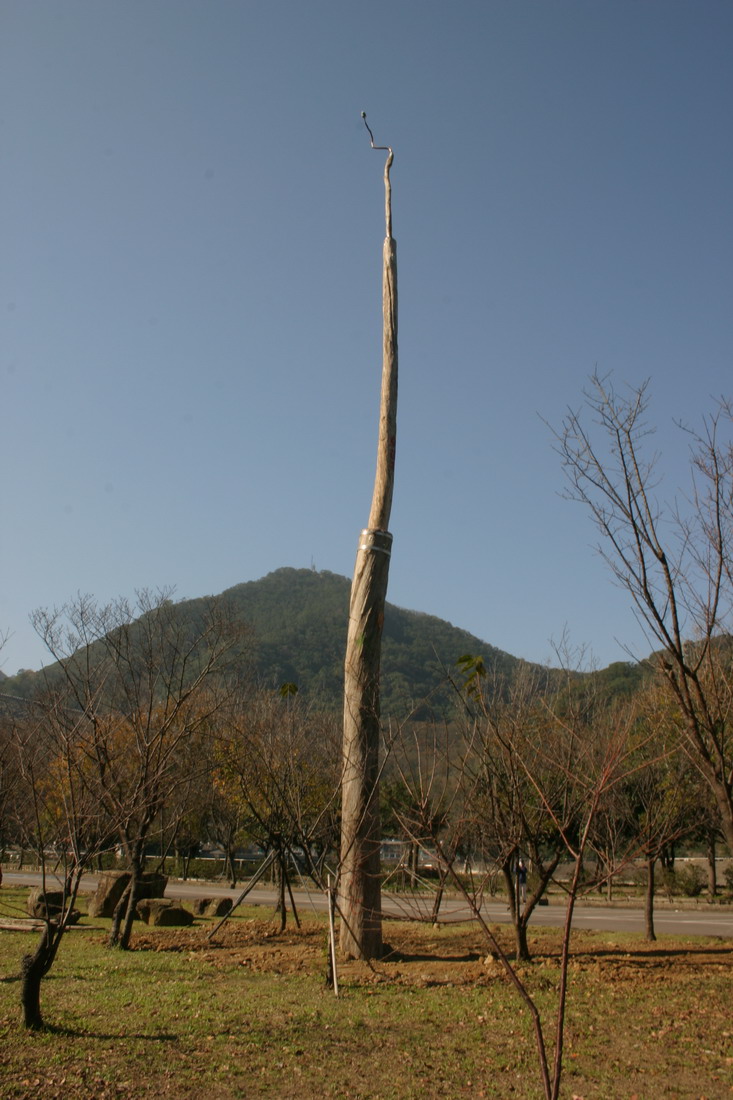
In 2005, at the Shimen International Driftwood Creation Camp, Lin Hung-Wen used local materials, Taiwanese native Xiao Nan wood. Just as in 2003 during his residency at Vermont, USA ("Back Garden"), where he used local oak logs to replace iron columns, implementing local context, connecting two or three sections from thick to thin into a monumental form, one pillar supporting the sky, the upper end full of vital wriggling curves, natural, floor-to-ceiling, and in infinite dialogue with the surrounding natural environment.
Clearly, Lin Hung-Wen’s masterpieces in iron sculpture were created during international steel art festivals or residencies. Each time was a firsthand challenge; each return brought transcendent growth. In 2010, at the Kaohsiung International Steel Art Festival, he completed the work Luomo de Kaishi (Lonely Beginning). Casual and natural, approximately fourteen meters high, free in thickness and fineness, an organic body extending from the earth toward the sky, resembling the most lyrical flowing line on the surface, narrating the artist’s lonely mood and field dialogue. He wrote: "A dialogue with steel. Everything beside him holds him up great. Of course, I do too. When shouting loudly or making those so-called boring sounds, one thing is true: pollution is rapidly corroding those innocent and tender hearts. It is all those so-called holders of some rotten flags. Life is a crawling creature. Blessings, I am too. Perhaps more is needed? Everyone always has their own explanation, quite interesting. Because of time and place, there is always a set of rules, and this set can always tease people’s hearts without them knowing. Of course, that delayed, considered, just now, pretending ignorance, or resting, the next topic, gently scratching. Just consider it, pitiful people sticking to lovely people, they stick together. Even if torn apart forcefully, there will be death. Of course, the adhesive dies. I want to say, I have always only told myself, of course, no sound will be emitted. And, the initial stage of sound is destined. All original limits, instantly forever separated" (Note 9).
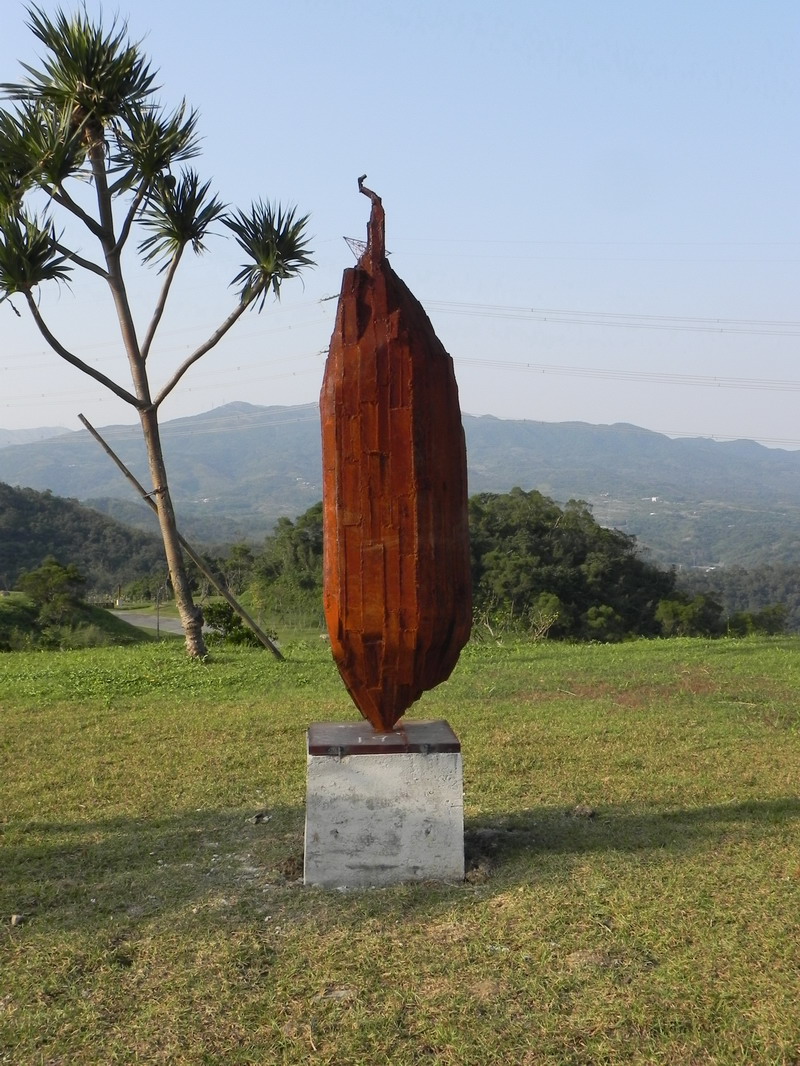
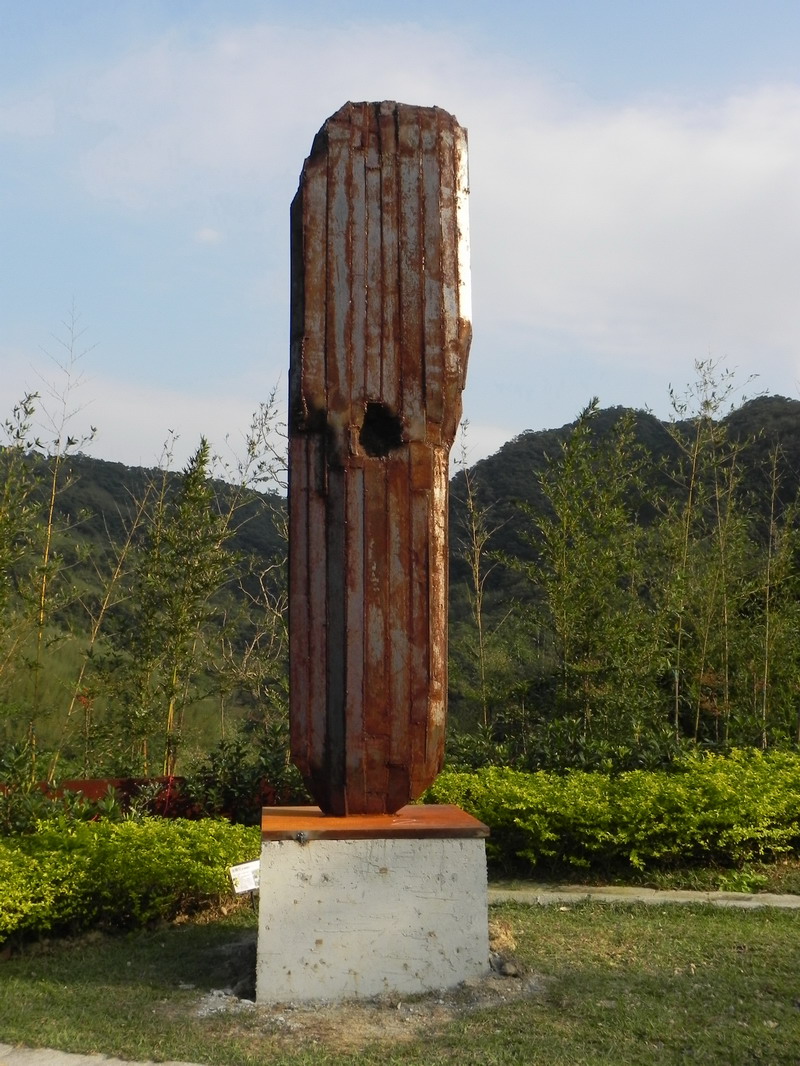
Lin Hung-Wen’s richest feast in iron sculpture was in 2010. Coordinated by the National Cultural and Artistic Foundation, in the Tung Ho Steel Residency Creation Project, in just four months, he completed 22 large and small works at once. Creating under the favorable conditions of the steel plant site, tools, and assistants, he handled it skillfully. Iron sculpture not only matured and advanced but also took a big step forward. Linear stacking became planes, constructing various natural shapes within high-density volumes. Majestic and spectacular, some resembling organic creatures, tool-like, anthropomorphic, and natural/mental imagery. The exquisite iron sculpture tones changed naturally with the oxidation of iron materials, resembling nature-made. This series of 39 pieces was installed on the vast hills of Gongliao, New Taipei City, shining under bright natural scenery. Lines and points in the environmental space, symbiotic shapes of volumes, encountered each other in form and color, masculine and soft, volume and mass, nature and humanities, matter and spirit.
Natural Installations and Environmental Art: Lin Hung-Wen tried early on to develop new materials and explore alternative paths for environment and space. As early as 1985, he made kites from bamboo and transparent plastic, releasing them directly into the sky, becoming the earliest installation action performance work in Southern Taiwan. The following year, on parking lot dividing lines, he used acrylic boards as action environmental installations. Next, in 1987, at the Cultural Center, he first used sunlight fluorescent tubes for an environmental space installation in a pitch-black exhibition hall, creating a dialogue between environment and space, displaying a humanistic context and spiritual field scenery.
Symbolic driftwood or drift bamboo appeared in Lin Hung-Wen’s work in the mid-1990s. Conveniently, his studio was in Qigu. Blessed by the annual summer typhoon season, the coastline would appear with large amounts of driftwood and bamboo. These seasonal gifts inspired the artist’s infinite creative reverie and possibilities. This plain material medium is very natural, possessing strong local emotional and hometown-earthly unique character. It became Lin Hung-Wen’s most intimate and primal exploration in natural installations and environmental art. This environmental space sculpture-object approaches the spirituality and dimension of Italian Arte Povera. The artist elucidates: "Finding mental image counterpoint (plane) in life space; finding subordinate symbols presented in the present (natural installation and environmental art) within the sub-layer of the plane, is a game and also a need for dialogue balance at the bottom of life" (Note 10). From this period, he continued to expand the artistic territory, integrating two-dimensional, three-dimensional, and installation, beginning to construct his virtual nation using driftwood and bamboo.
Most striking was in 1998 at the Tainan Art Festival, when Lin Hung-Wen constructed a huge environment installation work resembling a boat structure using drift bamboo (29 meters long, 6 meters wide). The intriguing proposition History Wave’s Regenerating Cocoon This Sound suggested this boat floated on Taiwan’s historical time-space. Rigorous architectural structure, audiences could climb inside to visit and hear the rustling sound of cocoons. A masterpiece crossing boundaries of object-sculture-environment-sound and interaction, it became the first major work of relational aesthetics in Southern Taiwan. It also became a precursor work for the 2002 Womb Poor Architecture.
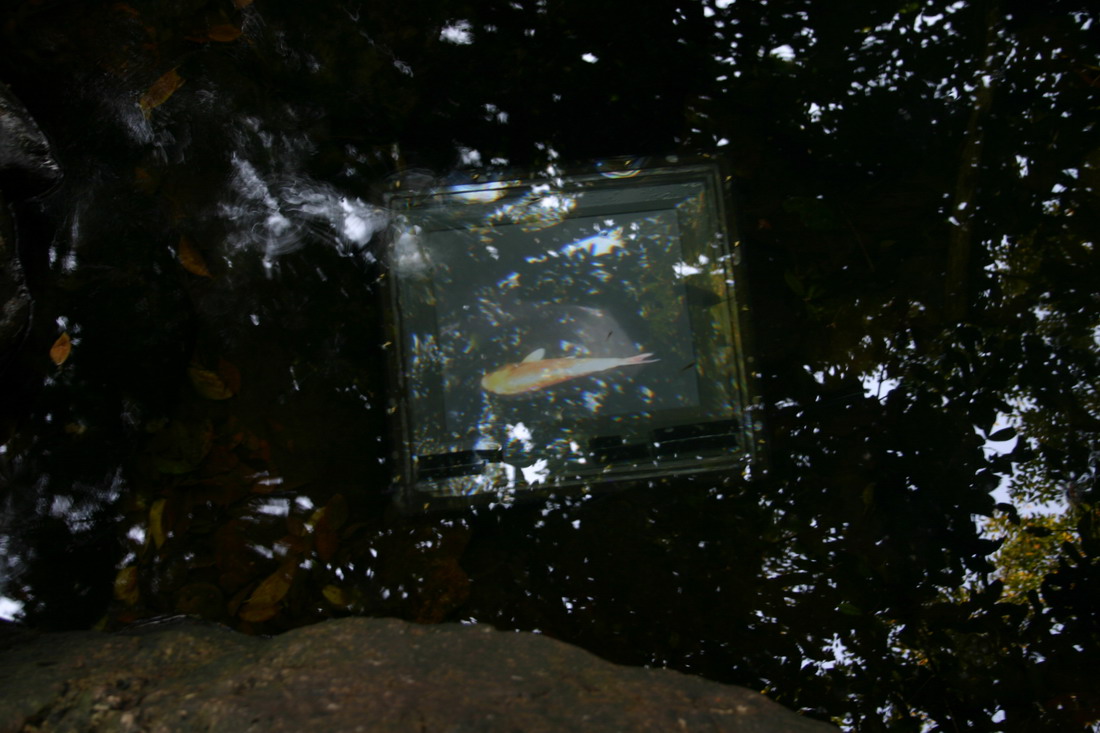
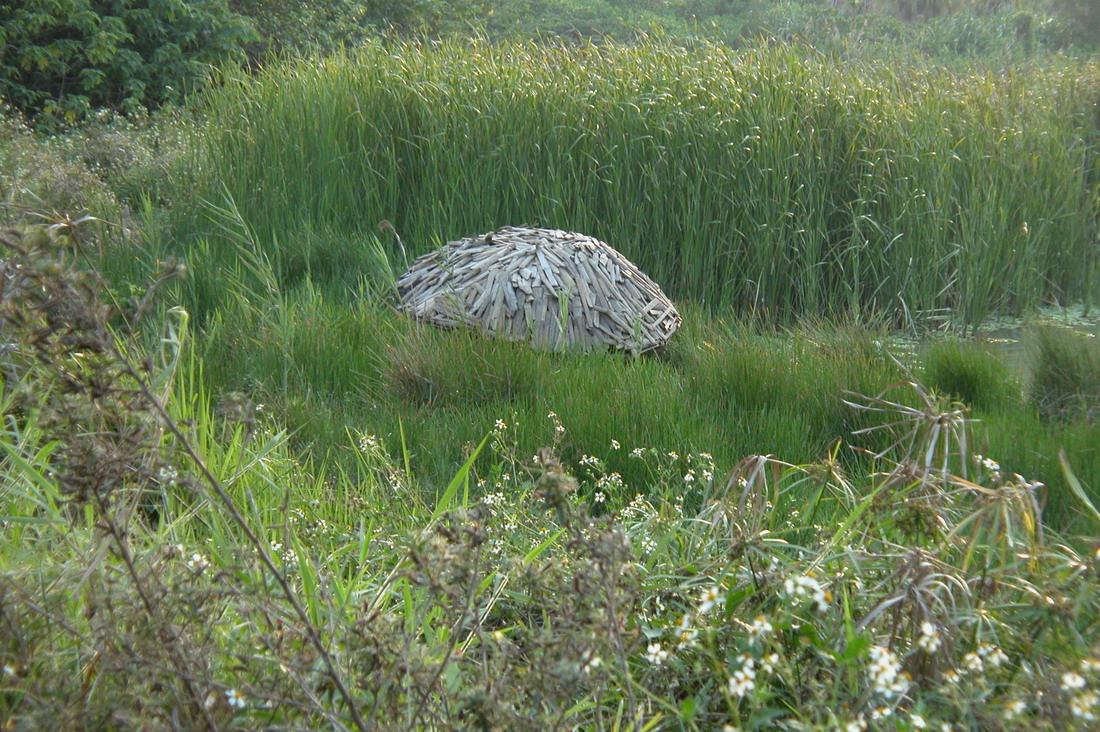
In 1999 at Tainan’s Wu Garden Yin Yu (Due Domain), a groundbreaking cross-boundary integration of object-video audio-visual exploration. Composed of numerous drift bamboos of varying sizes and thicknesses, piled into parallel structures, with wood shavings and spiderwebs scattered above and below, resembling an old fence in the countryside accumulated over years, more like an Arte Povera building object. Seeing beyond the work’s form, one could also hear faint, exquisite sounds (recorded from natural environments), constructing a unique context. Carrying memories of local time-space, it also elucidated natural experience and annotated southern consciousness. That same year, the groundbreaking Cocoon sculpture-object, missile-shaped streamlined, bamboo weaving covered with cloth outside, hiding a radio inside. Between time and space, metaphor and imagination, it contained living life energy, expecting rebirth.
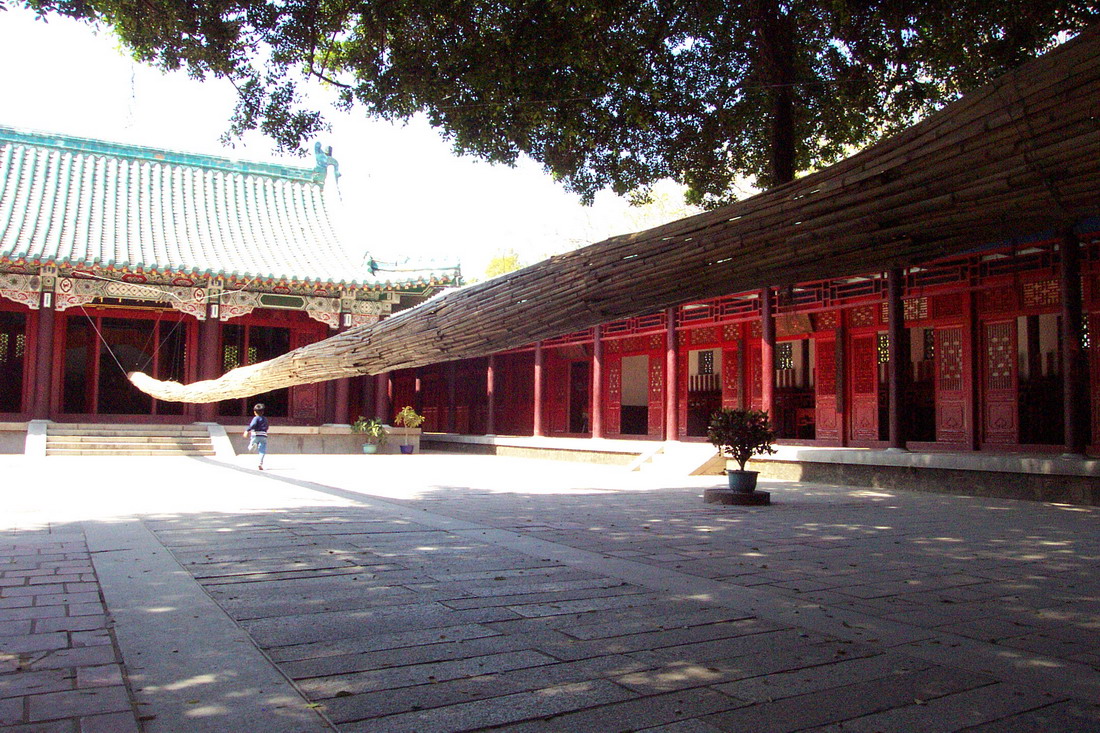
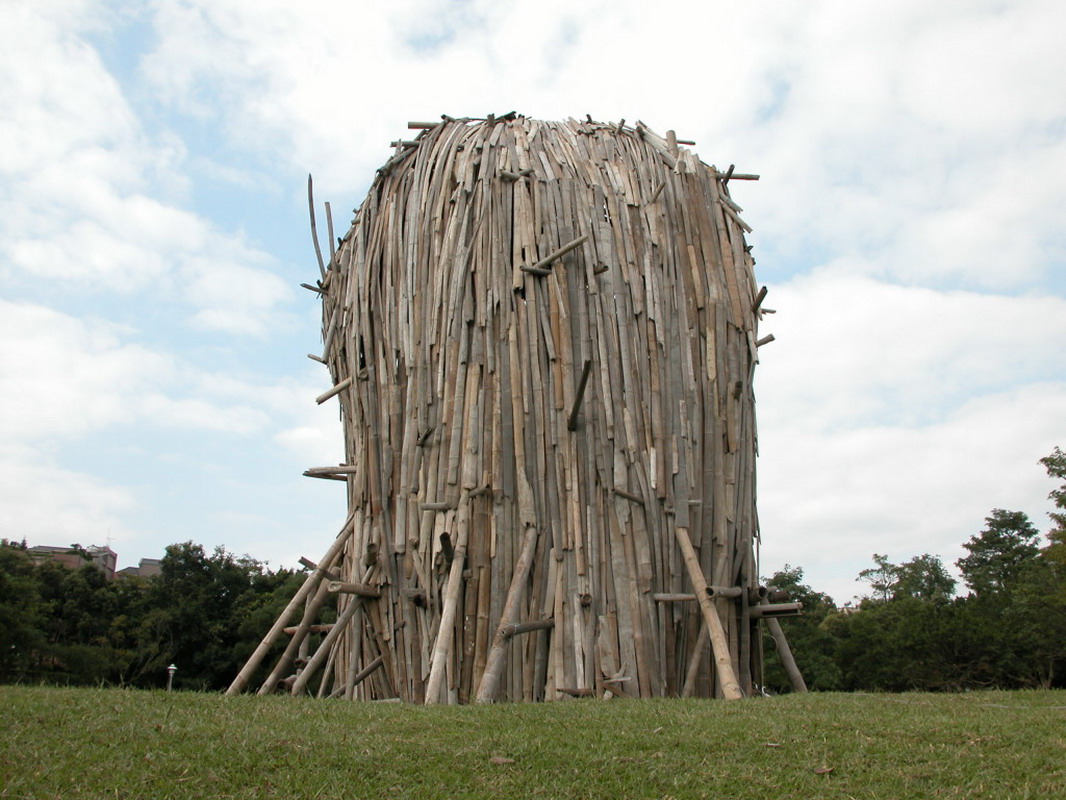
2000 was Lin Hung-Wen’s richest and most mature year for environmental art. Most moving was the object-sculpture-video spatial installation King’s Idea at Tainan’s Yansping King Shrine. Drift bamboo stretched continuously, 360 meters long, 6 meters wide, passing through the entrance plaza all the way to the temple gate. Surreal, like a peculiar monster with a large head and small body floating in the temple space. Video was installed inside the head. Between virtual and imagination, physical and psychological, imagination and dream, it elucidated a magical power. In 2001, Zhi Yan Da Ti Xia Hua Xiao (Straight Eye Large Body Below Flower Small), constructed from large and small driftwood sculptures-objects, with video installed inside, hovering in mid-air like a space shuttle launching. Audiences could watch the video underneath the work, metamorphosing into absurd contexts and imaginative spaces. Wu Yin Zi - Ji Chan (Soundless Child - Accumulated Cicadas), organic form, resembling a shell, containing infinite energy, faintly transmitting exquisite natural sounds, encountering between humanistic context and natural field.
In 2002 at the Taipei Public Art Festival, he combined drift bamboo to construct a dome-shaped closed high-rise resembling a remote village. The proposition symbolizing the mother’s womb was Womb, a primitive-flavored poor architecture building. Inside, complex intersecting pillars supported it. Spacious space, audiences could enter to visit and go upstairs to overlook the natural scenery on all sides. That same year in Quebec, Canada, the quite spectacular Three Rivers, Lin Hung-Wen used local materials, piling small woods into a column leaning to the sky, over ten meters high. The upper end was tapered, bundled wood strips became fine lines, presenting the imagery of water flowing downward. Whether mastering material media, natural imagery, or architectural construction, he reached perfection. It was also Lin Hung-Wen’s most outstanding performance in environmental art.
In 2004 at the Hong Kong Environmental Art Exhibition, Lin Hung-Wen again used bamboo weaving to construct a building castle. The proposition was Rounding Dreams, a replica of the Taipei Public Art Festival Womb work, intending to retrieve our great nature through dialogue with the environment.
The artist believes: "Artists use their own hands to create their inner imagination and thinking. Creation is a lifelong matter. If viewers understand, it is good; if they do not, it is also good. Creation is the path of life..." (Note 11).
Lin Hung-Wen – The Poet of Art: Poetry is everywhere; every place could be poetry. Poetry is a context, perception, association, and romantic sentiment. Poetry liberates people’s imaginative space, awakens people’s awareness and realization, witnessing the consciousness of life’s existence. Lin Hung-Wen’s works possess extraordinary uniqueness. His rich imagistic images hide certain bewitching poetic vocabulary and contexts. He is a rare, uniquely skilled artistic creator adept at mastering words and sentences. Insightful text contains references and revelations to pictorial context fields, also permeating a distinctive literati temperament and artistic texture. Because text never exists merely to explain something; it is merely a creative medium and need, connecting images and implying imagery and meaning, perhaps even understanding beyond the strings. Painting is like composing poetry; poetry is like painting. Thus, image is visual poetry; poetry is visualized image. Inspiration for images seems to come from poetry; inspiration for poetry becomes image. Like Wang Wei indicated: "There is painting in poetry, poetry in painting."
Clearly, imagistic or abstract painting is all beyond words; cannot be explained, only understood intuitively. Besides, Lin Hung-Wen often uses his poetic picturesqueness and referential literary propositions as a guide, intending to reveal and refer to the work’s connotation, translate its context, or prompt more explicit scene domains, merging the tangible and intangible, concrete and abstract, perception and experience, image and word into emitting a new artistic context. Audiences not only see visual poetry but can also meditate and listen to the echoing poetry and melody of the artist rhyming and chanting. Work titles possessing poetic vocabulary are not only full of literary quality and written state of mind but also contain the smell of earth and sensation, such as Qigu Wild Duck Cave and Waiting in the Season of Falling Leaves created in 1992; Hope He Was Left with Joy in 1995; Morning of the Sanctuary in 1997; Rare / Only Let the Wind Blow In, Sounds in the Temple, or I Like the Scenery Behind Home in 2000; Waiting Seems Like I Said in 2003; Person Who Promised Me? in 2004; Residence of Eternal Prophet in 2005; Illusion Without Flowers, Waiting Hidden In, Heartfelt Intentions at Winter’s End, or Wind Waiting for the Heart in 2008, etc.
Even more wonderful in series works, Lin Hung-Wen combines his poetic structures, naturally forming a rhyming lyrical poem. For example, in 2005, Untitled (Long Poem): "The rain of the previous night filled the already blocked ditches. Thistles took advantage of sprouting new buds. Before I decided to remove them, sometimes in the micro-second gaps of mood, watching light and shadow pounce/lie flat on them, there was also micro-second pity. When it is reflection." These propositions are Lin Hung-Wen’s immediate context writings, attempting to peer into unknown and unknowable domain worlds, verifying what is written on the artist’s studio wall: "Moving forward is only because we do not know," which is also a confession of imagery and concrete context. The artist wisely said: "In limited life, humans can only extend infinite journeys through thinking" (Note 12).
Note 1: Referencing Wassily Kandinsky Guide Card, Centre Pompidou Modern Art Museum, Paris. Note 2: New Style of Southern Taiwan was established on the eve of lifting martial law in 1986 (July 15, 1987, Taiwan entered an unprecedented new era—lifting martial law). Under a free atmosphere permeating Taiwan’s airspace, advocating the awakening of local sovereignty and cultural consciousness, bringing impact and new thinking. The New Style of Southern Taiwan Painting Association was established under Huang Hong-De’s leadership. Members were mainly artists from Kaohsiung and southern Tainan: Huang Hong-De, Lin Hung-Wen, Yan Ding-Sheng, Chen Rong-Fa, Ye Zhu-Sheng, Hong Gen-Sheng, Yang Wen-Ni, and Zeng Ying-Dong, as well as Zhang Qing-Feng, a member who had just returned from New York, USA. "Southern Taiwan" signifies distinction from northern mainstream, intending to display local unique elegance. Oriented toward Modernist inquiry under sensibility and instinct, creating forms and connotations belonging to this land. The symbols of the ambitious and adventurous New Style of Southern Taiwan are: experimental, material, autonomous, fermentation of internalization and transformation, attempting to propose a novel new form and unique viewpoint to dialogue with mainstream culture, situated between figurative and abstract, imagery and mental image, material and interpretation, local and international, modern and postmodern. After countless collective and individual exhibitions, infinite passionate discussions, and high debates, two years later, the New Style of Southern Taiwan Painting Association drew a period, transitioning to the New Style of Southern Taiwan Biennial, intending to expand new artistic territories. Two biennials were held at the Tainan Cultural Center, after which they retired. Note 3: Taichung Warehouse No. 20 Looking Back - Lin Hung-Wen 1990-2000 Two-Dimensional Painting Solo Exhibition Simple Text. Note 4: Cai Hong-Ming 1987. Note 5: Referencing Wassily Kandinsky Guide Card, Centre Pompidou Modern Art Museum, Paris. Note 6: Trial Reading Lin Hung-Wen This Person and His Painting Works Text by Jian Dan 2008. Note 7: Referencing Lin Hung-Wen Works Website lin hong-wen visualart worksit.url. Note 8: Trial Reading Lin Hung-Wen This Person and His Painting Works Text by Jian Dan 2008. Note 9: Referencing Lin Hung-Wen Works Website lin hong-wen visualart worksit.url. Note 10: Same as above - Lin Hung-Wen Works Website. Note 11: Same as above - Lin Hung-Wen Works Website. Note 12: Same as above - Lin Hung-Wen Works Website.