The Poor Fisherman (Puvis de Chavannes)
The Poor Fisherman, 155.5 x 192.5 cm, 1881, held in the Musée d'Orsay, Paris. Puvis de Chavannes (1824-1898) was a pioneer of French Symbolism and a mural expert. He initially attended the École Polytechnique, specializing in law, and decided to become a painter after two trips to Italy in 1846 and
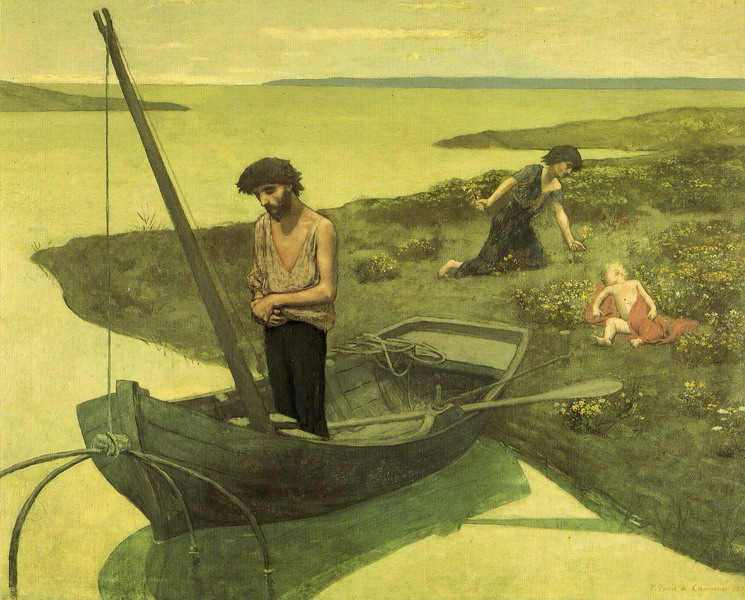
The Poor Fisherman, 155.5 x 192.5 cm, 1881, held in the Musée d'Orsay, Paris. Puvis de Chavannes (1824-1898) was a pioneer of French Symbolism and a mural expert. He initially attended the École Polytechnique, specializing in law, and decided to become a painter after two trips to Italy in 1846 and 1848. He studied painting in the studio of the artist Ary Scheffer, then briefly passed through the studio of the famous painter Delacroix, finally studying under the academic painter Thomas Couture. He favored classical subjects, from which he evoked a sentimental symbolism. He first participated in the Salon in 1850, but was then rejected by the Salon for the next ten years.
Starting in 1861, he undertook numerous historical decorative murals for institutions such as the Musée de Marseille, the Musée de Lyon, the Panthéon in Paris, and the amphitheater of the Sorbonne, achieving fame. In his works, which have the appearance of classical painting, he often expressed an inexpressible inner meaning and an extraordinary aesthetic. In his flat color planes, there is neither shadow nor a sense of three-dimensionality (like a mural); within an unusual harmony of light tones, he reveals a strange, almost peculiar world of sentiment. This incomparable poetic beauty captivated Gauguin, Seurat, and the painters of the Nabis movement, and Matisse was no exception.
"The Poor Fisherman" is Puvis de Chavannes's most mature, most concise, and also most absurd and most famous work. In the painting, a poor fisherman in ragged clothes stands in a small boat by the shore, eyes closed, hands clasped together, as if praying over the net he has just cast. On the shore, his wife is picking wildflowers, and their naked infant appears to be sleeping, presenting the inner world and living conditions of a fishing family. Clearly, the actions and spirits of these three figures are unrelated to each other, especially within this strangely light-toned seascape, creating an absurd and astonishing scene.
In 1929, the art critic Camille Mauclair wrote of Puvis de Chavannes: "He is a poet of fate, simple and touching like a folk romance, a painter-poet. Never has such a resolute synthesis of powerful artistic effect, so aptly appearing as a particular picture, a captivating painterly quality, made people completely forget the painting before the painting itself (...)."