Raymond Depardon and Paul Virilio "Homeland - There is Like Here"
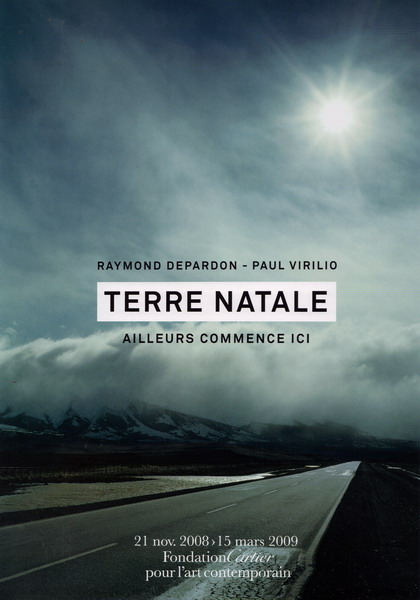
Poster for the Cartier Foundation for Contemporary Art special exhibition "Homeland - There is Like Here". Image from Cartier Foundation for Contemporary Art.
"There is Like Here" is a major work by Paul Virilio that questions the concept of homeland and foreshadows global shifts where elsewhere becomes like here. The special exhibition "Homeland - There is Like Here" ran at the Cartier Foundation for Contemporary Art from November 21, 2008, to March 15, 2009. It reflects on the relationship between the current world of great changes and the concept of homeland, exploring deep-rooted ties or displacement, as well as profound identity issues. It also addresses the increasing homogenization of globalization and the era of survival of the fittest, posing inquiries into the challenges facing the future world. Proposed by renowned French photographer and filmmaker Raymond Depardon (born 1942) and famous urban scholar and philosopher Paul Virilio (born 1932), the core question explored is: "The only Earth history in which contemporary humanity can inhabit—homeland; what remains of the world?"
Contemporary human history has reached an unprecedented moment of critique. From population, finance, food, crude oil, climate change, urbanization, environmental protection, and resources, these are the environmental conditions for human survival. Especially under the inevitable dominance of Western culture, the trend toward a homogenized world causes diverse cultural landscapes to gradually lose their vibrant colors. Many ethnic groups are threatened with forced displacement or disappearance. Facing this great migration phenomenon shaped by political, economic, urban, and natural disasters, the exhibition "Homeland - There is Like Here" is built upon the contrast and extraordinary dialogue and mutual supplementation between Raymond Depardon and Paul Virilio. Raymond Depardon provides a platform for these threatened minority groups to express their views, while Paul Virilio offers insights into the speed of current great changes, mass migration, the end of geographical space, and the pollution of distance.
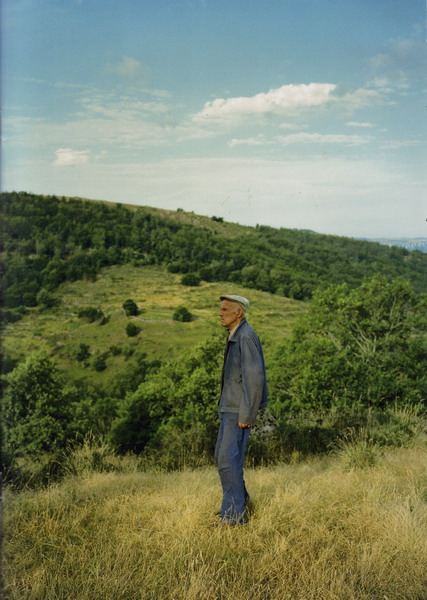
The first-floor exhibition "Homeland" features Raymond Depardon's monumental work. The photographer stated: "Traveling around the world to give voice to those threatened minorities (...), I had to face the challenge of my own world. Just as Paul Virilio exposed the pathology of speed." The exhibition begins in the main hall with "Giving Voice to Minorities," featuring a large screen resembling a cinema, offering individual in-depth interviews through anthropological sampling. These include the Kawesqar and Mapuche people of Chile in South America, the Chipaya and Quechua people of Bolivia, the Yanomami and Guarani Indians of Brazil, the Afar nomadic people of Ethiopia in Africa, the Occitan farmers of France, and the Breton fishermen of France's east coast. They all express their love for their birthplaces using their local languages, deeply rooted in their local languages and histories. One woman said, "I was born in my language." Language is the most basic culture and human right; they expressed their anger and pain over the violations and threats to life under globalization. Raymond Depardon said, "Listen carefully to these people, whether Chipaya, Yanomami, or Afar. Listen to their words, give them the opportunity to speak their minds in their language, their way of speaking, and their expressions."
Another small exhibition hall, "14 Days Around the World," simultaneously screens two small silent screens showing 14 days across seven stops: from Washington on the US East Coast to California on the West Coast, via Honolulu to Tokyo, Japan, Ho Chi Minh City, Vietnam, Singapore, and finally Cape Town, South Africa. From the metropolitan skyscraper jungle life in Washington to the seaside leisure scene in California, to the hurried pace of pedestrians in Tokyo. From poetic Ho Chi Minh City in Vietnam, with its endless flow of bicycles, motorbikes, and cars, to Singapore, a modern metropolis surrounded by lush greenery and high-rise buildings with harmonious multicultural scenery, and finally to the modern yet primitive city of South Africa with a touch of exoticism. Several fixed points around the globe in 14 days convey an experience of the whole world in minutes of footage. Through distance and shortened editing, a series of images narrate a sense of the world, travel memories, and impressions. Through the speed of current transportation and communication networks, the distance and time-space of the world are shortened, forming the current global village and close relationships between each other.
The basement exhibition hall "Elsewhere is Like Here" elaborates on Paul Virilio's views on the speed of current great changes, mass migration, and nomadism. He said: "Settlement and nomadism have changed nature (...). The settled are at home everywhere; for example, mobile phones and computers are never out of hand, whether in elevators, airplanes, or high-speed trains. In contrast to nomadism, one is homeless everywhere." Paul Virilio questions the right of settlement in the current "accelerated great changes of mass migration," predicting that under various conditions of globalization and climate change, 200 million people will have to migrate by 2050, representing an unprecedented great exodus in human history. Even innovations in mass media and transportation have changed the world. Following rural-to-urban migration, the world will re-urbanize. Virilio declares the emergence of cities outside cities, such as train stations, airports, and future air stations, becoming migration cities and waiting-out cities. Thus, Paul Virilio questions the concept of homeland and how "elsewhere is like here" foreshadows global overall changes.
In the large basement exhibition hall, rows of suspended television screens display video art, continuously broadcasting global news media reports on global natural and man-made disasters: racial riots in Africa, wars in Afghanistan and Iraq, the Israeli blockade of Gaza in Palestine, political conflicts in Colombia, etc., shaping numerous political and economic refugees. Natural disasters formed by climate change around the world—such as the tsunami in Southeast Asia, the earthquake in Sichuan, China, floods in the US and Vietnam, droughts in Africa, and migration due to climate change among many Atlantic islands—combined with the economic difficulties brought by the current world financial crisis, resulting in many illegal economic migrants, clearly elaborate on the various phenomena of global great migration in an era of great changes.
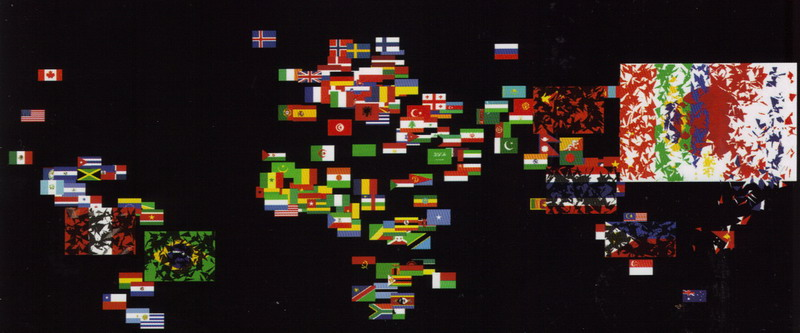
The small exhibition hall features a circular 360-degree large screen. Under modern audio-visual technology, it dramatically presents the current situation and human future visions through world map charts, data, and brief texts. It is divided into five major perspectives: First, Urbanization: In the process of globalization, cities become places for gathering livelihoods, growing larger and denser. It is predicted that by 2015, urban development in the Southern Hemisphere will converge, unimaginably resulting in 48 to 50 megacities with over 20 million inhabitants. Second, Circulation of People and Money: In this era of information, financial, and economic globalization, communication and transportation convenience form the global village, creating a relationship where the world feels like a neighborhood. Economic migration shifts to developing countries; under globalization, human migration constructs economic growth. Developing countries, especially the US, UK, Germany, and France, become havens for economic migrants. The proportion of remittances sent back home by annual economic migrants is considerable. Charts show the current situation of economic migrants and the circulation of money and people. Third, Political and Forced Migration: Due to natural disasters and man-made disasters, i.e., racial conflicts or war-related political migration, plus collective migration formed by current climate change. Internal and external migration of refugees, political persecution leading to international refugees, are clearly illustrated surrounding political and racial conflicts and wars, such as the Balkan Peninsula or Gaza Corridor in Palestine, wars in Afghanistan and Iraq, or racial conflicts in Africa. Fourth, Natural Disasters: In recent years, natural disasters caused by global climate variability have been particularly obvious, including tsunamis, earthquakes, floods, droughts, and others. Clearly, people in certain regions are more vulnerable. Unavoidably, both the Southern and Northern Hemispheres are affected. Charts display this data and the resulting migration or consequences. Fifth, Rising Sea Levels, Some Cities Will Disappear: Global warming causes melting of polar ice caps. By 2100, sea levels will rise several feet. At that time, many coastal cities or many islands in the Atlantic and Pacific will be submerged. Those living in coastal or low-lying areas will be the first to suffer, facing collective migration or a century-scale great exodus. Currently, many small islands in the Atlantic have already entered this migration situation. These are premises and challenges that people must face.