Richard Avedon - The Magnificence of Images
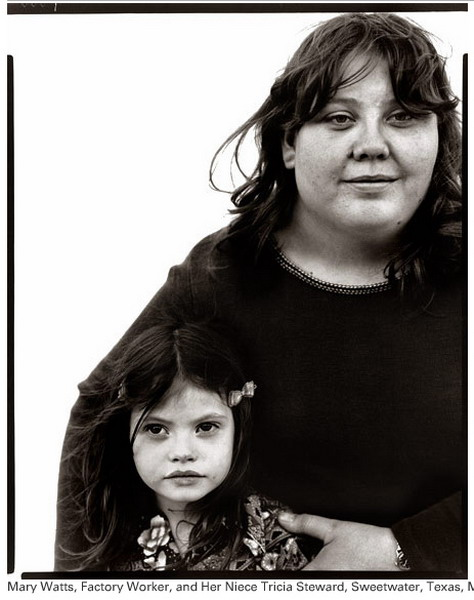
American West Series - Mary Watts, Factory Worker, and Tricia Steward, Sweetwater, Texas. Images from the Richard Avedon Foundation website, 2008.
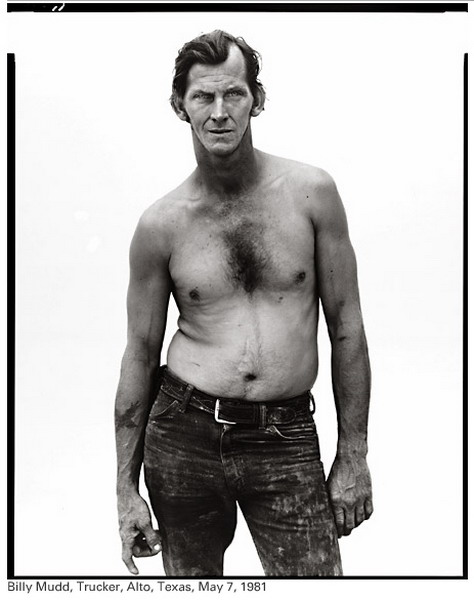
American West Series - Billy Madd, Trucker, Alto, Texas. Images from the Richard Avedon Foundation website, 2008.
Preface: After viewing the "Richard Avedon 1946-2004 Photography Exhibition" at the Musée de la Piscine in Paris last summer (I have wanted to write about this exhibition since returning to Taiwan), it gave me a deeper experience of viewing photographic art in an alternative way. These outstanding and moving images deeply touched my heartstrings, becoming spiritual music that echoes in my mind, leaving an unforgettable impression (I do not know why—this is precisely what moves me). It awakened my awareness of real life and a wonderful, profound vision (indeed, all depth comes from appearance; how one interprets this mystery shows that appearances are not merely superficial). It changed my understanding of daily people and things, attempting to witness truth and substance amidst the mundane. Are things in the world of appearances truly as they are? Is substance altered by individual mood and knowledge annotations, or is it the original state of objects themselves? In this illusory, dreamlike world where everything flows like clouds and water, what is the original source of things? Are appearances the truth? The truth of the vast world certainly resembles nothing yet encompasses everything; only through the eyes of a sensitive mind can this truth be thoroughly penetrated. Photographer Richard Avedon, with his wise eye, captured the core of these things in the instant of the lens (I dare not say this is truth or substance), presenting the artist's most acute emotions and highlighting the most immediate humanistic spirit. It was so bewitching that I could not forget it for a long time; waves of beautiful mental imagery echoed in the depths of my soul. I wish to share this emotion with friends who love art.
Richard Avedon (1923-2004) is widely known as one of the most outstanding photographers in the history of 20th-century photography. His photographic aesthetics are divided into two main parts: fashion/clothing and portrait painting, ranging from social elites to portraits of the common people of the American West. He not only updated fashion photography (previously treating models as clothes hangers, he turned scenes into living spaces, creating dynamic images akin to real-life settings), but also undoubtedly highlighted the emotions, psychology, and spiritual states of portraiture, presenting contemporary humanistic spirit. He said: "Portraits are not just objective resemblance. Transferring current emotions or a fact into a photograph does not stop it from becoming a basis for judgment. Inaccuracy does not exist in photography; all photos reflect reality truthfully, and no photo is merely a fact."
Fashion/Clothing: Richard Avedon was born in 1923 in New York to a Russian-Jewish family. At age ten, his father gifted him his first camera, which unexpectedly led him down the path of photography without formal instruction. He briefly attended Columbia University. In 1942, he spent two years on merchant ships, taking photos specifically for crew members (using a Rolleiflex camera gifted by his father). He then shot advertisements for department stores, quickly displaying his photographic talent and gaining recognition from Alexey Brodovitch, Art Director of Harper's Bazaar and head of the Design School. In 1946, he opened his own studio, providing photos for magazines such as Vogue and Life. He was hired as the primary fashion photographer for Harper's Bazaar, shooting fashion scenes in Paris for the first time, adopting an unusual perspective. Models were no longer just clothes hangers; they were emotional, talking, laughing, acting, and posing, often immersed in the lively, free atmosphere of Parisian streets mixed with real life (such as placing a model in a Balenciaga suit among street performers in 1948, the famous image of Dovima in an Audie evening gown with elephants in 1955, and fashion images of Dior clothing at the Place de la Concorde in Paris in 1956, all leaving a deep impression). By lowering the camera's field of view, he presented a unique spatial viewpoint, attracting attention and changing the stiff styles of past fashion photography. He did not just shoot models but created unique personal style images.
Outstanding Portraits: In 1966, Richard Avedon moved to American Vogue magazine, continuing to shoot fashion. In this historical era, he began shooting purely personal subjects, such as patients confined in mental hospitals, participants in the American civil rights movement and anti-Vietnam War demonstrations, etc. In the 1960s, he became famous, and social elites began inviting him to photograph them. Notable portraits include comedian Charlie Chaplin before leaving the US (1952), actor Bert Lahr (1956), sculptor Giacometti (1958), painter Chagall (1959), the Beatles who rocked the era in the 1960s, sexy star Marilyn Monroe, composer Stravinsky, a group photo of famous Pop artists and "Factory" members, portraits of Picasso's children, actress Elizabeth Taylor, portraits of Martin Luther King Jr., all quite striking, with expressions beyond words. However, the 1963 portrait of William Casby, a former slave from Louisiana, was not only mesmerizing but also transformed into an image of unparalleled shock power. From 1969 to 1973, Avedon photographed his father suffering from cancer. Facing his closest relative under the lens of life and death, he pondered the role of the photographer: merely recording appearances or leaving a mark for survival? The Father series was exhibited at the Museum of Modern Art in New York in 1974. Famous portraits from the 1970s include classical dancer Gelsey Kirkland, modern dancers Mikhail Baryshnikov and Twyla Tharp, whose postures and expressions were vividly portrayed. In the 1980s, his most famous image was Nastassja Kinski lying naked on a large python (1981), half sexy, half mysterious, full of imaginative space and extraordinary poetry. Striking portraits from the 1990s included French writer Marguerite Duras (1993), actor Ralph Fiennes (1995), and the eccentric John Galliano (1999). And in his later years, the dancer Savion Glover (2003). These became monuments of humanistic spirit in Richard Avedon's images.
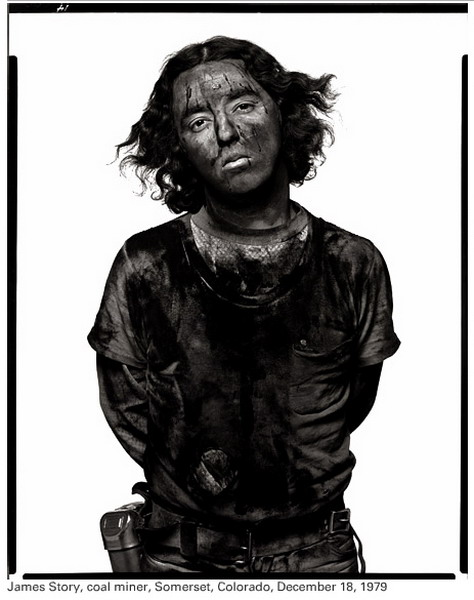
American West: After years of celebrity "family" photography, Richard Avedon became exhausted and bored. Between 1979 and 1984, commissioned by the Amon Carter Museum in Texas, USA, he had the opportunity to step out of the frame of existing glamorous portraits, delve into the folk world, and enter his new realm, embarking on a journey of "American West" portrait monuments of the common people. With a plain, curious gaze, he walked into rural fields, witnessing the hardworking, serious lives of civilian laborers suffering from economic contraction in the American West, or destitute marginalized people. He visited farms, livestock markets, oil extraction sites, coal mines, animal slaughterhouses, highway rest stops, and small bars, etc. The subjects were farmers, miners, oil workers, waiters, prison inmates, and vagrants, etc. Under these unusual subjects, Richard Avedon completely changed his existing concept of portraiture. Isolating the scene background, using natural light and white backgrounds to highlight black-and-white effects, the subjects stood out undeniably. This series of 125 radiant images, in their ordinary simplicity, under shocking realistic imagery, displayed extraordinary human dignity and inner humanistic spirit (regardless of social class). These mesmerizing American West civilian lives became monuments of human imagery, among the most powerful images in photographic history. Regarding this theme, Richard Avedon said: "My subject is not the (American) West: I could take these photos anywhere in the world. These are portraits of these people, no different from what I shot. The West is not the point."