Richard Serra "Promenade" 2008 Monument Exhibition
One of the magnificent scenes from Richard Serra's "Promenade" exhibition at the Grand Palais.
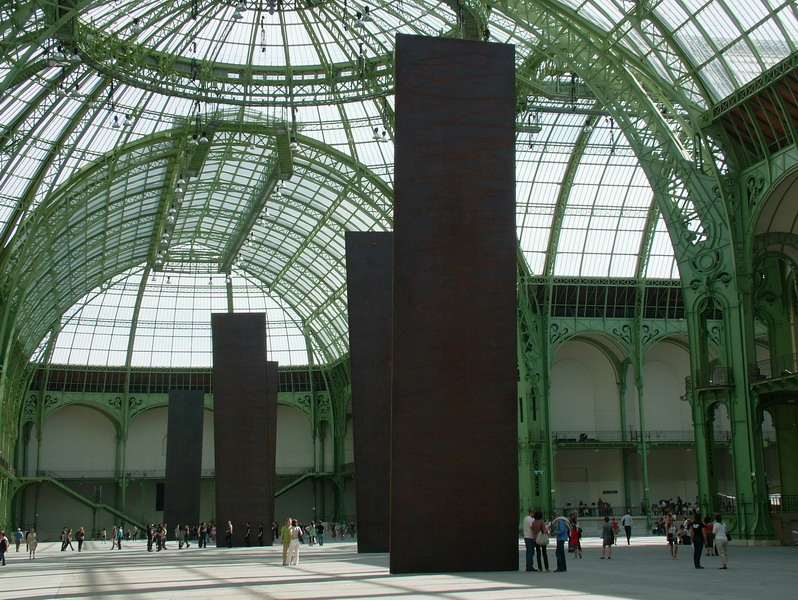
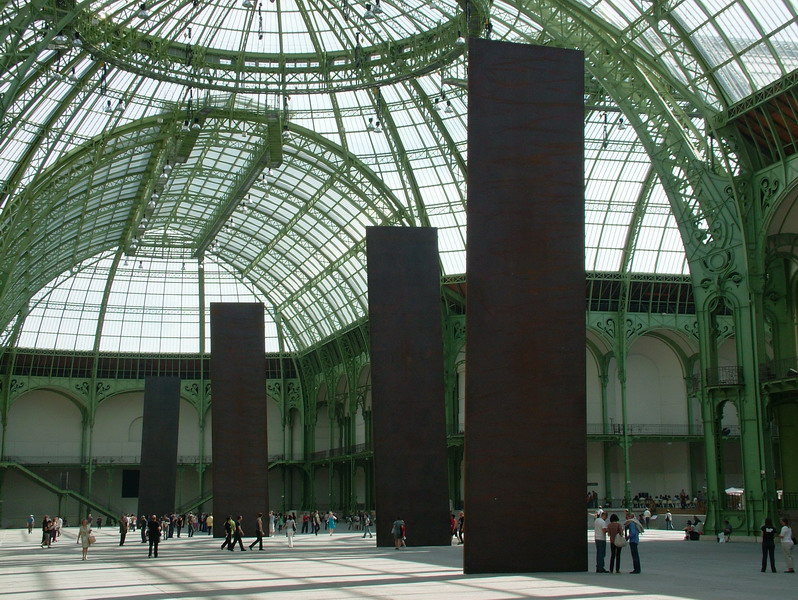
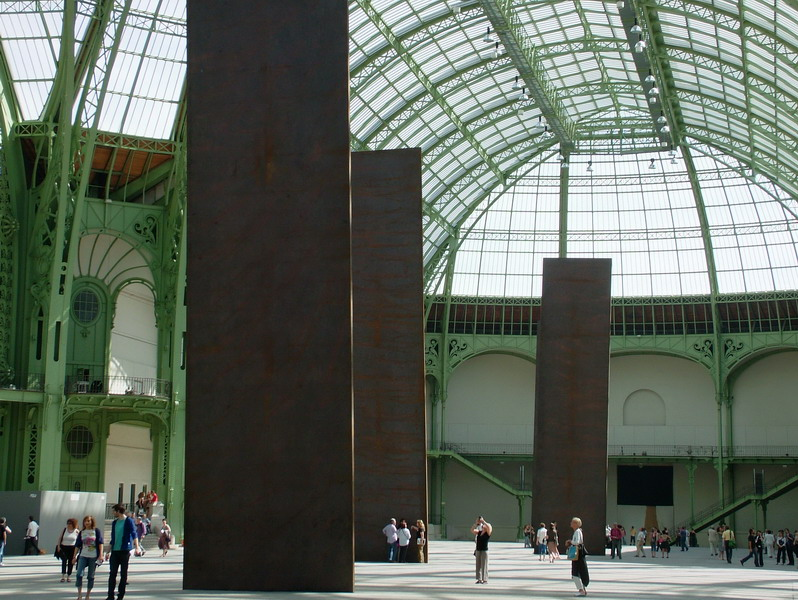
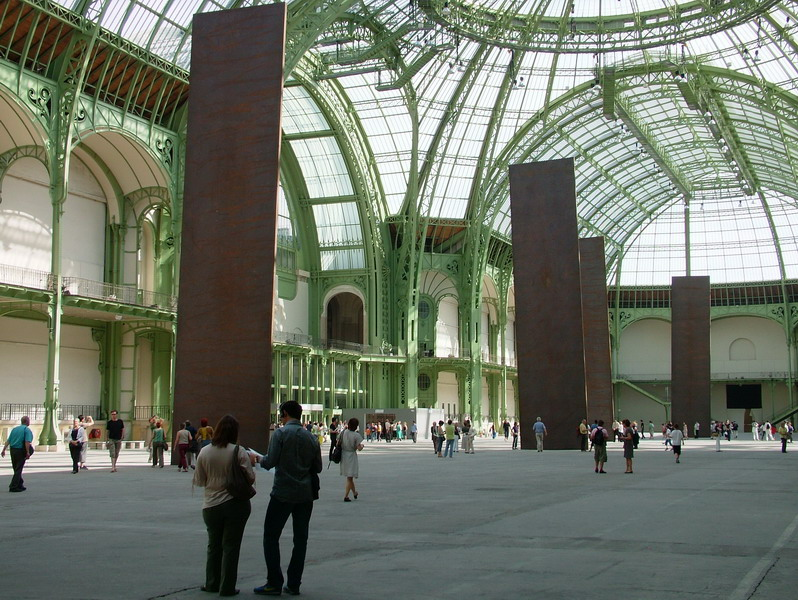
One of the magnificent scenes from Richard Serra's "Promenade" exhibition at the Grand Palais. Preface: Every year, on a breezy and sunny May day, the Grand Palais in Paris hosts its annual Monument Exhibition (May 7 to June 15). This grand show has become an institution for contemporary French and European art, and stands as one of Paris’s most international large-scale exhibitions. Following the unprecedented success of last year’s Monument Exhibition by renowned German Neo-Expressionist artist Anselm Kiefer—which attracted nearly 136,000 visitors in just five weeks—this year features American minimalist sculptor Richard Serra, who accepts the challenge of this vast space within the glass palace’s artistic showcase. Serra’s works have always challenged not only extraordinary spaces but also viewers’ perspectives and artistic boundaries, often sparking debate. His sculptures are unrestricted, challenging monumental spaces (both indoor and outdoor). For 40 years, he has constructed his works through site-specific methods; their volumes are extraordinarily massive, resulting from processes akin to grand construction projects. These innovative steel plates emphasize weight, gravity, and balance, creating overall structures under extraordinary tension that form magnificent, dramatic scenes, revealing unimaginable spaces and manifesting physical and spiritual volume.
Richard Serra: Richard Serra (1939–) is one of the most representative artists of American Post-Minimalism. After graduating from the University of California, he entered Yale University in New York, where under the guidance of master Joseph Albers, he quickly integrated into New York’s art circle, associating closely with figures like Rosenberg, Stella, and Reinhardt. The true influence came from his 1964 trip to Europe. In Paris, visiting the reconstructed Brancusi studio at the National Museum of Modern Art gave him a new sense of sculpture, particularly regarding the situational context of place and the problem of sculptural outlines. The artist stated: “In Brancusi’s work, I was interested in his power of three-dimensional conception and the lines on the edges (outlines); in short, form is most important in sculpture.” Subsequently, living in Italy, he discovered Arte Povera, especially concepts of material energy and instinctive material construction. Thus, Serra is not a traditional sculptor; he never used traditional tools. His techniques were closer to industrial machinery (e.g., cranes, worker teams). He said: “I often try to expand the potential use of equipment from steel mills or shipyards, which relates intimately to my creative needs.” This attitude changed the relationship between hand and work, pioneering a new imagination and forcing Serra to rethink tools and the artist’s actions.
Returning to New York in 1966, like Arte Povera artists, he began affirming materials and energy, abandoning substance to recall personality and emphasizing process, developing various possibilities. Early on, Serra was particularly interested in manufacturing systems and presentation, where process became the work itself, as seen in his 1967 works “Plinths” and “Splashings.” Starting with the “Prop” series in 1968, Serra began expanding the robust properties of steel, specifically using thick plates from shipyards (his father was a shipyard technician, giving him frequent opportunities to visit or participate in factory activities). In 1969, “One Ton Prop (House of Cards)” consisted of four thick (square) steel plates placed side by side without welding, resembling a card castle weighing several tons. This work established tension and unease in the viewer’s imagination. Serra believed: “Imbalance is a force and energy.” Later constructions like “Floor Pole Prop” or “Right Angle Prop” shared similar attributes, exploring balance within the relationship between weight and thrust. From the 1970s, he developed environmental sculptures in monument forms, focusing on the mutual influence between work and audience. Like Minimalist art, site-specificity became the core of Serra’s exploration of space. The artist wrote: “It is the site that determines the method; thus, I think about what I will construct.” For example, his 1972 work “Circuit” is an environmental installation where four heavy rectangular steel plates are arranged diagonally in a square gallery space, perfectly forming two contrasting “V” shapes. The audience is surrounded by the work, with sculptural surfaces forming dividing lines that construct space. Similarly, his 1972 work “Twins” formed a dramatic space. The artist said: “I analyze the site and decide to redefine the boundaries of sculpture; it is not the external boundary of her existence.”
Starting in 1974, he opened another mode of creation: “drawing.” He considered this an individual activity, applying dense black print ink directly onto supports (paper or canvas), such as “Shafrazi” on burlap. These matte black rectangular areas emphasized the mass of matter and imagined space, resembling (black) monochrome paintings. The artist believed: “Drawing is a focused work, immersed in itself, accompanied by inevitable and simultaneous problems.” In 1975, “Sight Point” was an environmental landscape sculpture constructed from three large, solid steel plates standing upright, emphasizing the combination of planes and lines, possessing an industrial aesthetic. A more dramatically managed space was his 1977 work “Span,” where geometric linear steel columns were vertically and parallelly erected in a white gallery, constructing an excellent and perfect “emptiness.” It is arguably Serra’s most outstanding and rare work of the 1970s because here the audience felt no coercion or oppression.
In 1980, “St John Rotary Arc” was constructed in New York’s Holland Plaza, followed by “Titled Arc” on Federal Plaza the next year. Both were extraordinary public monument sculptures made from a single large, thick semi-circular steel plate, erected in urban public space to establish a distinction with the space, allowing audiences to view it from all around, poetically resembling a rainbow of the industrial age. (However, it became an obstacle in the city plaza, like a wall, and was demolished in the 1990s under public demand in New York.) In 1981, at the Castelli Gallery in New York, the work titled “Marlyn Monroe – Greta Garbo” consisted of two large, thick semi-circular steel plates arranged in dialogue, dividing the overall space to form two walls, creating a sense of spatial oppression and emphasizing material energy, surface, and dramatic space. In 1983, another masterpiece titled “Clara-Clara” was installed in the Tuileries Garden in Paris in monument form. Also consisting of two large, thick semi-circular steel plates open-endedly arranged in a double “C” shape, it dramatically displayed unprecedented “industrial aesthetics.” Such “planes” became the sole means of understanding, having no direct connection with unevenness or environment, fully residing in the material. After this innovative “Clara-Clara” monument exhibition ended in the Tuileries Garden, no space could be found or anyone claimed it (no one wanted it), so in 1985, the work was placed in Choisy Park in the 13th arrondissement of Paris. To the surrounding residents, it was simply two walls obstructing the garden view, and it was soon demolished, finally liberating the oppressed vision. Of course, walls, ground, and environmental space are objects Serra continues to question through solid material forms and energy. He provides viewing and understanding of place and space, proposing an urgent “industrial beauty” that further establishes new boundaries for sculpture.
“Promenade” 2008 Monument Exhibition: In this special exhibition “Promenade,” Serra perfectly established space, resembling an extraordinary metaphysical garden. He beautifully presented the relationship between this transparent, massive architecture and the audience, engaging in a tacit dialogue between sculptural works and architecture. He proposed a unique artistic and spatial experience, challenging viewers’ perception and the concept of gravity. In this immense space, the artist was both radical and poetic, presenting magnificent steel landscape installations in a minimalist yet vivid manner. Through subtle contrasts with the building, he highlighted an open space, inviting viewers to stroll through this physical and spiritual space. People can view from all angles or contemplate the strong tension and energy of the perceptual works wandering freely around them, evoking special emotions and extraordinary feelings.
It is said that the inspiration for this innovative installation came from Serra’s experience living in Japan, especially the Zen gardens of Kyoto. There, amidst insignificant stones, their absolutely accurate and perfect relationships manifested the beauty of the natural cosmic order and metaphysical space. Acting upon this metaphysical relational experience, Serra titled this special exhibition “Promenade,” conceiving the exhibition as a leisurely journey through a magnificent artistic scene space, metaphorically hinting at the mysteries of gardens within substantial spatial relationships. Each viewer observes and contemplates according to their own shifting perspective, entering the core of the work as if entering an artistic garden.
On the main axis of the Grand Palais, Serra simply and powerfully established spatial installations with five giant iron plates (4 meters wide x 17 meters long, each weighing 70 tons). Long rectangles stood vertically on the ground like colossal modern industrial monuments, subtly slightly tilted and rhythmically spaced 100 meters apart (not on the same line). They formed effective lines, planes, and forms, cleverly using minimalism to display complexity, and using “substance” to reveal extraordinary “emptiness.” The immense spatial field became the core of the work. When viewed from afar, the sculpture appears stable from all sides; when approached, the huge planes (like walls) and tilting dynamics create a sense of oppression. Strolling around the work, there is a swaying sensation. Viewing spots have their mysteries from every angle (differences in sight). To see the whole, one must look from specific angles for a clear overview, feeling it vaguely. The most subtle viewpoint occurs when facing the sculpture directly from the left, seeing only one; moving slightly right reveals the second; continuing to move brings the third into the gap; then the fourth (only a small part); finally, the fifth appears in the gap, completing the set of five. Vision pierces layer by layer, constructing a wonderful perspective. This visual experience holds mysteries only found in Japanese or French gardens.
Clearly, the “Promenade” scene space became a large public space, even a social theater. The sculptural works served as the best scenery and magnificent backdrop. The clothing colors and movements of the audience strolling leisurely became objects of viewing and being viewed; during garden strolls, all activities were included as subjects of observation. In this crowd of public space, the experience of coexistence involves collective relationships. Of course, strolling or viewing belongs to personal, unique life and artistic experiences. Additionally, in this glass palace, bright light dances with time. Under the diurnal field (open Thursday to Sunday until 11 PM), the sculptural works resonate with light and shadow. On breezy, sunny days, the sun caresses the sculpture, enhancing its brilliance and weight, forming an unexpected light-and-shadow theater. When lights come on, the works are not lonely, accompanied by many viewers coming after work, sometimes conversing with the starry sky or meeting the bright moon. This poetic scene possesses unique sentiments only found in the Grand Palais exhibition. The “Promenade” special exhibition, in the tightest relationships of accurate and perfect height and length, plane and form, volume and material, void and substance, or in the convergence of sculpture and architecture, space and environment, physical and spiritual time and space resonance, formed a magnificent artistic scene.