Rirkrit Tiravanija Solo Exhibition "Homeless Shelter"
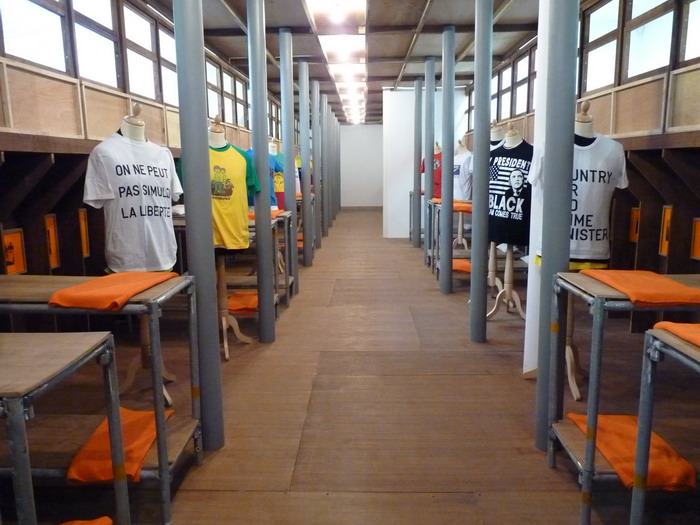
"Cabin" panorama of "Homeless Shelter", 2010
Rirkrit Tiravanija Solo Exhibition "Homeless Shelter": May 5 to June 17 at Chantal Crousel Gallery. Rirkrit Tiravanija (born 1961) is an internationally renowned Thai artist whose practice nomads between Bangkok, New York, and Berlin. He is famous for unique new forms of interaction, such as sharing food, personal objects, books, and life with the audience. Skilled in appropriating, manipulating, transforming, and displacing ready-mades, he states in a post-Duchampian context: "What I do is take Duchamp's urinal, hang it up, and pee in it (...) We live today in a world of ready-mades; this is what I can do. Naturally, this creates a discourse on the prospects of post-ready-mades and Western art." Since the 1990s, Tiravanija has developed a new form of aesthetic morphogenesis based on interaction. Through gallery or institutional performances like live cooking, sharing food and reading with visitors, or dramatically turning galleries into restaurants or living apartments, museums become recording studios, libraries, or leisure centers, exchanging information via the internet with students in Thailand. Thus, various activities are realized within these artistic institutions to transform art.
Tiravanija often acts as a catalyst for situations, inviting audience participation to share the extraordinary experience of the artwork, granting a sense and freedom to choose its form. Particularly due to the works of Tiravanija and Felix Gonzalez-Torres, the famous French curator and critic Nicolas Bourriaud coined the concept of "relational aesthetics." They clearly emphasize the role of the artist in society. This is his fourth solo exhibition in Paris, themed around the "Homeless Shelter" built by the famous French architect Le Corbusier for the Salvation Army in Paris. Using a modernist building shaped like a ship as a set design, it hints at the complex and inevitable relationship between utopian architecture and real society.
Inside the gallery, Tiravanija constructed a wooden boat. People climb the stairs onto the boat and enter the cabin, which displays a series of T-shirts filled with political and capitalist slogans, vocabulary, or images critiquing them, much like a shop window: red ones saying "Capitalism," white ones saying "People cannot pretend to be free," black ones saying "Our Black President - Obama," and red question marks printed with the most powerful figures of the 20th century such as Mao Zedong, Stalin, Lenin, Nixon, and Hitler, with "Power" written below, or white ones saying "Free Thinking," or Nike logos transformed into "Jerusalem Just Do It," etc. The colors have strong implications, and concise text clearly conveys the artist's concepts and insights. The T-shirt part is partly self-created by the artist and partly collected from around the world, clearly emphasizing that any clothing possesses a function of interaction and transmission, becoming a space for political discourse.
On a wall behind the boat, the series "T-shirt Demonstratio Drawings" is presented, with images taken directly from mass media, especially pictures of anti-government or political propaganda slogans worn by protesters during the recent Red Shirt demonstrations in Thailand. These were custom-made by the artist for young Thai artists. The proceeds from this part will be donated to the Land Foundation in Sanpatong Village, Thailand, of which the artist is a co-founder. Tiravanija transforms the homeless shelter into an effective contemporary political critique, discussing the current global political atmosphere and relations, especially the turbulent political situation in Thailand. He raises issues regarding the consumption and distribution of information in contemporary culture, or more importantly, that we have all become active participants.