Robert Barry "Word Lists" Solo Exhibition
Monumental spatial installation, 2009
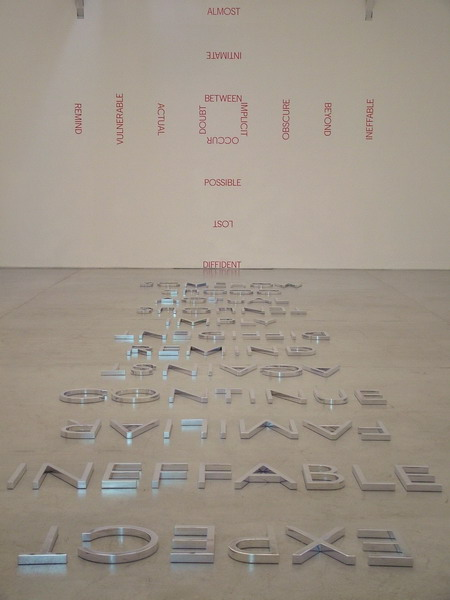


Text/Chen Chi-Hsiang | Time: May 22 to July 18 | Location: Yvon Lambert Gallery
Robert Barry (born 1936) is one of America's most representative conceptual artists. He studied at Hunter College in New York under the guidance of renowned painter Robert Motherwell; however, the truly decisive influence was artist Ad Reinhardt. After meeting him in 1967, he determined to break away from visual formalism, as depicted in Reinhardt’s twelve rules of painting: “No texture… no brushstrokes and no graphics… no form… no movement… no object, no subject… no material” (Note 1). He sought to explore a new concept regarding the relationship between language and artwork. In 1967, he incorporated works into space by painting black squares in each of the four corners of the wall (geometric symmetry symbolizing a large square). In 1968, he placed transparent nylon threads in the exhibition space, creating an effect similar to Lawrence Weiner’s exploration of “the visible and invisible, definite and indefinite” discussed that same year, within the potentiality of the “invisible.”
After 1969, he underwent a complete transformation, liberating himself from material forms entirely, focusing on the non-visual material world. Within reduced logic, he tended toward abolishing all material components, attempting only to manifest a space of “emptiness.” For example, releasing inert gas near California evokes a feeling that can only be intuited; there permeates an odorless, colorless, and formless gas, equally striking like electromagnetic waves. This invisible inquiry or pure absence on site leads to subsequent appearances in the exhibition venue through a proposal directly written on the wall, reflecting on the display scene: “A place where we can express, and for a period of time we can freely think about what we are doing.” He further abolished overall visible elements, seeking a purely conceptual perceptual world with metaphysical transcendental effects. For instance, when participating in an exhibition at Simon Fraser University, he wrote in the catalog: “Attempting a work of telepathic transmission, naturally a series of thoughts, it can only be transmitted neither through language nor through images” (Note 2). All these statements declare something abstractly idealistic based on the artist’s will, built on the cornerstone of transmitting knowledge, incorporating the spiritual volume of art, thus developing more ingenious works such as Invitation Work (1971), Closing the Gallery, or Marcuse Works. Barry mailed invitations stating that the gallery would be closed during the exhibition period. Or during his solo exhibition at the Yvon Lambert Gallery in Paris in 1971, the exhibited works were not his own but those of other artists or critics he invited. The artist disappeared, leaving behind radical concepts. This stands in contrast to Weiner’s abstract proposals; while Barry focused on immateriality, L. Weiner grasped the material aspect.
Starting in 1977, Robert Barry operated a series of works returning to painting, using monochromes or direct painting on large walls, emphasizing the linguistic effect of writing (often painted on the edges of the canvas or wall), thereby giving a special emotional resonance. Robert Barry stated that his themes are: “Color reveals the characteristics of space, that is, the background of text. Each element relates to and affects all others (e.g., the exhibition environment), while all retain their individual appearance. This becomes a space of refined technical operation… ensuring everything continues to transform in space, and all expect the whole not to collapse” (Note 3). These sentences possess an impressionistic depiction, lacking any analysis or criticism; they dominate a diverse sense of feeling, triggered by architectural or psychological backgrounds and conceptual structures.
Robert Barry’s “Word Lists” solo exhibition, in the most perfect spatial installation, synthesizes over 40 years of conceptual art experience, continuing its possibilities. The most striking work extends from past walls to the floor: a monumental arrangement series (stainless steel) featuring facade text. Under rhythmic structural cadence, it echoes and contrasts with text written on the main wall. Two single-gray paintings and two series of wall-space writings resonate in plane and facade, perception and cognition, imagination and space. Intellectual construction creates a unique emotional resonance.
Note 1: Art Press magazine, Issue 4, May–June 1973. Note 2: Ghislain Mollet-Viéville, Minimal Art & Conceptual Art, published by Skira S.A., Switzerland, 1995, p. 110. Note 3: Reference to the “Art & Language” exhibition card at the Centre Pompidou Modern Art Museum in Paris.