Robert Rauschenberg (1925-2008)
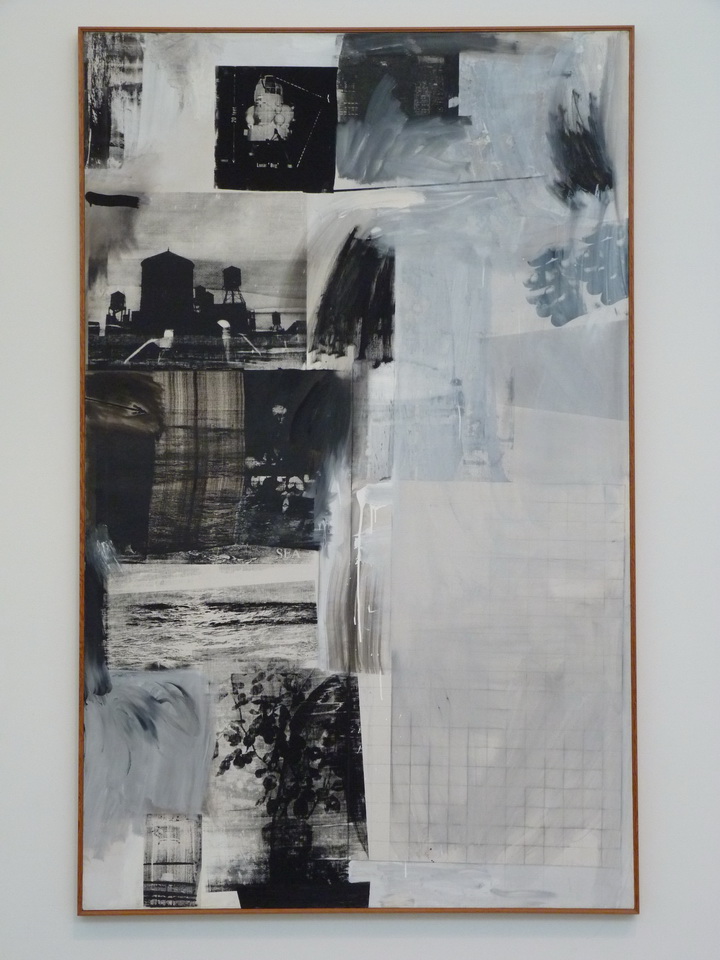
Robert Rauschenberg Almanac 1962, collection of Tate Modern, London
Rauschenberg (1925-2008) was the most unkempt artist in American art history and a pioneer of Pop Art. His works are filled with clichéd subjects and self-mocking attitudes, blended into his highly creative expressions and poetry. He never stayed within one stylistic mode; thus, formalist artists of the 1960s strongly disliked him, believing his work represented all modernism's flaws: frivolity, diversity, self-absorption, impurity, and lack of seriousness. Conversely, they were stimulated by his bold, abundant, and unpretentious talent. For him, art could exist for any length of time, on any object (from goat specimens to living bodies), in any place (not just stages, video cameras, underwater, on the moon, or sealed envelopes), for any purpose (to please, contemplate, meditate, entertain, stimulate, or frighten), and in any exhibition venue—from museums to trash cans. As he declared: "Why not admit that the world is a composite painting!"
After exhibiting his first monochrome paintings in 1950, Rauschenberg began to favor "Composite Paintings," a new creative form where painting surfaces (silkscreen) incorporated various objects. His early Composite Paintings were created following the method of Dada artist Kurt Schwitters, loosely linking related images into a theme, like Puzzle, dominated by flight, including photos of bees, dragonflies, mosquitoes, fly eyes, and the smoke from Botticelli's The Birth of Venus. Twenty years after completing this work, he explained: "I tried to use very abstract things so others couldn't see what it was, or the tangled (overlapping image) objects so they couldn't be recognized. Yet also obvious things people hadn't thought to use."
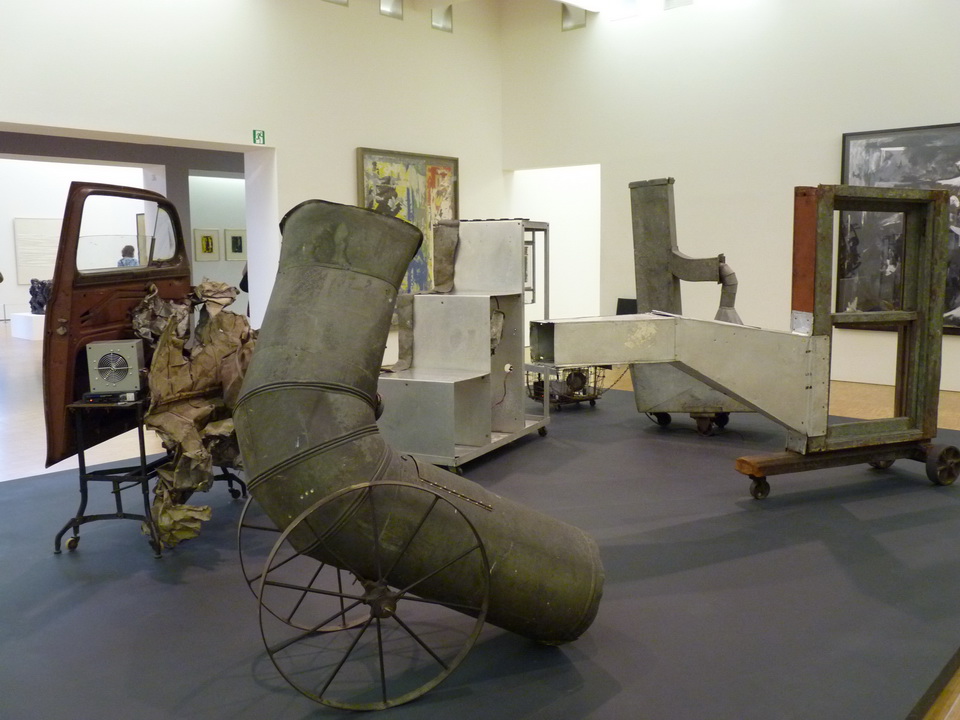
Through the development of these Composite Paintings into three-dimensional objects, people realized Rauschenberg's Composite Paintings, sometimes combined with found objects, became both painting and sculpture, breaking traditional boundaries between them, hence termed "Art." For example, Odalisk (completed 1955-1958) recalls Ingres' masterpiece, depicting a nude woman in a harem, with columns standing on soft pillows, and boxes covered in prints of classical nudes on the columns, while a gauze net covering the box metaphorically represents the veil worn by Muslim women. A stuffed chicken stands atop the box, referencing the French term for high-class prostitutes. Canyon (completed 1959), featuring a stuffed eagle with spread wings, and Monogram, with a poetic goat hanging from a car tire in the center, proved the space between painting and sculpture, flat and three-dimensional, painting and object.
The artistic philosophy behind Composite Paintings came from composer John Cage, whose main idea was: "Do not give the audience's psychology a focal point of attention. The artist does not create something that alienates or closes off viewers; rather, he creates works that make viewers more open and more aware of their own existence and environment." He also said: "New music, new listening, is not about trying to understand what is being said, because if anything really is said, the sound will be a verbal shape; what we should do is simply pay attention to the activity of the sound." Under this viewpoint, Rauschenberg's Composite Paintings displayed non-focal (scattered) imagery, or simply focused on the activity of painting itself. For instance, his act of erasing a drawing by Duchamp, his statement in a telegram: "If I say this is a portrait of Iris Clert, then it is Clert's portrait," or his numerous improvisational performances, all became pioneers of performance art, influencing subsequent Pop Art development. As art historian Rosenblum said: "Rauschenberg possesses the characteristics of a versatile genius; artists after 1960 who challenged the boundaries of painting and sculpture and believed life could become art were all influenced by Rauschenberg."