Samuel Beckett Special Exhibition
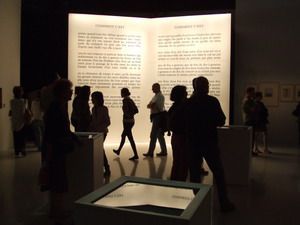
(Left) Samuel Beckett special exhibition poster. (Right) The special exhibition retains a unique scene in the exhibition space. The Samuel Beckett special exhibition was grandly displayed on the second gallery of the sixth floor of the Centre Pompidou from March 14 to June 25, and I thought it was a
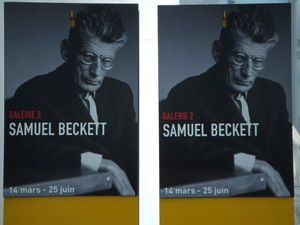
The Samuel Beckett special exhibition was grandly displayed on the second gallery of the sixth floor of the Centre Pompidou from March 14 to June 25. I thought it was a literary special exhibition, but unexpectedly this Nobel Literature Prize S Beckett special exhibition is more profound and more exploratory than current art. The entire special exhibition is built on Samuel Beckett's literary works manuscripts and personal data, experimental theater, play directing, films, etc. Rather than being based on unique and powerful visual image thinking, it combines the works of avant-garde artists of his era to expound contemporary insights, and verifies the works of current artists influenced by Samuel Beckett's thoughts.
In the smooth dramatic audio-visual and reading scene installation exhibition, there are eight major themes displayed: Sound, Retention, Scene, Trick, Eye, Square, Bram, and Black. Upon entering the exhibition space, one is immediately attracted by a large video art work of a mouth constantly reciting lines (Not Me), an Italian artist C. Parmiggiani work. Close to a wall, audiences can listen to fragments of the sound of Samuel Beckett's literary and poetic works. Of course, literary works are text, welcoming visitors with sound. The retention or only exhibition space displays numerous manuscripts of Samuel Beckett and large wall texts for audience reading, accompanied by some performance artists who drew inspiration from Beckett, such as Bruce Nauman, Paul McCarthy, Andrew Kotting, etc., presenting unusual body art performances.
The scene exhibition presents a series of theater films and picture materials directed by Samuel Beckett. Theater allowed Samuel Beckett to break out of his closed novel creation, directly conveying deeper and internalized thoughts and insights through theater scenes and spaces. In these experimental theater films, he ingeniously constructed images, texts, music, spaces, and emotions, conveying the absurdity and ineffable feelings of human existence in comedies and tragedies such as "Waiting for Godot" and "Endgame."
The Trick exhibition room displays life data of Samuel Beckett, including documents, letters, and pictures, as well as audio-visual recordings of contemporary writers and playwrights discussing and interpreting Samuel Beckett's works and influences under the blue sky and white clouds. The Eye exhibition room screens the script written by Samuel Beckett in 1963, and the film shot with Buster Keaton in 1964. The eye perceives objects or objects perceive; perception is entangled through the will to perceive. This exhibition room also screens the film by British contemporary video artist Stan Douglas close to Beckett's absurd world.
The Square exhibition room is immediately attracted by a video of logical gameplay projected on the ground by Samuel Beckett. In the square geometric space, four figures dressed in white enter one after another, walking around the square, and then disappear one by one outside the square. There is a strong visual effect that brings a sense of inexplicable unease. On the wall, there is a video work "Slow angle walk" by Bruce Nauman, who looks like Beckett, which has always been a video of exaggerating steps in the studio. Ingeniously, this video is played in reverse, making people even more uneasy.
The Bram exhibition room displays a series of paintings by Bram Van Velde, a lyrical abstract painter in Paris in the 1950s. In 1937, Beckett met Geer and Bram Van Velde brothers and became good friends. Beckett once wrote the preface and research articles for the catalog published for Bram's painting exhibitions. From Bram's paintings, one can feel empathetic as if reading Beckett's literature: "Except for emptiness, no, emptiness too, neither more nor less."
In the Black exhibition room, the dim light is almost monochromatic. The disappearance of limits confuses Beckett. Here, works created for television in 1975 and 1986 are displayed. Almost all language and writing are exhausted beyond experimental images, such as "Ghost Trio," "Nacht und Traume," and "What Where," as well as black and white monochrome paintings by French and American painters Genevieve Asse and Robert Ryman. Finally, the painting "Silence" by Italian artist C. Parmiggiani ends this physical and mental feeling of the Samuel Beckett special exhibition.
Samuel Beckett is one of the most representative novelists and experimental playwrights of the 20th century, and the winner of the 1969 Nobel Prize in Literature. He is famous for his unusual absurdity, irony, and unpleasant novel world, and his thoughts clearly reflect the background of his era, a type of human disaster. S Beckett was born in Dublin, the capital of Ireland, in 1906. From 1923 to 1928, he studied at Trinity College and discovered French literature. From 1928 to 1930, he visited Paris and met another famous writer James Joyce, his fellow countryman, and began to express his poetry, essays, and translations in English and French. From 1931 to 1937, he began writing and became a teaching assistant at Trinity College, but resigned automatically in less than a year due to family problems, economic difficulties, and poor health. He went to London to study psychoanalysis with W-R Bion. In 1937, he published his first English novel "Murphy," traveled to Germany, and came back and forth between France and Ireland.
From 1938 to 1946, he settled in Paris. During World War II, he became a member of the Resistance, hiding from the German army in the countryside of Vauluse, France, until the end of the war. During this period, he wrote "Watt" and in 1944 became a member of the Irish Red Cross, participating in relief work in Saint-Lo, France. From 1946 to 1951, he decided to write novels and plays in French. In 1951, he completed "Molloy" and "Malone Dies (Malone meurt)." In 1953, "The Unnamable (L'Innommable)" was published by the Minuit Press in Paris. In 1953, the script "Waiting for Godot (En attendant Godot)" was directed by Roger Blin at the Babylone Theater.
From 1954 to 1964, he translated his novels and plays into English and wrote "Happy Days." In 1957, "Endgame (Fin de partie)" and in 1963, the script "Oh! The Beautiful Days (Oh les beaux jours)" were interpreted by Madeleine Renaud and performed at the Odeon Theater. In 1964, he filmed with Buster Keaton. In 1969, he won the Nobel Prize in Literature. From 1969 to 1988, he acted and directed theater himself, and wrote scripts for television. After publishing "Not Me (Pas moi)" in 1972, he continued to publish "Last Poem (Dernier poeme)" and "How It Is (Comment dire)." In 1989, shortly after the fall of the Berlin Wall, he passed away on December 22 in his beloved Paris.