Botticelli (Sandro Botticelli 1445-1510) - The Birth of Venus (c. 1483–1485)
The Birth of Venus (c. 1483–1485), 172.5×278.5 cm, tempera on panel, Uffizi Gallery, Florence. "Venus" is arguably the most elegant formal symbol of the Italian Renaissance...
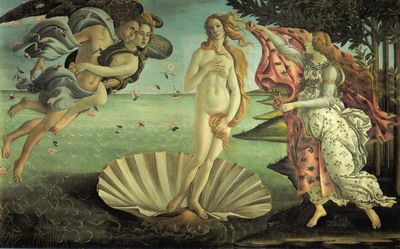
The Birth of Venus (c. 1483–1485), 172.5×278.5 cm, tempera on panel, Uffizi Gallery, Florence. "Venus" is arguably the most elegant formal symbol of the Italian Renaissance and the perfect image of humanists, representing Botticelli’s most mature expression. In this theatrical scene set against a vast, clear sky and stormy coast, Venus, full of romantic youth, appears pure and flawless. According to myth, she was born from the sea, standing naked on a half-shell; her captivating curves and skin white as water gaze at us (the secular world) with a hint of confusion and sorrow. One hand shyly covers her breasts, while the other holds her hair to conceal her private parts, quite charming. From the upper left, two dynamic Zephyrs fly intertwined in an embrace, their clothes billowing down from heaven, blowing hard to propel Venus’s golden hair flowing in the wind toward the shore. Roses fall from the sky, waves roll in, creating a romantic atmosphere. On the shore, a nymph dressed in splendid floral attire adorned with rose vines holds a red garment with gold edges and flowers to welcome her, presenting a poetic and highly visual allegory. This carries strong metaphorical significance for the arrival of a new era, especially the beginning of a secularized new world; he has broken religious constraints on life itself, freeing the spirit to enter a earthly paradise.
Clearly, both The Birth of Venus and Primavera are masterpieces under naturalistic realism, emphasizing object volume, movement, soft light, harmonious tones, and rigorous structure through lines and forms, though perspective space was not his focus. Of course, his detailed depiction of the elaborate costumes and hairstyles of these youthful goddesses, Flora, and Cupid, or the image of Venus, manifests the intellectual and ideal beauty of Neoplatonism at that time. Art historian Caneva wrote about Botticelli: “This mythological allegory, along with his style and his background in the Neoplatonic era of Lorenzo il Magnifico, whether ‘Primavera’ or works from around 1480, naturalistic realism became for those intellectuals and artists a way to express ideal beauty, dominating their creation. The appearance of Venus is the incarnation of this concept and a harmonious, perfect world, becoming a symbol of humanity’s noblest qualities.” The Birth of Venus elucidates the wisdom of this social context, just as ‘the true birth of beauty combines idea – spirit and nature – matter, realizing such a perfect and excellent concept of humanity.’