Shirin Neshat Solo Exhibition
"Munis and Revolution" video art, sacrifice for righteousness - romantic sentiment plot. 2008. Image from www.galeri-jeromdenoirmont.com
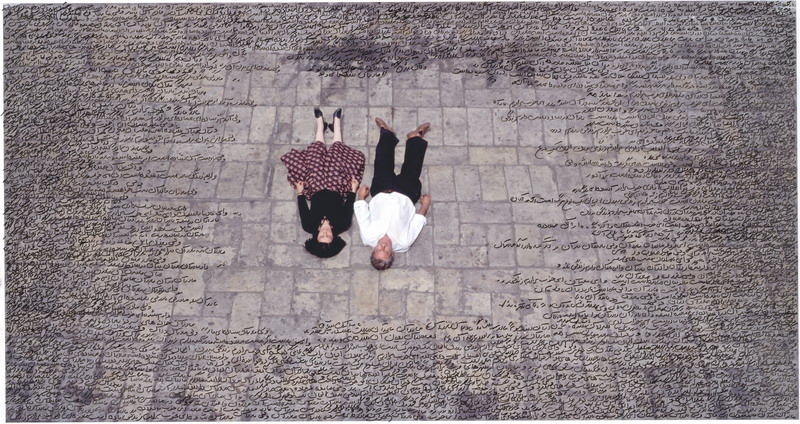


Haji Portrait 152.4x101.6 cm 2008 Image from www.galeri-jeromdenoirmont.com Shirin Neshat solo exhibition: On display at Jerom de Noirmont Gallery from February 8 to April 5. Born in Qazvin, Iran in 1957, Shirin Neshat immigrated to California, USA in 1974. Like Mona Hatoum, she is one of the most representative female artists under current globalization, within their cross-cultural explorations today. Her work is built on the relationship between her Iranian homeland emotions, Islamic religion, society, and women's bondage. Shirin Neshat says, "I understand my creation as a kind of visual discourse on the theme of 'Islam and Feminism Today,' like a discourse analyzing some mysticism and reality. The conclusion is that these are all infinitely more complex than we can imagine." As early as the 1999 Venice Biennale, I was moved by her chaotic video works (this work won the Golden Lion Award at this Biennale). Those powerful and poetic images and elegant music contrasted with the dramatic scenes of male and female singers (the male singer had enthusiastic audiences and applause when singing, while the female singer performed to an empty hall), which maximally demonstrated the obvious differences and unequal treatment of men and women in Islamic society, such as domination and subjugation, East and West. Today, it is a great honor to watch Shirin Neshat's new works again. In quite professional film art, the images are more refined, perfect, and mature, continuing in a unique literary narrative style, entangling delicate female thinking structures and dense poetry. In recent years, she has expanded from feminist issues to concepts closer to the Third World's society, identity, exile, refuge, and utopia. This new work release presents two major series: large portraits (photographic images) and two video works titled "Munis" and "Faezeh." Since 2003, Shirin Neshat's creative inspiration has come from her fellow Iranian writer Shahrnush Parsipur's "Women Without Men," a bewitching magical realist novel depicting the intertwined lives of five women in Tehran during the summer of 1953, when the US intelligence agency helped the Shah regain power in a coup. The author was imprisoned for this book and eventually exiled. The novel narrates how five brave women pursuing freedom struggled against social pressure during national crisis. Shirin Neshat interprets their life relationships through five video artworks. In 2003, the first one titled "Mahdokht" presented how a woman fought against sexual taboos. Then in 2005, titled "Zarin," dealt with the touching scene of a young female worker's physical and mental depression. In this solo exhibition, two more romantic yet tragic works, "Munis" and "Faezeh," were released. The event construction of the "Munis" video centers on a story about a young girl around thirty years old. Munis is an idealistic, socially and politically active member who longs for freedom and democracy during this era of regime change. However, facing her brother being oppressed, and witnessing a political activist being murdered beneath her building from a high-rise platform, in extreme sadness, anger, and despair, she jumped to her death from the high-rise. Her body landed right next to this male activist. This rather romantic death seemed to provide an extraordinary opportunity to converse with him. She discovered that reality is sometimes hopeful and simultaneously disappointing when it is right before your eyes. "Faezeh" depicts even more tragically a young, beautiful girl who converted to religion and dreamed of a happy marriage. This beautiful dream was shattered by a rape incident. Her good friend Munis took her to the countryside fields for recuperation. In this quiet rural area, her schizophrenic mind was filled with hallucinations, frequently haunted by a woman wearing black clothes and a face-covering mask (a representation of Islamic women) appearing and disappearing around her life and throughout the forest. Eventually, she became paralyzed and insane. This work fully interprets the emotional and spiritual collapse of women under Islamic religious society, including the overall shattering of religious faith, morality, and existential beliefs after accidental violent assault, etc. These two videos, under superb cinematic professionalism, excellent actors, bewitching lighting and scenes, perfect lens frames (like paintings), and unusual narrative techniques, are full of imaginative space like poetry and pictures. Shirin Neshat created this new series of male and female portraits from the novel "Women Without Men." These portraits are figures from the historical background of Iran in the 1950s. Exquisite and perfect large portraits, including full-body and half-body images. Many striking portraits feature densely coded Arabic script set against different scenarios and frames, either on faces or becoming backgrounds, obviously hinting at, of course, introducing the artist's extraordinary culture of origin and her beloved literature, and strengthening the mysterious narrative characteristics of the portrait figures, allowing written text to eternally contrast with images.