Visit to the Reina Sofía Art Center in Madrid
(Front) The front of the Reina Sofía Art Center. (Left) Plensa's Monument sculpture in the plaza. (Right) The permanent exhibition hall is nearly ten stories high, with geometric square skylights; one can see clouds floating in the sky, centered on a Roy Lichtenstein monument-style carving. (Third)
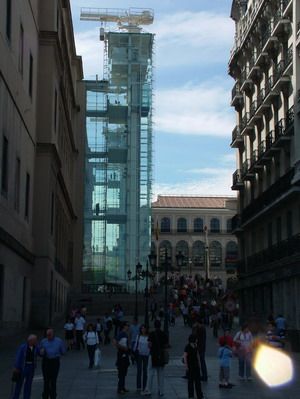
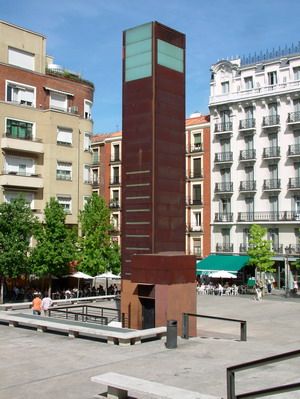
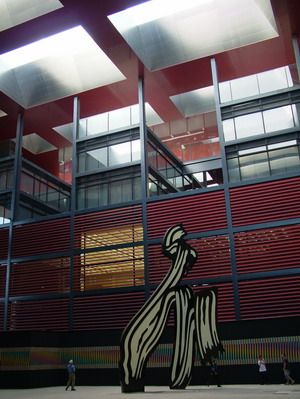

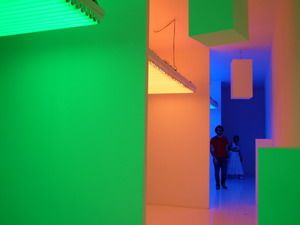
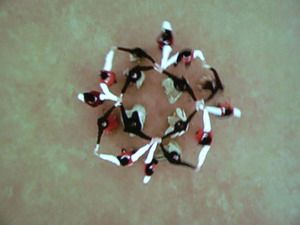
The front of the Reina Sofía Art Center. On the left, Plensa's Monument sculpture in the plaza. On the right, the permanent exhibition hall is nearly ten stories high, with geometric square skylights that are quite poetic, allowing visitors to see clouds floating in the sky; at the center is a core carved in the form of a Roy Lichtenstein monument. In the third image, Picasso’s Guernica, world-renowned and the crown jewel of the Reina Sofía Art Center. Bottom left: Carlos Cruz-Diez’s dramatic installation by a South American artist. Bottom right: Alberto Peral’s video art Bailando by a Spanish artist.
A must-visit for art pilgrims in Madrid are the Prado Museum and the Reina Sofía Art Center. The Prado is the temple of Spanish classical art, while the Reina Sofía is the stronghold of modern and contemporary Spanish art. Carefully visiting these two museums provides a clear understanding of Spain’s glorious artistic history over five centuries, perfectly presenting an exquisite and complete evolutionary history of Spanish art.
The Reina Sofía Art Center was constructed from a former general hospital. Two transparent elevators stand out prominently in front, appearing somewhat incongruous but serving a remarkable function by leading people directly to the exhibition halls on the fourth floor. The plaza itself is not particularly striking, featuring three monument-style environmental sculptures: Miró’s naive sculpture and two geometric architectural Plensa sculptures on either side (marking the entrances/exits to the underground parking lot). Surrounded by restaurants and cafes, it serves as a resting place for tourists and young Spaniards.
The collection focuses primarily on Spanish art, with each theme engaging in dialogue between local art and international trends. Its crown jewel is Picasso’s Guernica, attracting thousands of art pilgrims daily who wish to witness this tragic masterpiece with their own eyes, especially in Exhibition Room 6c on the second floor, which is often crowded with curious onlookers. As the center for Spanish modern and contemporary art, it features permanent collections (on floors 2 and 4) and regular contemporary special exhibitions (on floors 1 and the basement).
The second-floor permanent collection begins with the "Depiction - Figurative" theme, including "New Object - Magical Realism," featuring famous painters such as Miró, Dalí, and Picasso (alongside many lesser-known local artists). Sub-themes within Cubism include Analytical Cubism, Late Cubism, and Geometric Abstraction, with notable works by Picasso, Gonçalas, and Lezère. The "Picasso - Background of Guernica" section is the most crowded area, housing the famous painting. In the Surrealism section, attractive works come from Dalí, Magritte, Mata, and Tanguy. Sub-themes like "Surrealist Objects" feature whimsical pieces, while "Surrealism, Film, and Photography" offers rare views of works by renowned Spanish filmmaker Luis Buñuel.
The fourth-floor permanent collection begins with "Spanish Art in International Trends," featuring Anthony Caro, Isamu Noguchi, David Smith, Mark Rothko, Francis Bacon, Jean Dubuffet, Cy Twombly, among others. There are also dedicated rooms for French artist Yves Klein, Italian artist Lucio Fontana, and Spanish artists Antoni Tàpies and Antonio Saura. This is followed by a room on 1970s Italian Arte Povera, an American Minimal Art room, and a narrative realism room presenting the Guernica school and Eduardo Arroyo. In postmodern art, there is Georg Baselitz representing German Expressionism. Additionally, the focus is on the younger generation of Spanish artists: Barceló, Broto, Sicilia, Urzay, Usle, Solano, Plensa, Muñoz I, and Iglesias, covering painting, sculpture, objects, photography, video art, and installations. Naturally, the distinctive characteristics, unique style, and atmosphere of Spanish art cannot be replaced elsewhere, making it easy to understand the relationship between Spanish art and global artistic trends.
Regular special exhibitions are held in three rooms on the first floor. Currently, Spanish artist Alberto Peral’s video art Bailando is being shown across three screens in two exhibition rooms. Young Spanish dancers, paired up and wearing traditional red, white, and black costumes, dance gracefully to rhythmic music, holding hands and changing forms. Due to the bird’s-eye view, various novel patterns emerge, resembling a kaleidoscope with exquisite variations.
The latest regular exhibition space is located in the basement, a highly modern building constructed with steel and glass combined with existing structures, showcasing excellent postmodern style (a masterpiece by French architect Jean Nouvel). Two regular special exhibition spaces currently host a 1960s Op Art (Los Cineticos) exhibition, featuring groundbreaking works by Jesus Rafael Soto, Carlos Cruz-Diez, Julio Le Parc, and others.
In the large triangular exhibition hall, which is nearly ten stories high, the roof features geometric square skylights that are quite poetic, allowing visitors to see clouds floating in the sky. At the center is a core carved in the form of a Roy Lichtenstein monument. Beside it is a dramatic neon light and architectural space installation by South American artist Carlos Cruz-Diez. Surrounding the large exhibition hall are a bookstore, library, lecture hall, and restaurant. Those interested in the Reina Sofía Art Center in Madrid may visit the website or watch the following: [[http://www.museoreinasofia.es|www.museoreinasofia.es]].