Sophie Calle "Take Care of Yourself" Solo Exhibition
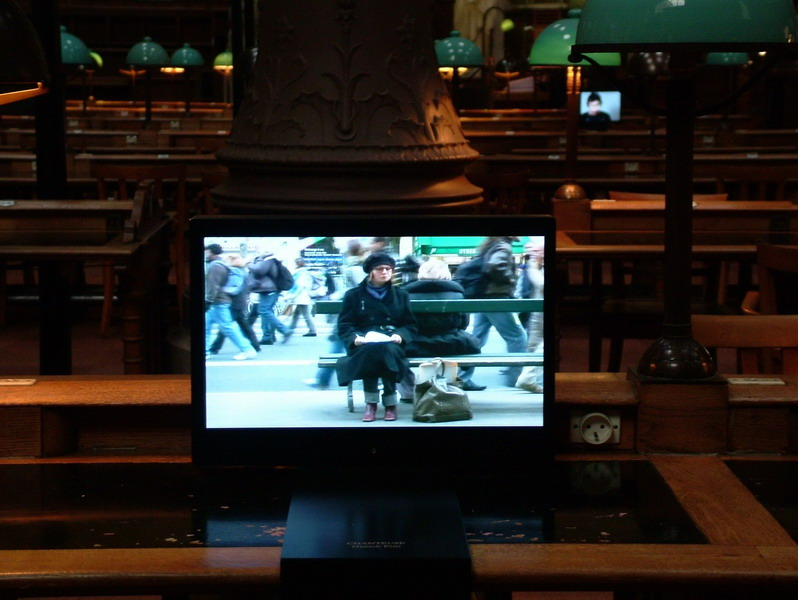
Video art is another climax of viewing and reading in this exhibition.
Reading a letter of breakup becomes the core of the "Take Care of Yourself" exhibition. Sophie Calle's "Take Care of Yourself" solo exhibition: on display from March 26 to June 15 at the Labrouste Reading Room, Richelieu National Library. Sophie Calle (born 1953) is an outstanding visual artist, photographer, writer, and director, operating across the unusual fields of art and literature, and is one of the few female artists in France with international renown. Since taking her first non-preferential photographs while traveling in California, USA, in 1978, photography has become the scaffold for her artistic expression. After returning to Paris, she participated in the 11th Paris Biennale in 1980, then created the "Street Follow" works (photography and text) within narrative plots. Approaching the conceptual art forms of the 1970s or more explicitly narrative art, such as that explored by French artist Jean Le Gac. She worked as a maid in a hotel in Venice, recording the situations of rooms used by guests, the famous "Hotel" series. In 1984, she was invited to California, where she asked residents—"Where are the Angels." And obtained a grant to travel around the world, touring Siberia, China, Japan, India, etc.; travel became performance art akin to actual life experience. The experience of emotional breakup became her memorial form of descriptive record works, such as the "Subtle Pain" series from 1984-2003 or the "Take Care of Yourself" series, etc., between the subtle and complex relationship of life and art. In 1986, she asked blind people about their views on beauty, the beautiful "Blind" series, contemplating an aesthetic perspective. From 1988 to 2000, it revolved around personal intimate narrative biographical series. Her first retrospective was held in 1989 at the Fred Hoffman Gallery in California; in the same year, she asked employees of the Paris Municipal Museum of Modern Art and the New York Museum of Modern Art to depict abstract works from their memories—the "Imaginary" series. In 1990, she realized her only photographic series without text, "The Cemetery"; in the same year, she began her large-scale survey series "Last Seen," museum acceptance of art. In 1991, she again asked blind people to depict monochrome paintings, regarding the experience and insight of color—the "Blind People's Colors" series. In 1992, she collaborated with artist Greg Shephard on the "No Sex Last Night" series. In 1996, she conducted a documentary series asking East German residents about "Memories of East Berlin," and went to Israel to ask Jews and Palestinians about their views on Jerusalem—the "L'Erouv de Jerusalem" series. In 1997, she produced the ecological diet series "Color-Specific Recipes" through monochrome recipes, thus generating the life series under the shapes of letters B, C, and W in 1998. In 2000, she sent her bed across the Atlantic to San Francisco, asking a stranger to depict a story of personal grief—the "California Travel" series. In 2001, another new private investigation series "20 Years Later"; in 2003, she was invited to the Centre Pompidou Contemporary Gallery to hold the retrospective "Do You See Me?" In 2007, a grand exhibition at the French Pavilion of the Venice Biennale. For 30 years, Sophie Calle has used her personal (virtual and non-virtual) intimate life as a narrative literary artistic exploration, under categories similar to conceptual art and narrative art, using all possible material scaffolds: photos, video, film, performance, and books, etc. Images become indispensable text of the body, while text becomes the soul of the work. In all of this, through her feminine sensitive creative process, she interprets or narrates the delicate and emotional life situations of "her" or "women," like a novel of a woman's secret garden of continuous whispers or a bewitching human theater.
This special exhibition "Take Care of Yourself" is Sophie Calle's major work from participating in the Venice Biennale in 2007. Following last year's exhibition, this year she specially shares this series with French art-loving audiences, selected to be exhibited at the Labrouste Reading Room of the Richelieu National Library. The overall space was curated by the renowned spatial artist-curator Daniel Buren. Under seamless arrangement, the intensity of the work's space is highlighted, allowing the audience to enter a unique artistic reading context in this open library reading exhibition room, carefully sharing Sophie Calle's dramatic masterpiece.
These special exhibition works revolve around the stories of 107 women, interpreting the state of mind reflected in a broken emotional "cut-off electronic letter." Sophie Calle explained this theme: "I received a cut-off electronic letter, as if it were not my destiny. The last sentence of the letter was 'Take care of yourself,' so I took this sentence as the theme for exploration. I solicited 107 ladies to interpret this letter from their perspectives based on their professions and talents. Analyze, annotate, perform, dance out, sing, etc. Help me analyze carefully, understand, and exhaust, in my position. As a way of interruption in time, in my pace, thus taking good care of myself." The artist solicited 107 women from various walks of society (such as famous actors, vocalists, playwrights, writers, clowns, puppeteers, physicists, and Indian dancers, etc.) to freely interpret this cut-off letter in various workplace scenes. Under the most literary narrative context, through photos, texts, videos, and one plot book after another, the visit becomes a poetic reading, a dual reading of audio-visual and text, that is, the reading of images (photos and videos) and texts, immersing the audience in a narrative literary context, freely soaring in personal imaginative spaces and the realm of human emotional worlds.