Steven Parrino "La marque noire" Retrospective
(Fig. 1) Trashed Black Box II, constructed as a frontal square box, 2003. (Fig. 2 left) The striking 3-unit combination Units Aluminiam death shifter, 2001. (Fig. 2 right) Coustic Pill, 2001. (Fig. 3) Full view of the environmental spatial installation — 13 S…
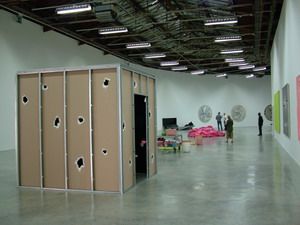
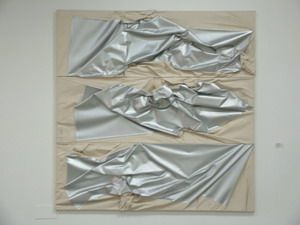
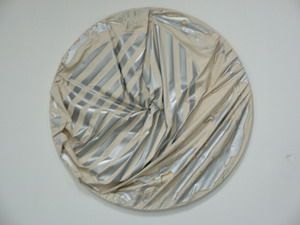
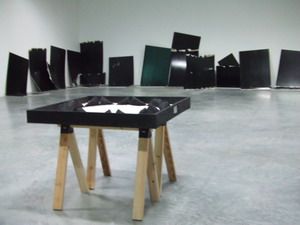
(Fig. 1) Trashed Black Box II, constructed as a frontal square box, 2003. (Fig. 2 left) The striking 3-unit combination Units Aluminiam death shifter, 2001. (Fig. 2 right) Coustic Pill, 2001. (Fig. 3) Full view of the environmental spatial installation — 13 Shattered panels for Toe Ramme, 2001.
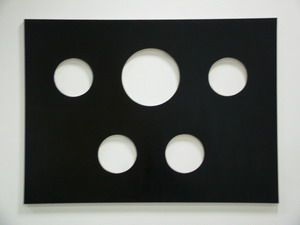
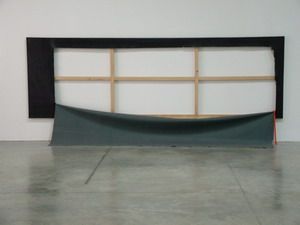

(Fig. 1 left) The unconventional Stockade - Existential trap for speed freaks, 1988–1991. (Fig. 1 right) Crowbar, an exploration of painting space, 1987. (Fig. 2) The painting spatial installation The self mutilation bootleg 2 - The open grare, 1988–2003.
The Steven Parrino retrospective "La marque noire" was grandly presented from May 24 to August 26 at the Palais de Tokyo contemporary art center in Paris. This extraordinary retrospective comprised two exhibitions, Before (at most or at least) and Bastard creature, encompassing his explorations and activities in the plastic arts. The exhibition Before featured artists who had profoundly influenced Steven Parrino's creative work, such as Frank Stella and Donal Judd, among others. Bastard creature was an exhibition curated by Steven Parrino in 1999 and 2003 based on his artistic viewpoint. Through these, one can gain a more complete and in-depth understanding of Steven Parrino's overall oeuvre and logical concepts. This mode of exhibition broke with the format of many traditional retrospectives of the past, no longer presenting a single chronological system, and opened up a new vision for future retrospectives.
Steven Parrino (1958–2005), a Swiss artist, lived a life of absolute intensity. Driven by a radical avant-garde will, he engaged in diverse artistic explorations ranging from the plastic arts to experimental film, industrial design, and comics. In the early period (the 1980s), amid the storm of postmodern sensibility and figurative painting, he moved further into the post-minimalist abstract world, rediscovering the source of American Minimal art through a love of infinite surfaces, and radically entering into the most extreme exploration of painting. Clearly, within the great current of postmodern art, the 1980s saw a return to the embrace of history and a return to sensibility-driven figurative art. The emergence of neo-geometric abstraction or neo-abstract geometric rational painting in the 1990s was clearly a reaction against the passionate, expressive figurative painting of sensibility. Thus, the stronghold of European neo-geometric abstraction or post-minimalism was not in Germany, nor in Vienna, Austria, and certainly not in Paris, France (France appeared quite indifferent to geometric abstraction), but in the hardly imaginable Geneva, Switzerland — a gift of the subtle influence of Mosset (Geneva, Switzerland), a member of the BMPT group. Steven Parrino also fell within this scope.
Surveying Swiss neo-geometric abstraction (or post-minimalist) art, one can categorize it into three cases. First is the exploration of Armleder (the most internationally representative figure in Swiss neo-abstraction of the 1990s), who re-established a kind of aesthetic awakening, synthesizing geometric art and Op art while cleverly incorporating Duchamp's readymades — a hybrid of modern art history, ingeniously establishing a unique species of neo-geometric abstraction or neo-abstract geometry. Second is the Swiss artist Federle, based in Berlin, Germany, who restored Mondrian's rigorous aesthetic vision, demonstrating the regularity of harmonious and perfect plastic form within the logical thinking of a rigorous (vertical and parallel) structure and systematic form. Last is Steven Parrino, who built upon geometric form and color reduced to the utmost minimal (with black as the dominant tone), constructing works through his actions: opening a skylight — that is, making holes (geometric forms) (as in Crowbar of 1987 and Stockade - Existential trap for speed freaks of 1988–1991); piercing through clothing — repainting and reconfiguring the picture plane (as in Lee Marvin-Marion Brando of 1990, Repulsion painting IV of 1992, and the circular Coustic Pill series of 2001); taking off clothing — painting (without stretcher bars) taking any form (as in Blod – Fuckheadbubblegum of 1996, placed directly on the ground); constructing frontal paintings (as in Trashed Black Box II of 2003, resembling a cubic building); and through ingenious spatial installation (as in Shattered panels for Toe Ramme of 2001, formed from a series of black wooden panels folded in half), allowing painting to manifest in every possible state. He entered from American Minimal art yet emerged from the French Supports/Surfaces movement to question the very conditions and possibilities of painting itself. (The central question explored by the Supports/Surfaces movement was: what is the object of painting? Is it painting itself? They understood the boundaries of painting itself and moved toward an exploration of all painting materials. Through a dual theoretical perspective — analyzing the conditions of these ideologies and the social relations of these plastic art products — and through practice, they developed these particular methods of painting work, organizing all aspects of their works according to the color and form of materials within the distinction of tools and support formats, seeking to develop upon a formalism of materialists.) (Fortunately, thanks to the current Swiss director of the Palais de Tokyo, Marc-Olivier Walher, people have the opportunity to view art from this unconventional perspective, and because of him, the brilliance of Swiss art radiates and shines in Paris.)
Postscript — In this post-postmodern era and the death of painting, to speak of painting is rearguard or decadent. What more is there to say about "what is painting"? Everyone knows that painting is painting itself. Under the tradition where anything could be art, what is not art? It would be too feeble to still talk about art. Open your eyes and look out at the vast world — everyone knows that art is precisely that which is not. Under the institutional framework of contemporary art, who can forcefully argue what is non-art? Non-art is what is interesting; it is enough just to know. (There is no commentary here pointing to Steven Parrino's works; when inspiration strikes, one must record it for everyone to ponder — how delightfully gossipy.)