"Superdome" Special Exhibition at the Palais de Tokyo, Paris
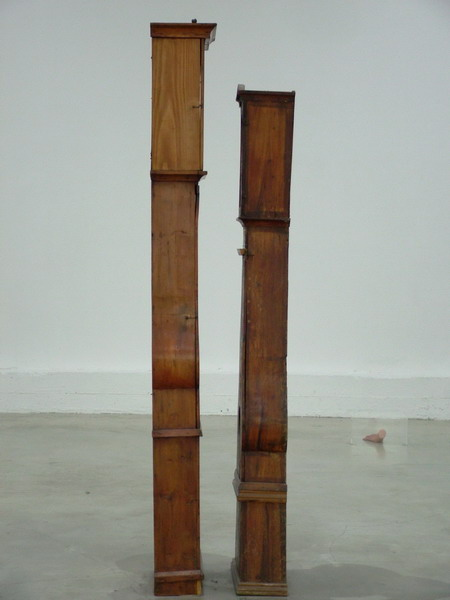
Jonathan Monk - "The Bizarre Couple": Two life-sized grandfather clocks facing each other in a dialogue-style installation, 2008.

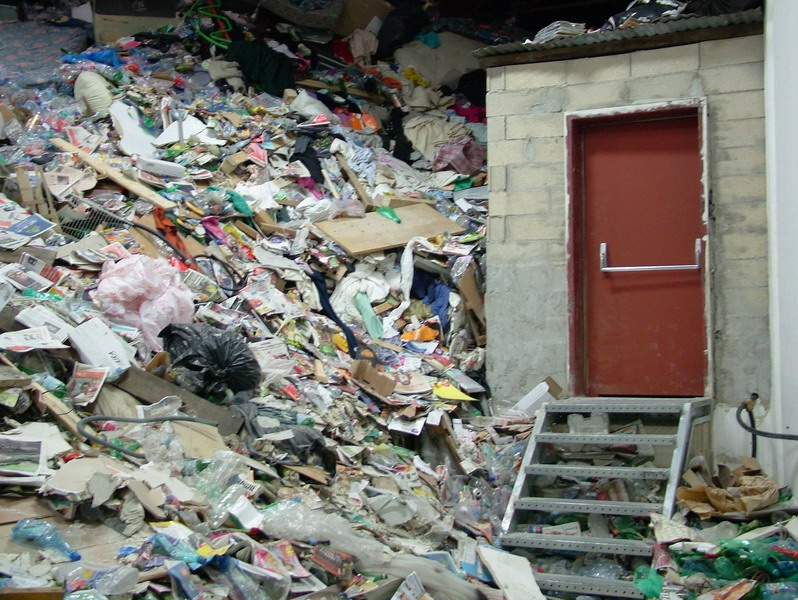
Christoph Büchel - Facing the mountain of garbage head-on is the true nature of the work "Dump". Detail of the work, 2008.
Preface: The "Superdome" special exhibition was held at the Palais de Tokyo in Paris from May 29 to August 24. A group of uniformed Star Wars black steel helmet soldiers, an air gun, an upside-down elephant, two opposing wall clocks, and a huge pile of garbage—extraordinary objects with no connection to one another, unlike any art that resembles art. Viewers wandering through them experienced an extraordinary visual and psychological shock.
The "Superdome" special exhibition offers a new perspective on current European artistic trends. This group exhibition features five monumental solo exhibitions by young artists from three European countries: three French artists Daniel Firman, Fabien Giraud, and Raphael Siboni; Swiss artist Christoph Büchel; British artist Jonathan Monk; and Italian artist Arcangelo Sassolino. All belong to the younger generation of the art world, with the French artists Giraud and Siboni, born in their early twenties, being the most promising. In the current characteristics of artistic forms, where works are exceptionally dramatic, cross-disciplinary, conceptually linked, skilled in mastering new media and techniques, and established in spatial installation forms, these large-scale object and environmental installations point to an extraordinary possibility of chaotic geometry between behavior and concept, matter and form, time and space, imagination and metaphor, fragility and balance.
Theme of "Superdome": The theme of "Superdome" metaphorically represents the collective venting of emotions and situational consciousness of a crazy society since modernism, summarized through super-large sports events, carnivals, political rallies, masses, concerts under festive and frenzied atmospheres, and even collective disaster situations and consciousness of compassion. "Superdome" comes from the legend of stadiums. The magnificent Superdome stadium was built in 1975 in Louisiana, New Orleans, USA, hosting numerous grand sporting events—such as the crazily popular American National Football League Championship—and major political activities—such as the Democratic Party presidential nomination convention. It once hosted Pope Paul II's dramatic blessing mass. When the US mainland suffered the catastrophic Hurricane Katrina a few years ago, this giant dome stadium became an extraordinary shelter for refugees. Under this dual contradictory phenomenon of grand celebration and fear, the inspiration for the "Superdome" special exhibition comes from these attached and schizophrenic emotions and situational consciousness, clearly referring to the portrayal of certain mental states and existential conditions of contemporary Western modern society.
The "Superdome" special exhibition continues Marc-Olivier Wahler, Director and Curator of the Palais de Tokyo, to flexibly operate contemporary art concepts after the Wu Wan period, gathering five contemporary art discussion aspects, wandering between drama and arrogance, decibels and requests, high-tech technology and chaos. "Superdome" is the first group-exhibition-style solo exhibition. It is the first solo exhibition of German artist Jonathan Monk in the Paris art system, the first collaboration between the Palais de Tokyo and the opposite Musée d'Art Moderne de la Ville de Paris, the first major solo exhibition of Fabien Giraud and Raphael Siboni, the first French solo exhibition of Italian artist Arcangelo Sassolino, the first practice of Swiss artist Christoph Büchel's magnificent environmental installation, and the first time a real elephant supports itself in space with its trunk, etc.
The World of Chaotic Geometry: Fabien Giraud (born 1980) and Raphael Siboni (born 1981) are the most promising newcomers in the current French art scene. The two have collaborated since last year's Lyon Biennale, establishing their works on the edge of subculture, wandering between mass consumption, folklore, and Pop. Their disruptive objects often appear exceptionally dramatic under complex event scenes (such as cutting up a civil aircraft in the Lyon Biennale and reconstructing the scene again), questioning the creative possibilities of contemporary subjectivity from a futurist perspective.
Here, "Last monoeuvres in the dark" is an extraordinary audio-visual-object installation, exceptionally dramatically constructed by three hundred evil Dark Vador helmet-wearing death warriors (super warrior heroes from the Star Wars trilogy movies). The neat arrangement resembles a well-trained heroic army, forming a majestic battle atmosphere in a series of rumbling drum symphonies, with magnificent face-to-face fierce combat right before our eyes. Under dramatic cinematic scenarios, each statue is connected to the main computer via micro-electronic wires, commanding group behavior like a military dictator or absolute brain drive, between artificial intelligence's matter and form, imagination and metaphor, chaos and geometry.
Daniel Firman (born 1966) is one of the most representative artists in France today, constantly expanding the field of sculpture with various extraordinary methods. His cross-disciplinary works are very dramatic, raising unusual questions about the overlap of everyday elements and anonymous figures, showing unstable balanced surface structures. Art critic H. Besacier wrote: "The body involves like a magnet, similar to tools surrounding him (like extended furniture), thus allowing him to change the world he surrounds." Through this grotesque architectural accumulation (figures and objects), it obviously crosses behavior and gesture language, revealing the fragile balance relationship between contemporary consumer society and humans. With this high interest in bodies and balance, he developed this gravitational and inverted balance like the dramatic work "Wursa (18000 underground)". In the empty exhibition room, an elephant like in a circus stands on its trunk, a fragile balance that feels like it could collapse at any moment, exploring gravity and balance under extraordinary geometric mechanics, imagining the situation when gravity disappears near the earth's core at 18,000 kilometers underground. Regarding the theme of "Wursa", it comes from the name of the Soviet space probe Sputnik, evoking objects in outer space losing gravity, in a physical and psychological unique dramatic experience, poetic infinite reverie.
Arcangelo Sassolino (born 1967) is Italy's most innovative mechanical design engineer-artist today, influenced by Minimalism's Serra and Judd, considering personal professional experience. Also inheriting Italy's Futurism like Arte Povera. His creation focuses on industrial material processes: mechanical objects and stunning installations. Each planned work is carefully designed and planned by the design team until astonishing results, unimaginable industrial materials and diverse forces (such as gravity, pressure, conflict), emphasizing all aesthetics and metaphors of human and industrial technology. Architectural space walls, floors, and ceilings participate in the construction of the work, obviously emphasizing the mutual penetration relationship between environmental space and the work.
In this Paris solo exhibition, he innovatively exhibited "Afasia 1", an unbelievable pneumatic air gun, target, nitrogen cylinder, and timer environmental space installation, enclosed in iron mesh and transparent plastic houses for safety considerations. "Afasia 1" is an extraordinary sculpture-object. This air gun is mounted on a central lifting column axis, vertically balanced mechanical structure, on which a series of green beer glass bottles can be placed. Timed, the gun shoots beer glass bottles at full speed of 600 km/h to an iron plate (target) one hundred meters directly in front. At this intensity, the ground is covered with crushed green ashes, imaginable results of speed and intensity. Viewers always excitedly wait for this dramatic shooting moment and are often surprised by the unexpected explosion sound. The relationship between the work and the audience is not only intellectual but also physical, in a sense of unease and threat. The artist believes this is our current living situation, full of violence or hidden violence. He explains: "My sculptures are temporary releases of bodily pressure, a lasting memory, a crisis balance. I do not create images, but create a state of tension things, and thanks to pneumatic pressure and gravity, constructed through massive friction." Regarding the use of beer bottles, it is a reference to Pop and rock culture to urban environments.
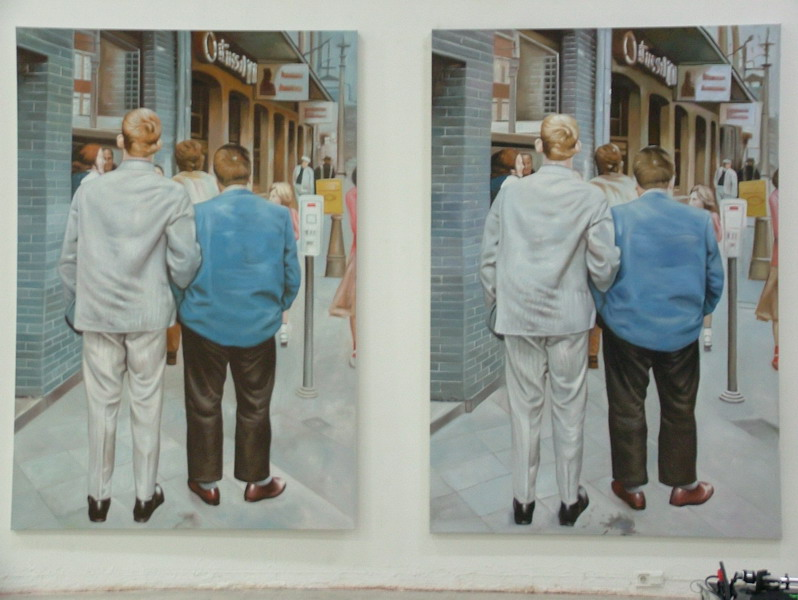
Jonathan Monk (born 1969) is currently the most famous in Britain, asking what is left for artists after modern heroism? How does art continue after avant-garde thorough innovation? Monk turns around through multiple media, multi-layered filtering, attempting to deconstruct contemporary art creation. Creating linguistic modeling, semantics, and logic, such as "Constant Motion and Keeping Original" in 2005, presenting an upside-down bicycle, original but two wheels constantly rotating. Persistently thinking backwards, referencing daily life and interpreting history with literary feelings. "What time is it on the moon now?" the artist asks, is it the same as on Earth? It is certain that time on Earth is governed by NASA in Houston, Texas, USA. Imagining these two geographical locations allow this synchronization possibility, this "Time Between spaces" solo exhibition is exhibited simultaneously in these two similar buildings (Musée d'Art Moderne de la Ville de Paris and Palais de Tokyo) facing each other. Pointing out an extraordinary simultaneity, questioning stereoscopic vision, showing event-based, autobiographical, simple historical time feelings, transcending traditional creation types and time-space: two life-sized grandfather clocks facing each other in a dialogue-style installation, in the ticking pendulum sounds of simultaneity (people cannot see time), titled "The Bizarre Couple". Or disassembled original wall clocks "Meeting no-3", time can only be perceived, not just numerical reference. Mirror-reflected symbolic relationships, presenting two identical puzzle sculptures, different scene installations, titled "The Outside of Something" on the ground and "The Inside of Something" around the pillar. Deconstructing British Pop painter David Hockney's famous "Swimming Pool" painting, the original has a person diving into the pool splashing water, here both imagine before and after diving into the water, that is, quite calm in the pool, this is post-modern contemporary art game, within insignificant literary connotations. Autobiographical portrayal in two identical figure paintings, depicting shots of two artists' uncles on the street, titled "My Handsome Uncles Look Similar to My Mother", showing a simultaneous view in a similar kinship. Series writings on the wall, such as "Paris on What Month and Day in 2030" or "Paris on What Month and Day in 1789", like the time-space meaning of "What Time is it on the Bright Ball", people are capturing the past and future, dialoguing with conceptual art.
Christoph Büchel (born 1966) is Switzerland's most representative artist today, exploring current post-capitalism, super-consumption, globalization, environmental protection, political geography, and disaster aesthetics under natural and man-made disasters in the subversive behaviors and attitudes of Super-Dadaism. Imagining various problems and environmental sites of real society as art, displaying inevitable dreams post-9/11 under Hollywood's most dramatic and intense scenes. Reality is more shocking, more tense, and more touching than virtuality. Art is like a collective metaphor, artworks here are us, our society and situational status, within the scope of realistic politics and sociology. For example, the 2006 London Hauser and Wirth Coppermill Factory Gallery exhibition "Hotel" environmental space installation (becoming London's most watched exhibition of the year), politely asked viewers to sign first, because visiting this work must risk life, and all items must be stored in lockers. Because this hotel is messy and shocking, even lacking a viewing route, unexpected visits are like an adventure, bumping into walls or falling if careless, suffocating space, piled everywhere with unimaginable messy things, crisis-ridden situations, seemingly abandoned for a long time or occupied by refugees and illegal immigrants struggling to survive, each room having its own world, dirty and messy, sometimes with erotic pictures and forgotten music and noise on the walls, metaphorical traces of people. The artist imagines that like social sites, viewers must truly participate with their bodies to deeply experience the aesthetics of this disaster, intending to awaken people's social, political, and environmental sustainable awareness and perception.
Christoph Büchel continues his extraordinary exploration, exhibiting a large pile of garbage here, burying a (one meter high) round tunnel titled "Dump", seeming to lead to another world after crossing the tunnel, always arousing viewers' curiosity and inspection. Coming to a contemporary art museum seeing a large dirty industrial garbage pile, what do you feel? Is this art? Patting your head, art is like a suburban garbage dump, in surreal situations, reality is like art, art metaphor is like reality, that is, the portrayal of contemporary modern urban living conditions. Art is like a collective metaphor, artworks here are us, our society and environment. In this sacred hall of art, let people more consciously face and reflect. The "Dump" environmental space installation does not just represent this mountain of garbage, the most curious is this tunnel, everyone wants to explore, but visiting requires patience and must carefully read the entry notice, black text on white paper informs visitors of precautions: only two people can enter at a time, people with allergies and asthma please do not enter, all consequences are your own responsibility, all objects must be stored. Before entering the tunnel, you must register with the exhibition staff, who will first ask if you have read the notice clearly, must answer explicitly, register and sign before scheduling a visit. Imagine that the more conditions or prohibitions, the more it attracts people's curiosity and adventure. Exploration in the garbage pile must wear helmets and masks, crawling into the core of art, coming to some traces of survival shocking scenes, like the living conditions of refugees and illegal immigrants on the edges of contemporary metropolises. Deeply experiencing this dramatic disaster aesthetics, the artist imagines that art, like social sites, must viewers truly practice with their bodies to explore this complex and abnormal world, between life, behavior, and art, chaos and order, reality is more shocking, more intense, and more touching than virtuality.