T. Gericault - The Raft of the Medusa
The Raft of the Medusa (1818-1819), 491 x 716 cm, oil on canvas, held at the Louvre Museum.
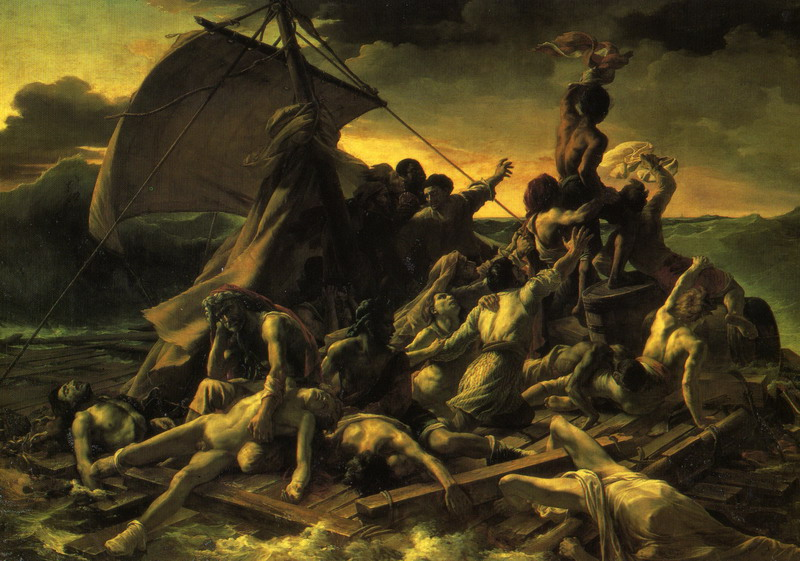
The Raft of the Medusa (1818-1819), 491 x 716 cm, oil on canvas, is held at the Louvre Museum. Théodore Géricault (1791-1824) was a pioneer of French 19th-century Romantic painting; his works often used bold intent to break free from the dominance of David's Neoclassicism, thereby establishing the foundation for Romantic painting. His completion of "The Raft of the Medusa" in 1819 sparked intense controversy. Regrettably, he died young, and the mantle was taken up by the talented Eugène Delacroix.
This poignant and dramatic work, The Raft of the Medusa (1818-1819), drew inspiration from a contemporary tragedy: On June 17, 1816, a French steamship named Méduse, carrying 365 passengers, departed Île d'Aix bound for Senegal, Africa. In African waters, it encountered a storm; due to the captain's inexperience, the ship wrecked. All passengers attempted to board lifeboats, but finding them insufficient, they hastily constructed a crude raft carrying 149 survivors, most of whom perished. Twelve days later, only fifteen clung to the raft, surviving through sheer will.
Géricault completed this work after careful investigation and data collection, confirming details with those who survived. He rented a studio facing a hospital, where he studied anatomy and observed corpses. During the creation of this piece, he bore immense psychological pressure, even finding that laughter hindered his work.