Valerio Adami "Until Here" Solo Exhibition
Blue Mask with Mythological and Imaginative Space, 2006, 198x147 cm
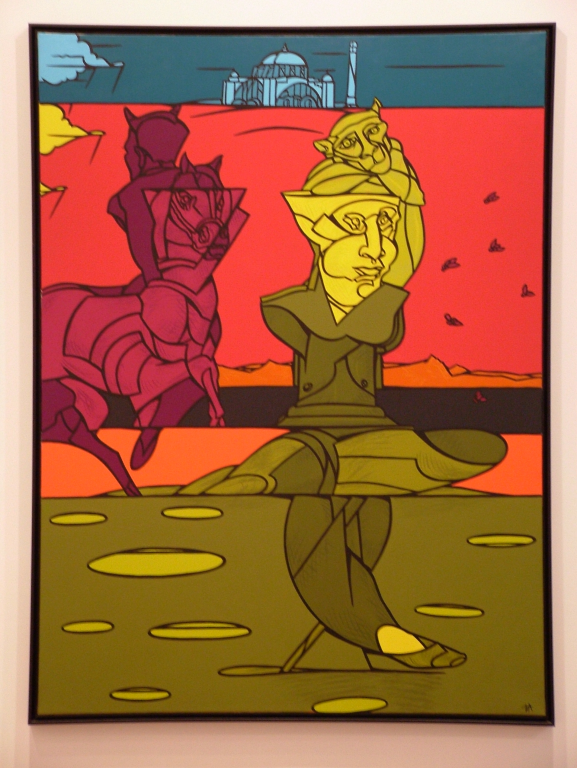
Blue Mask with Mythological and Imaginative Space, 2006, 198x147 cm
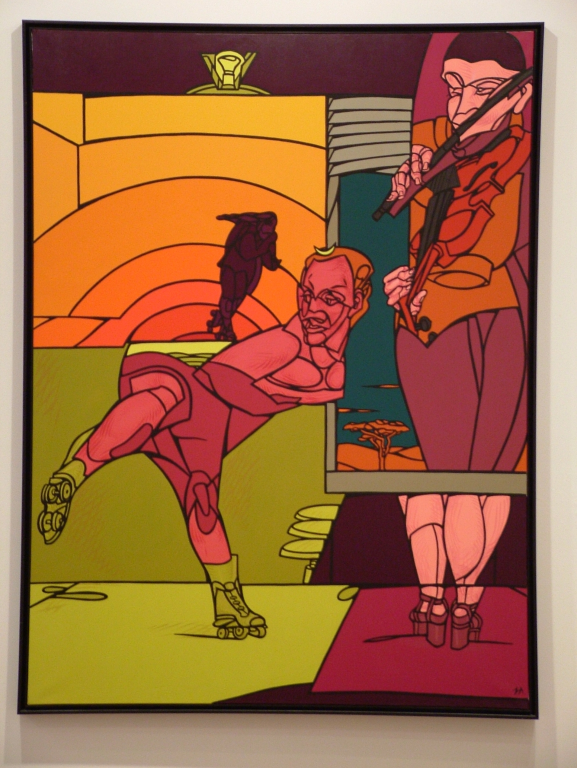
Lines and color planes are Adami's greatest painting features - Vita_Faccia, 2006, 198x147 cm

Dramatic A Midsummer Night - Titania and Bottom, 2006, 198x147 cm

Color and imagery compose narrative - Über Berg und Tal - Kubin, 2006, 200x265 cm
Valerio Adami "Until Here" Solo Exhibition: On display at Daniel Templon Gallery from October 27 to December 29. Born in 1935, Valerio Adami is the most representative Italian painter of European narrative realism. Active in the Paris art scene since the 1960s, he is famous for his flat, slightly acidic color planes and thick black lines outlining figurative forms. Lines resemble figurative souls, colors like bodies, and within intellectual compositional structures, he narratively introduces literature, travel, and theater, exploring the beautiful relationship between poetry, music, and painting. In the early 1970s, on famous portraits of historical figures, this series became Adami's most representative masterpieces: such as portraits of the writer Joyce, Nietzsche at the University of Leipzig, psychoanalyst Freud in London, as well as portraits of Benjamin and Gandhi, among others. These are presented through subjective codified imagery within puzzle-like color plane abstract forms, supplemented by references to narrative black written text. Adami does not adopt any pre-existing super-meaning in painting, because this kind of painting generates meaning in its own way; it is highly literary and anecdotal, poetic and full of imaginative space. He believes: "In this codified painting, the audience must re-experience his educational process to understand the image." After 1975, he returned to traditional cultural sources, establishing his creative core around grand themes of ancient Greek and Roman mythology. Referencing culture to elaborate further, within a postmodern consciousness, Ulisse, Arcadia, Apollo, and Laocoön are interpreted in Adami's most modern formalist style. However, viewers see objects symbolizing the modern world on the canvas: cars, cameras, carriages, handbags, and tableware, etc., displaying an analogy of the past to the present. The painter believes "pictures are like travels, reading discoveries from here to there." In the 1980s, under postmodern cultural circumstances, he reinterpreted classical masterpieces such as The Murdered Mahon, The Prodigal Son, and The Spring. Regarding Adami's works from the 1980s, postmodern philosopher J-F. Lyotard wrote self-questioningly: "I want to satisfactorily place order in chaos, that is to say, those lines. However, what people see as 'it' is before interpretation. People say lines are sacredly visible, even if there is visibility. This is the visible; people speak less of color than of lines. Oh!, colors obey lines (……). Adami is a classicist because his lines conform to materiality and proportion. ……Proportion plays a role, obeying standards, as rigorously as Raphael." Since the 1990s until now, sketching and black lines have remained primary. For the artist, lines and especially imagery have a very close relationship with text and language. Continuing to reference all literary works, particularly Shakespeare and Nietzsche, such as recent works The Blue Mosque, Vita Faccia, La Slitta, Über Berg und Tal – Kubin, etc. The development of pictures occurs in the atmosphere of poets writing poems, childhood memories, or unreachable travels. Recent works are quite introspective; figures in colorful canvases carry strong sentimentality. The artist says: "The progress of painting is the progress of the self. This developmental path will be the simplification and disappearance of images. Expanding continuously, it will gradually vanish, and suddenly reappear: Land! Land is the end of travel. Viewing things is different from their substantial existence, a method of seeing, which is touching them with closed eyes… In perfect tranquility, before the storm of non-tense expression in pictures. The value of object modeling and our tactile sensations must be perfectly realized: this consistency gives birth to that boundary, sketching, becoming the result of the picture… Sketching and thinking are similar. It only has the action of exploration, without any intention to approach the goal. It is painting for painting, eyes for eyes, a dog biting its tail, endlessly… Painting talks too much about painting, instead it needs to return more healthily to figuration."