Encountering Oneself in the Mirror
Text by Fang Hsiu-Yun (art historian, art critic, poet, founder and director of "Nest" Art Enterprise, UK)
Images by Chen Chi-Hsiang (Titien)
Taiwanese-French artist Chen Chi-Hsiang (b. 1956) has a solo exhibition titled "Encountering Oneself in the Mirror" (Rendez-vous dans le miroir) at Galerie Gaba in Paris, showcasing new works from 2022-2024. Each piece has a paired twin work, totaling eleven diptychs, continuing his earlier "Miroir Phaseless" series. This iteration advances the imagery's connotations, offering a nuanced reflection on the COVID-19 pandemic and its lingering symptoms, differing not only in form and color but also in mood.
Since his first solo exhibition in 1984, alongside writing books, articles, and giving lectures, he has never ceased artistic creation. Before the "Miroir Phaseless" series, he traversed series such as "Observing the Mind, Surveying the Realm," "Surveying the Realm, Observing the Mind," "Flowers in the Mirror, Moon on the Water," "Spring Dream—Not a Dream," "Realm—Native Land," "Original Image as Form," "Like Mirror—Like Realm," and "Dream Within a Dream." Each phase represents the outcome of prolonged philosophical and aesthetic contemplation. The evolution of the "mirror" has been a long journey, beginning in early 1988 and reaching a key point in 2008 with the "Flowers in the Mirror, Moon on the Water" series, when his method shifted from photography to painting, meticulously rendering twin mirror images.
The Cast Shadow
In the "Encountering Oneself in the Mirror" exhibition, the artist rarely presents two twin diptychs from 2010-11—one from "Dream Within a Dream." Here, naturally formed organic shapes with wrinkled textures and irregular curved surfaces initially resemble fossilized animal bones or weathered dead wood, adorned with some flowers, grass, and twigs. With the pointed end down and the wider part up, this unstable posture gives a sense of suspense. This also transports us to the world of anatomical drawings by Renaissance masters, where the heart-like form with folds and branches seems like the junctions of external blood vessels. Interestingly, a shadow falls on the ground—the dark area, viewed from another angle, reveals the profile of a skull, strikingly similar to the anomalous object in German painter Hans Holbein the Younger's (c.1497-1543) 1533 masterpiece "The Ambassadors" (held at the National Gallery, London), which also requires a sidelong view to discern as a skull—a remarkable parallel! The cast shadow also signals a warning: "death" and "vanity."
Chen's mirror images and skulls are long-standing themes in his work, each time yielding unexpected surprises. How has the impact of post-COVID syndrome struck him this time?
The Spell of Arrayed Formations
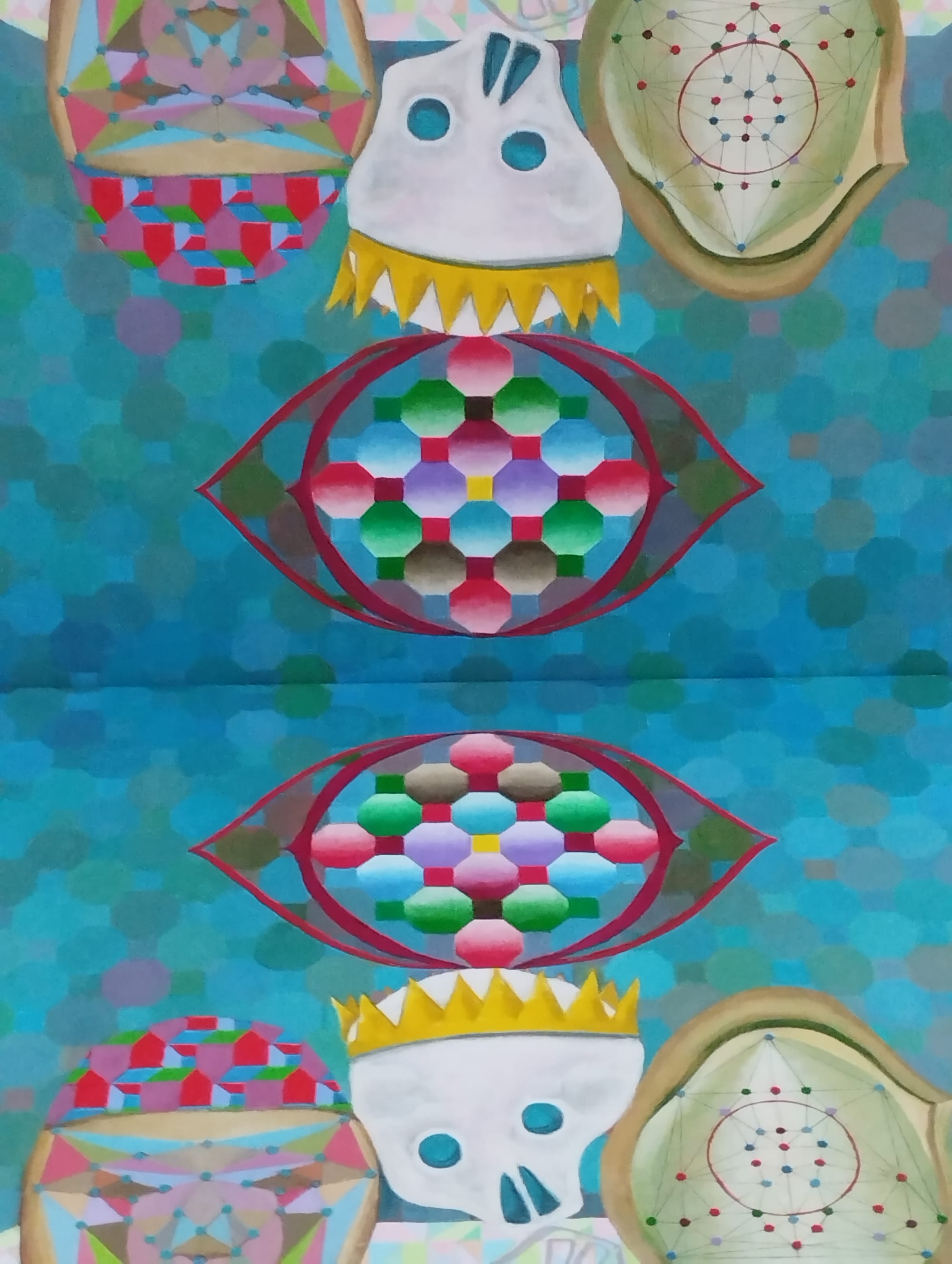
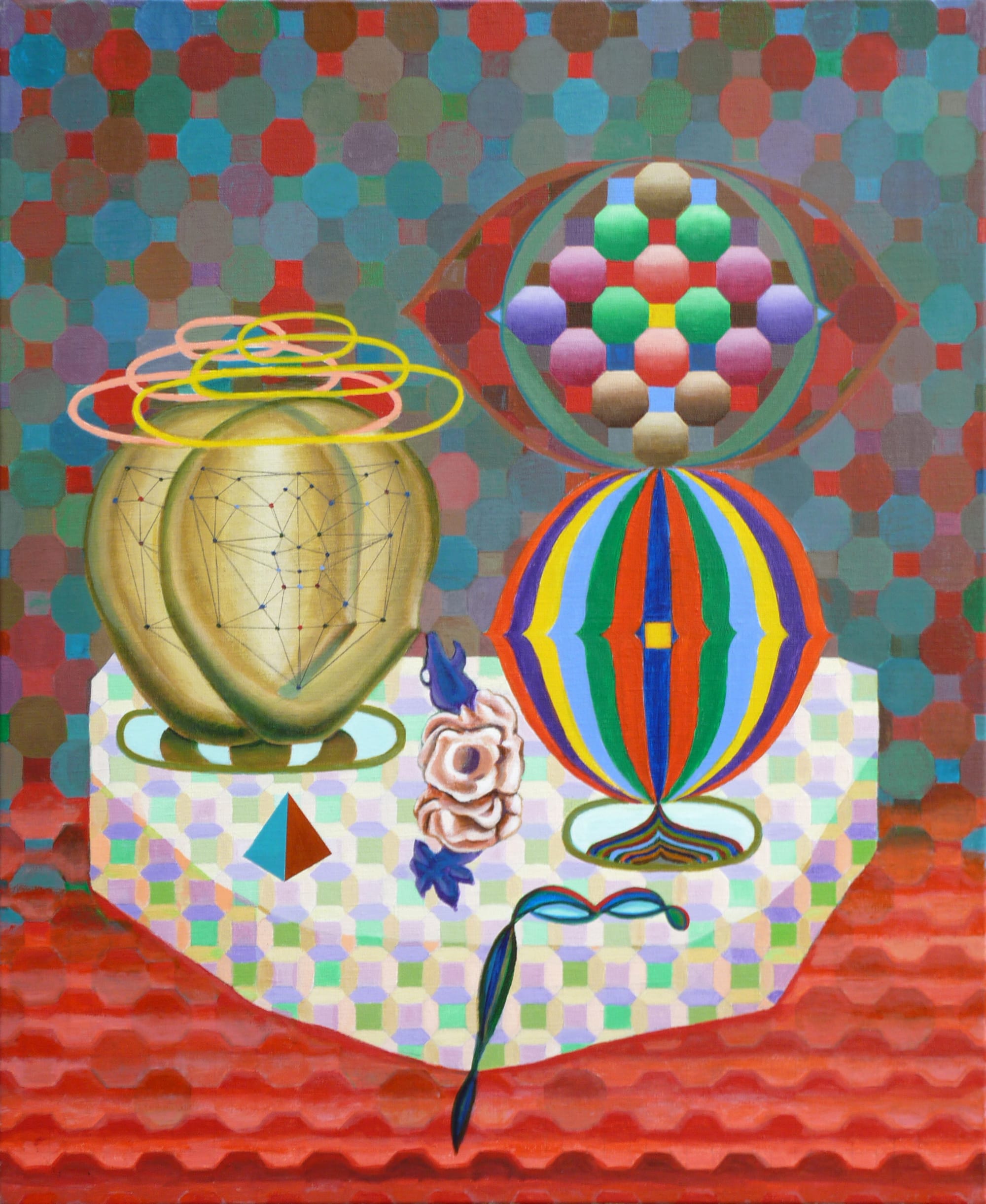
The exhibition includes six pairs of twin works related to the arrangement of various strange objects, including "Royaume secret numérique," "Juli monde," "Tomber de l’autel," "beau masque," "La mascarad," and "Vanité." Wow! Numerous particles render the composition so vibrant, with objects clearly visible—some easily recognizable, others enigmatic no matter how one looks. Why are they arranged this way?
Space always contains inescapable repetitions and chain-reaction particles, countless and constantly in motion, provocatively challenging our visual senses. These paintings are set on "stages": some resemble bar counters or dining tables (like "Royaume secret numérique"), most stand on ground platforms (or altars), but some are suspended (like "Juli monde"). What objects? There are colored balls, hourglasses, small pyramids, snails, butterflies, vases, peacock-eye feathers, and others, but the rest are ambiguous or inexplicable foreign objects, awaiting our exploration! Each object has its own attributes, perhaps symbolizing or representing something (e.g., the hourglass represents the passage of time), but what is placed and how is not deliberately arranged by the artist. This naturally brings to mind the famous phrase by 19th-century Uruguayan-French poet Comte de Lautréamont (1846-1870): "As beautiful as the chance encounter of a sewing machine and an umbrella on a dissecting table!" Unrelated things brought together have an unconscious flow, immensely mysterious; what chemical changes occur depends on the interaction between viewer and work.
What is this world that manipulates our visual senses? The artist openly states:
In digital programming, humans are flattened into numbers; everyone becomes a digital identity, with passwords as entry points. Those without data become outsiders in administrative organs, no longer possessing social identity. Digital labyrinth-like arrays dazzle the eyes. From the COVID pandemic, people saw and experienced how rulers or governors manipulate the flock digitally; the virtual becomes more real than reality, simulacra replace reality, labyrinth-like programming societies, and humans enter seemingly open yet closed digital farms without realizing it. Under comprehensive surveillance, in this slanted, black-and-white inverted world, a pitiable era of misinformation and manipulation, digitization becomes a tool of democratic authoritarian regimes, a means to comprehensively dominate society, popularizing facial recognition, digitization, QR codes, and social credit. The beauty and sorrow of a future where humans might be implanted with chips to become robots, and the optimism and concerns brought by the AI revolution, etc.
I believe there are two most urgent problems facing humanity today: one is the proliferation of political correctness, which has distorted beauty, sanctity, and truth, evolving to severely harm freedom of speech—we live under self-censorship norms; the second is the habit of indulging in virtual worlds, where people can no longer distinguish true from false, beautiful from ugly—reality is swallowed. What to do? This aspect has become more rampant post-pandemic. The artist, meticulously observing societal pulses, conscience-driven, naturally grew concerned. The virtual world appears bewildering, controlling body, mind, and spirit—where will this lead us? Through creation, the artist expresses that mysterious, enchanting, lingering illusion, seemingly another incarnation of the "femme fatale," skillfully practicing hypnotism, enchanting like an obsession!
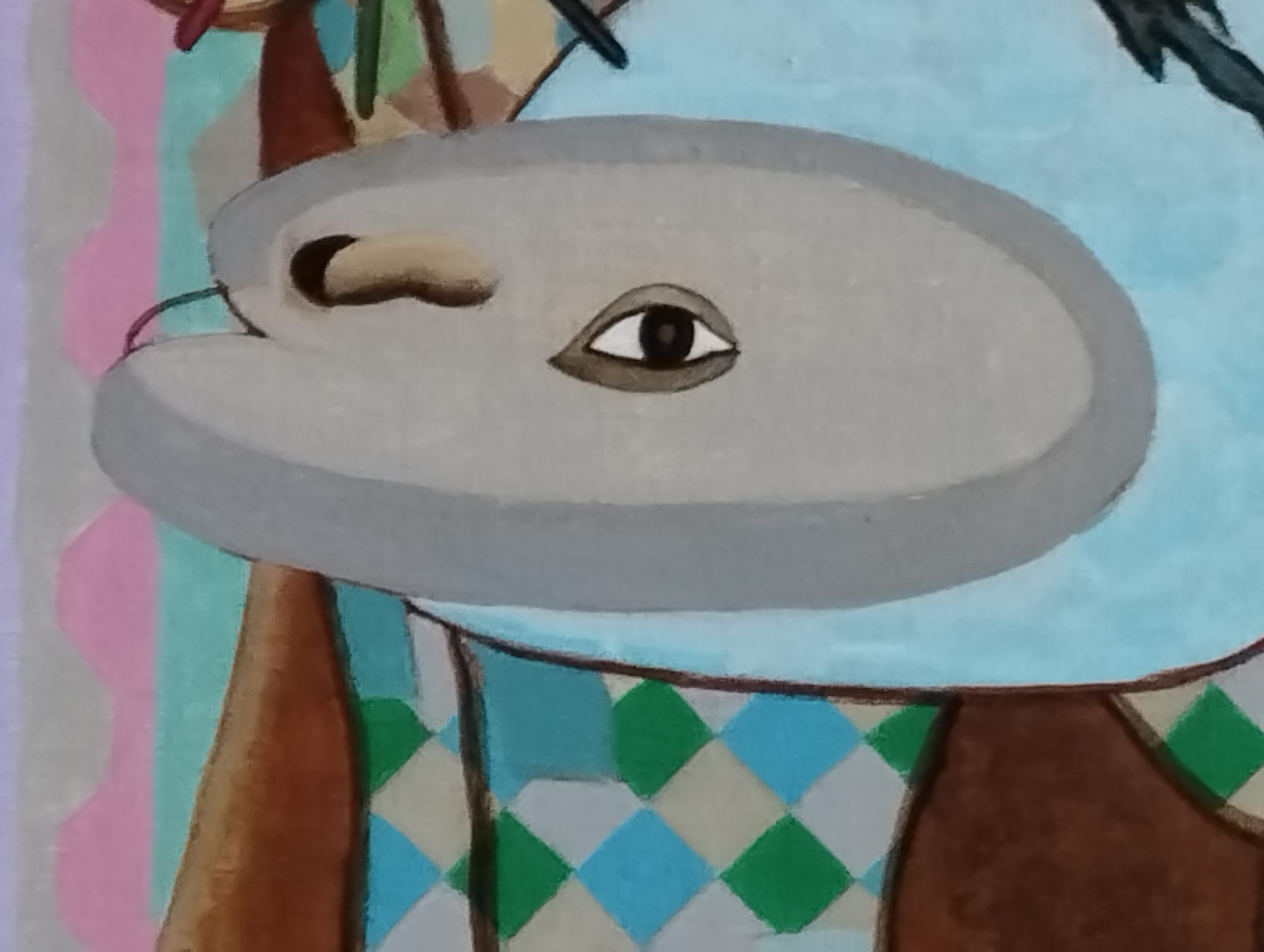
Oddly, each composition presents one or two large objects, approximating elliptical yet irregular organic shapes. Remarkably, some stand upright (like in "Royaume secret numérique," "Tomber de l’autel," "beau masque," "La mascarad," "Vanité"), while others appear as reflections in the mirror (like in "Juli monde"). With diverse compositions—whether multicolored geometric patterns or points, lines, and surfaces linked against a golden-like backdrop, or the gorgeous scenes after connection—what do these large objects symbolize? Thanks to guidance from a long-time friend (also a monk), he guessed they might be vessels made from human skullcaps, perhaps ritual objects for empowerment ceremonies—"kapala" bowls? Regardless of whether the artist truly placed this bowl imagery here, it is certainly a skull outline. Death and illusion trouble us again, don't they? The artist thoroughly expresses this bewildering new world; since it is illusory, how can it bring happiness?
Here, the artist incorporates another striking image: "eyes," located above the colored balls in "Royaume secret numérique," "Juli monde," "Tomber de l’autel," and "La mascarad"; at the center and below the encircling colored balls in "beau masque"; and above the skull in "Vanité." Are these Eastern "third eyes" (gateways to the inner world and higher consciousness)? Or the "soul's" seat as indicated by da Vinci's anatomical drawings after speculation?
In "Vanité," the skull's eye and nose sockets are hollow, wearing a crown, standing on a stage where another skull outline is cast. Did the artist think of Shakespeare's "Hamlet"? Prince Hamlet, seeing the object before him, horrifyingly realizes it is the skull of the court jester he grew up with, lamenting profoundly:
Alas, poor Yorick! I knew him, a fellow of infinite jest, of most excellent fancy; he hath borne me on his back a thousand times; and now, how abhorred in my imagination it is! My gorge rises at it. Here hung those lips that I have kissed I know not how oft. Where be your gibes now? Your gambols? Your songs? Your flashes of merriment, that were wont to set the table on a roar? Not one now.
"Hamlet," Act V, Scene I
Past joys are now only a skull, truly lamentable. Strangely, our artist, under death's summons, places a spotted butterfly. In some cultures, butterflies metaphorize the soul's incarnation, also symbolizing the mind or new life, like a third eye, simultaneously announcing human awakening and enlightenment.
Self-Written, Self-Directed, Self-Acted
After the spell of arrayed formations, let's enter the world with "people"! In "Unexpectedly Encountered Knight," the knight sets out—what encounters await? He appears in profile, wearing a feathered hat, a butterfly bow tie under his neck, holding a cane, dressed in soft-toned clothing and a green robe, barefoot stepping forward; before him is a pink area, approximating a woman's face in profile. Are they kissing? "Knight" is an honorable title; long ago, he rode a horse, a warrior with military capability, but here he is far from it—with no intention to fight, seemingly an incurable romantic, his amusing demeanor reminiscent of Chaplin's humor!
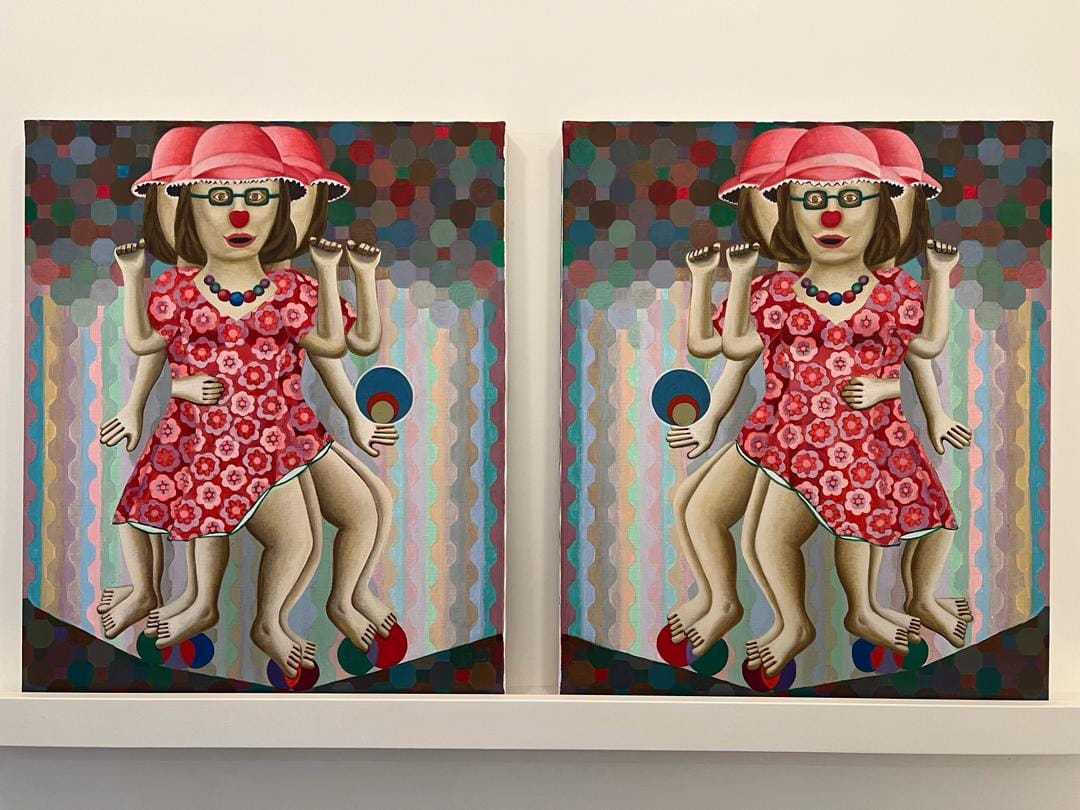
In "Self-Amused Player," a player in a baseball cap, dressed energetically, sings and dances, feet on mirrors, with over ten mirrors floating in space. Lost in ecstasy, is he performing magic? And "Clown's Glasses"? A clown in a red hat and red-patterned summer wear, with a red nose and red lips, wearing green glasses, barefoot on a colored ball, appears comical, clearly performing tricks. When the audience laughs, it's the best time to expose lies. Then "Little Girl Capturing Eyes"? Like an indigenous girl, playful, wearing a forehead band, colorful short top and capris, alternating bare feet and sneaker-clad feet, she captures eyes everywhere. With penetrating vision, is she a witch foreseeing the future?
Here are knights, players, clowns, and witches, all performing solos, emphasizing body language against magnificent backdrops and bewildering backgrounds; though expressionless and without dialogue, the intent is strong. Is life like theater? Or theater like life? Drama is like a mirror, reflecting life—intense and tense presentations instead show more clearly! Chen uses exaggerated colors and body movements to depict life more vividly. Worth mentioning: here are juggling, magic, song and dance, parody, truth-telling, and surreal fantasy—isn't this the tone of "satire" and "comedy"! Speaking of which, the earlier "spell of arrayed formations" has a sequel: first, in "Royaume secret numérique," an hourglass on the counter strangely contains green pointed objects instead of sand—turned over, it cannot measure time. Has time stopped? Then in "Juli monde," of all things on the platform, only one casts a shadow—the artist says it's a "walnut." What does this signify? The entire space is illusion; only it is real, and moreover, nutritious food, reminding me of Derek Walcott's (1930-2017) poem "Love after Love":
The time will come when, with elation, you will greet yourself arriving at your own door, in your own mirror, and each will smile at the other's welcome,
and say, sit here. Eat. You will love again the stranger who was your self. Give wine. Give bread. Give back your heart to itself, to the stranger who has loved you
all your life, whom you ignored for another, who knows you by heart. Take down the love letters from the bookshelf,
the photographs, the desperate notes, peel your own image from the mirror. Sit. Feast on your life.
This poem has "mirror images"—in the mirror, seeing two selves meet, then peeling your sorry image from the mirror to enjoy life! I believe the "walnut" in "Juli monde" is the key object the artist placed here, symbolizing the world's good food, welcoming joyful feasts. In "La mascarad," two anthropomorphized small objects like fingers at the front—one with a long nose, the other sheathed in a shrimp tail shell—the former symbolizing lying, expression ashamed, the latter self-amused! And "Vanité"? In "Hamlet," the skull in the prince's hand gloomily foretells the eventual demise of all in high positions and power, oneself included; crowns eventually fall from these powerful heads—indeed, thoroughly "tragedy." Yet, Chen crowns the skull—it seems well-matched with the head. Have death and vanity won? Actually, he takes tragic art and, with absurd techniques, ends the unbearable situation with a satirical (humorous) tone, much like ancient Greek comic playwright Aristophanes (c.446-c.386 BC) rehandling tragedy with humor. Thus, I suddenly have a wild imagination: at that key point, the court jester (comic actor), seeing Hamlet's gloom, suddenly comes alive, punches the prince to sober him, and tragedy ceases.
Initially, one might think Chen's works depict humans falling into traps of compromise and death, never escaping—so terrifying. But no—why be trapped in passing time? Why lie? Why end tragically? To find an exit, the artist counterattacks tragedy with humor is the best way! Yes, his works contain many unexpected elements, awaiting our gradual perception.
British playwright Oscar Wilde (1854-1900) said: "Satire (humor) is the highest form of intelligence." Absolutely right.
Kaleidoscopic World
Original artists have obsessions they cannot shake off—like Cézanne's Mont Sainte-Victoire, which, not counting drawings, accumulated at least over eighty paintings due to his persistent spirit, continuous observation, and exploration, gradually evolving into simplified geometric shapes, thus foreshadowing Cubism's advent. Renaissance master Michelangelo had a lasting fondness for circles and rectangles, constantly using these geometric shapes as creative elements, building immortal structures like the Medici Chapel and Laurentian Library. Many similar examples exist. I emphasize: never underestimate "obsession."
Chen's space has countless chain-reaction particles; every object, thing, concept, and pattern is pieced together from these particles. He uses "regular octagons" and "squares" as geometric foundations, constantly replicating them. With changes in color, form, light and shadow, etc., each geometric combination, when magnified, shows symmetry and asymmetry, non-single perspective, truncation, polyhedra, and tessellated textures. With endless variations, movements, and leaps, visual breadth expands, patterns diversify, and the evolutionary process is limitless. The artist says:
The mirror surfaces constructed from complex grid patterns still operate in twin ways. I choose this creation to test and refine my own will, working in a state of focused, meticulous patience, practicing dhyana. Each painting session is like entering a timeless wandering, a silent secret space where words fail. It has been ten years now—hard to imagine.
If asked what his "obsession" is? I think it is "complex grid patterns," nearly geometric "truncated quadrille tiling." He continuously cultivates this, with evolving connotations. Recently, crossing the pandemic phase, his form and color have become purer, as if the soul was washed, becoming clear and elevated. But where does this pattern originate? Tracing back, it comes from readily available organic shapes in nature. "Tomber de l’autel" gives a hint—"flowers." Indeed, drawn from flowers' myriad charms, their infinite allure is his endless inspiration source. The artist loves flowers, long jokingly reputed as a "flower thief"—truly stolen well!
Undoubtedly, his works can live with us, dialogue with us, simultaneously producing infinite nourishment and energy.
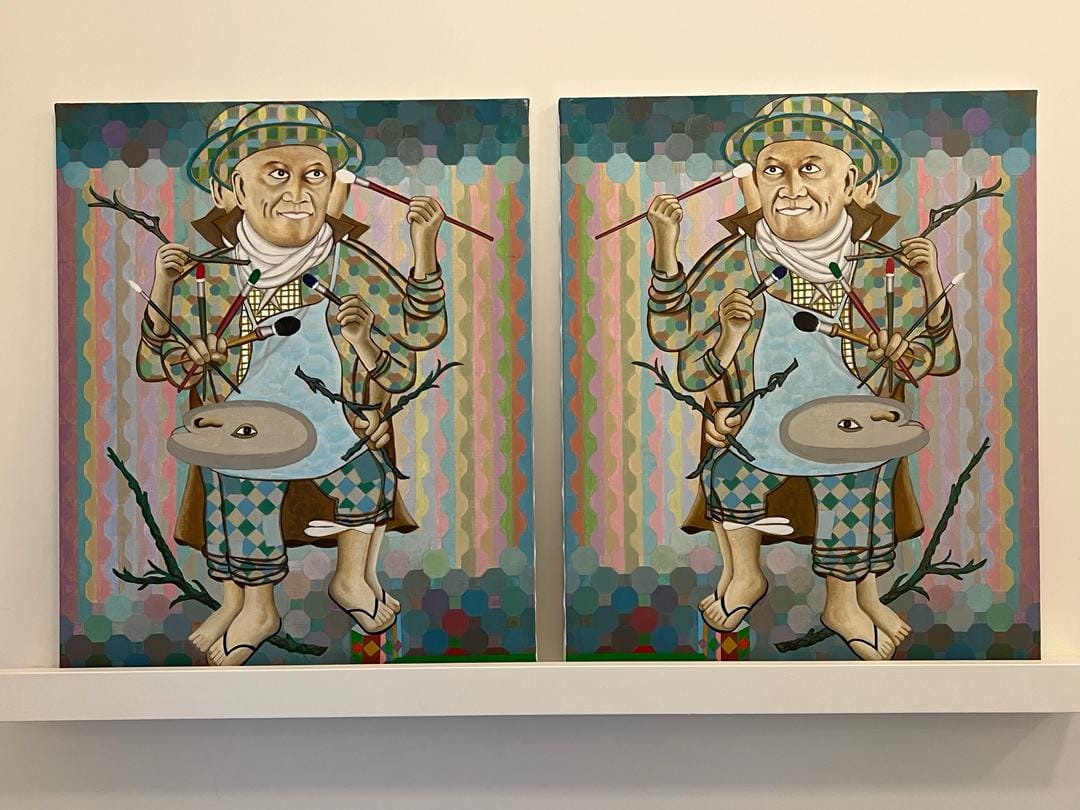
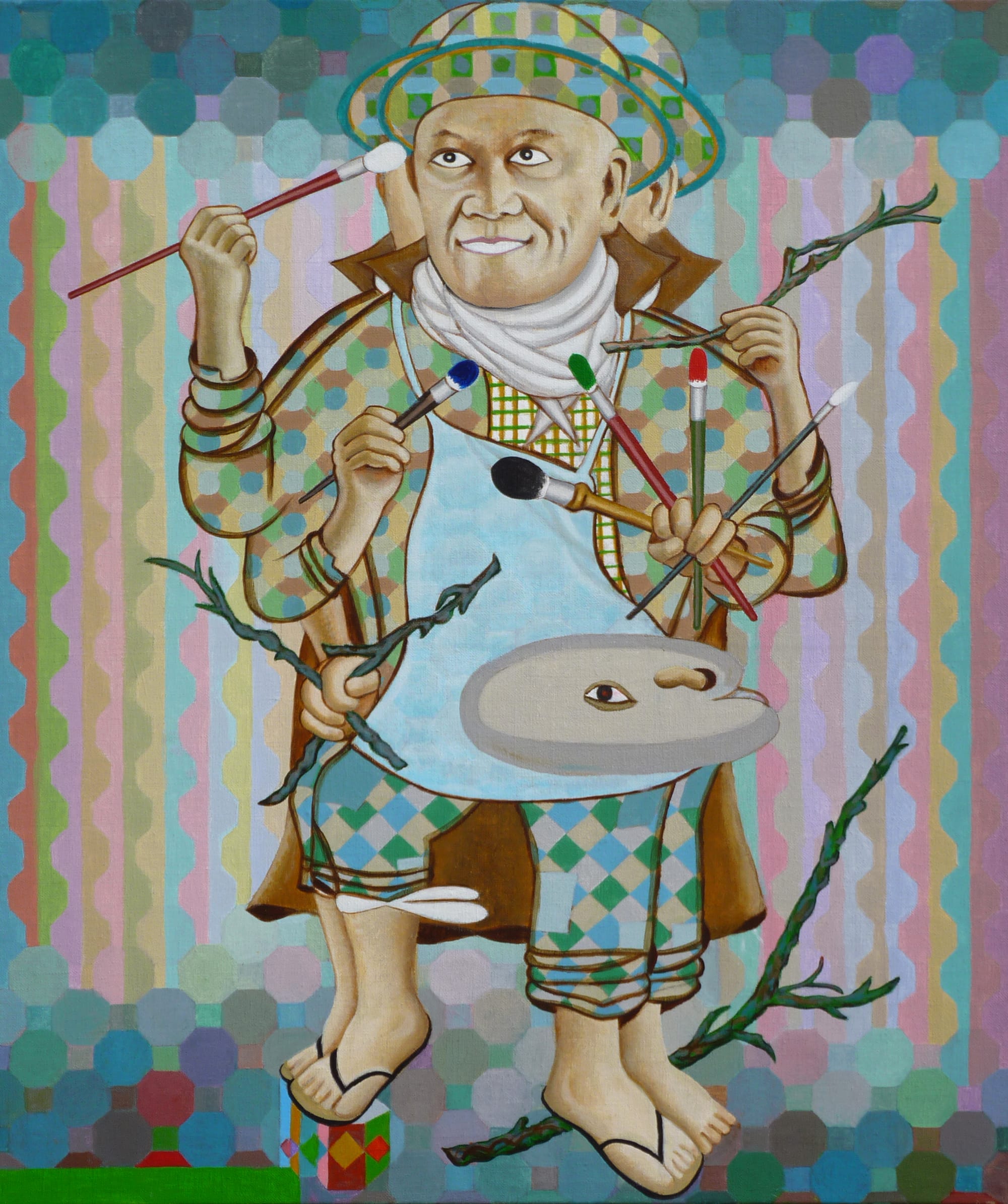
Finally, I conclude with the artist's self-portrait: in "Painter's Eyes," he wears an apron, rolled-up pants and sleeves, holds a paintbrush and some twigs, with colorful objects on one side and green twigs on the other underfoot, his eyes bright and expression resolute. I believe the artist, facing today's murkiness and illusions, is concerned, painting stroke by stroke like a laborer—a process of cultivation and meditation, clarifying his heart, not following trends. See! His brush and twigs are like swords, the palette like a shield—the best tools to pierce darkness.
In life, he might be a romantic knight, but in creation, he is a complete warrior!
2024